

Sogeting Success: Breaking the Ice Like a Pro! 💖
Hello, everyone! It’s Daily Hangul, here to upgrade your Korean skills! 😊
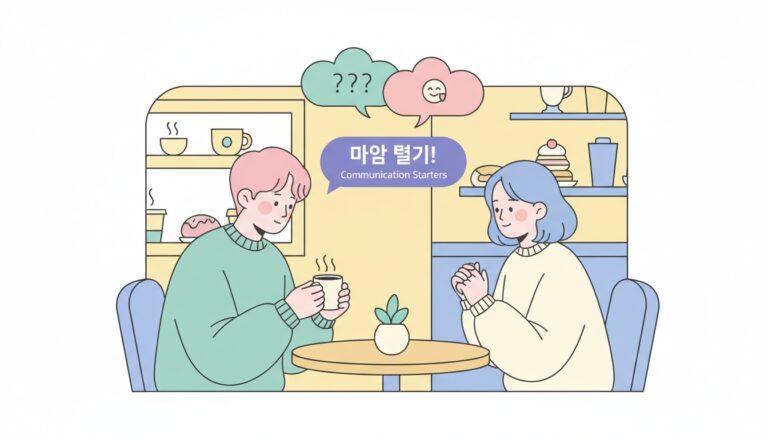
Have you ever watched a K-Drama where the main characters meet for the first time on a blind date? In Korea, this is called a “Sogeting” (소개팅). It can be super romantic, but also… very awkward! 😅
Imagine sitting across from someone you like, but silence fills the air. Awkward, right? Don’t worry! Today, we will learn how to break the silence and start a fun conversation. These expressions are perfect for making a great first impression, just like in your favorite dramas!
Ready to become a conversation master? Let’s go! 🚀
🔑 Key Expressions
Here are 3 magic phrases to save you from awkward silence!
1. 취미가 뭐예요?
- Pronunciation: [Chwimiga mwoyeyo?]
- English Meaning: What is your hobby?
- Detail: This is the classic icebreaker! It’s polite and safe. You can use this with anyone new, not just on a date. Asking about what they love is the fastest way to open their heart!
- 💡 Pronunciation Tip: The word ‘뭐(mwo)’ can be tricky. Try to say it quickly like “mwo,” not “mu-eo.” Also, raise your tone at the end to show you are asking a question! ↗️
2. 인상이 참 좋으세요.
- Pronunciation: [Insangi cham joseuseyo.]
- English Meaning: You have a really good impression (vibe).
- Detail: Koreans care a lot about “first impressions” (인상). Telling someone they look kind or have a good vibe is a huge compliment! It relaxes the atmosphere immediately.
- 💡 Pronunciation Tip: ‘좋으세요’ sounds like [Jo-eu-se-yo]. The ‘ㅎ’ in ‘좋’ is silent when followed by a vowel! So it flows smoothly like butter. 🧈
3. 주말에 보통 뭐 하세요?
- Pronunciation: [Jumare botong mwo haseyo?]
- English Meaning: What do you usually do on weekends?
- Detail: If asking about “hobbies” feels too formal, ask about their weekend! It’s a natural way to find common interests (cafes, movies, hiking).
- 💡 Pronunciation Tip: When saying ‘주말에’, the ‘ㄹ’ sound moves over. So it sounds like [Ju-ma-re]. This is called the Liaison rule!
💬 Real-life Conversation
Let’s see how Min-su and Ji-won talk at a cafe during their Sogeting!
Min-su: (Smiling shyly) 안녕하세요. 인상이 참 좋으세요.
[Annyeonghaseyo. Insangi cham joseuseyo.]
(Hello. You have a really good impression.)
Ji-won: 감사합니다! 민수 씨도요. 😊
[Gamsahamnida! Minsu-ssi doyo.]
(Thank you! You too, Min-su.)
Min-su: 혹시… 취미가 뭐예요?
[Hoksi… chwimiga mwoyeyo?]
(By any chance… what is your hobby?)
Ji-won: 저는 카페 가는 걸 좋아해요. 주말에 보통 예쁜 카페를 찾으러 다녀요.
[Jeoneun kape ganeun geol joahaeyo. Jumare botong yeppeun kapereul chajeureo danyeoyo.]
(I like going to cafes. I usually go looking for pretty cafes on weekends.)
🇰🇷 Culture Tip & Drama Vibes
What is “Sogeting”?
In Korea, meeting someone through friends is very common. The word comes from “Sogae” (Introduction) + “Ting” (from meeting).
Unlike casual dating apps, a Sogeting implies that a mutual friend vouched for you, so people tend to be polite and dress nicely (often called “Dandy look” or “Clean fit” style).
📺 Drama Scene: Think of Business Proposal! Even if you are nervous, a small compliment like “인상이 좋으세요” can change the whole mood. Manners make the romance! 🌹
📝 Wrap-up & Quiz
Today we learned how to break the ice! Don’t be afraid of silence; just ask about their weekend or give a warm compliment.
Let’s practice! (Answers are at the bottom)
- Fill in the blank:
“__________가 뭐예요?” (What is your hobby?) - True or False:
In Korea, saying “You have a good impression” is rude. ( O / X )
Keep practicing, and I’ll see you in the next lesson! Annyeong! 👋
Answers:
1. 취미 (Chwimi)
2. X (It is a great compliment!)
Frequently Asked Questions (FAQ)
Q: What does "취미가 뭐예요?" mean in Korean and how do you pronounce it?
A: In Korean, "취미가 뭐예요?" is pronounced [Chwimiga mwoyeyo?] and means: What is your hobby?
Q: What does "인상이 참 좋으세요." mean in Korean and how do you pronounce it?
A: In Korean, "인상이 참 좋으세요." is pronounced [Insangi cham joseuseyo.] and means: You have a really good impression (vibe).
Q: What does "주말에 보통 뭐 하세요?" mean in Korean and how do you pronounce it?
A: In Korean, "주말에 보통 뭐 하세요?" is pronounced [Jumare botong mwo haseyo?] and means: What do you usually do on weekends?







