

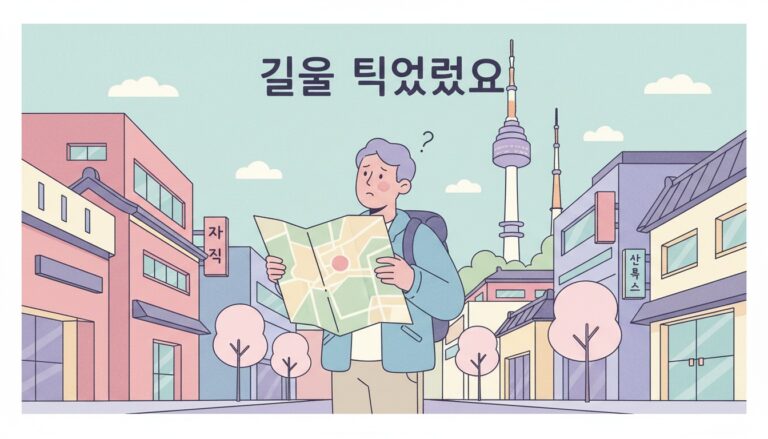
👋 Annyeonghaseyo! It’s your Korean tutor, Daily Hangul! 😊
Welcome back, K-culture lovers! Imagine you’ve just landed in the bustling streets of Seoul or the beautiful beaches of Busan. You want a map, or maybe you need a recommendation for the best tteokbokki place nearby. But you don’t know where to go!
That’s right! You need to find the Tourist Information Center.
In K-dramas, the main character often gets lost and coincidentally meets their destiny (or a handsome lead! 😍). But in real life, getting lost can be scary! Don’t worry. With today’s expressions, you will never be lost in Korea.
Let’s upgrade your Korean skills right now! 🚀
🔑 Key Expressions
Here are the 3 most important phrases you need to survive on the streets of Korea!
1. 관광 안내소 (Tourist Information Center)
- Pronunciation: [Gwangwang annaeso]
- Meaning: Tourist Information Center
- Explanation: ‘Gwangwang’ means sightseeing/tourism, and ‘annaeso’ means information desk/center. You will see this sign often in popular areas like Myeongdong or Hongdae.
- 💡 Pronunciation Tip: The ‘ng’ sound in ‘Gwangwang’ is soft, like the ‘ng’ in the English word ‘sing’. Try to flow the words together: Gwan-gwang-an-nae-so.
2. …가 어디예요? (Where is …?)
- Pronunciation: […ga eodiyeyo?]
- Meaning: Where is …?
- Explanation: This is the magic phrase! Put any place name before this phrase to ask for its location.
- Hotel + ga eodiyeyo?
- Subway station + ga eodiyeyo?
- 💡 Pronunciation Tip: When saying ‘eodiyeyo’, link the sounds smoothly. It sounds like [Eo-di-ye-yo]. Raise your tone at the end to show it’s a question! ↗️
3. 저기예요. (It’s over there.)
- Pronunciation: [Jeogiyeyo.]
- Meaning: It is over there.
- Explanation: If the place is visible but a bit far, people will point and say this. ‘Jeogi’ means ‘over there’.
- 💡 Pronunciation Tip: The ‘J’ in ‘Jeogi’ is soft, almost like ‘Ch’ but with voice.
🗣️ Real-life Dialogue
Imagine you are in downtown Seoul looking for a map to start your tour.
👤 You (Tourist): 저기요! 실례합니다. (Jeogiyo! Sillyehamnida.)
(Excuse me!)
🇰🇷 Local: 네? (Ne?)
(Yes?)
👤 You (Tourist): 관광 안내소가 어디예요? (Gwangwang annaesoga eodiyeyo?)
(Where is the Tourist Information Center?)
🇰🇷 Local: 아, 저기예요! (Ah, jeogiyeyo!)
(Ah, it’s over there!)
👤 You (Tourist): 감사합니다! (Gamsahamnida!)
(Thank you!)
🎭 Culture Tip & Drama Scene
Did you know about the “Red Angels”? 👼
If you are in major tourist spots like Myeongdong or Dongdaemun, you don’t always need to find a building. Look for people wearing red jackets and red hats with the “i” (information) symbol!
They are movable tourist guides. They speak English, Japanese, and Chinese fluently. Just like a helpful hero in a K-drama appearing to save the day, they are there to help you! Don’t be shy to approach them.
📝 Wrap-up & Quiz
Today we learned how to ask for the location of the Tourist Information Center. Now you can travel Korea with confidence! 😎
Let’s check your understanding! (Answers are at the bottom)
- Fill in the blank to complete the sentence: “Where is the Tourist Information Center?”
= 관광 안내소 _______? - True or False: “Jeogiyeyo” means “I don’t know.”
- (O / X)
Good luck, and see you in the next lesson! Annyeong! 👋
[Answers]
1. 가 어디예요? (ga eodiyeyo?)
2. X (It means “It is over there.”)
Frequently Asked Questions (FAQ)
Q: What does "관광 안내소 (Tourist Information Center)" mean in Korean and how do you pronounce it?
A: In Korean, "관광 안내소 (Tourist Information Center)" is pronounced [Gwangwang annaeso] and means: Tourist Information Center
Q: What does "...가 어디예요? (Where is ...?)" mean in Korean and how do you pronounce it?
A: In Korean, "...가 어디예요? (Where is ...?)" is pronounced [...ga eodiyeyo?] and means: Where is ...?
Q: What does "저기예요. (It's over there.)" mean in Korean and how do you pronounce it?
A: In Korean, "저기예요. (It's over there.)" is pronounced [Jeogiyeyo.] and means: It is over there.







