

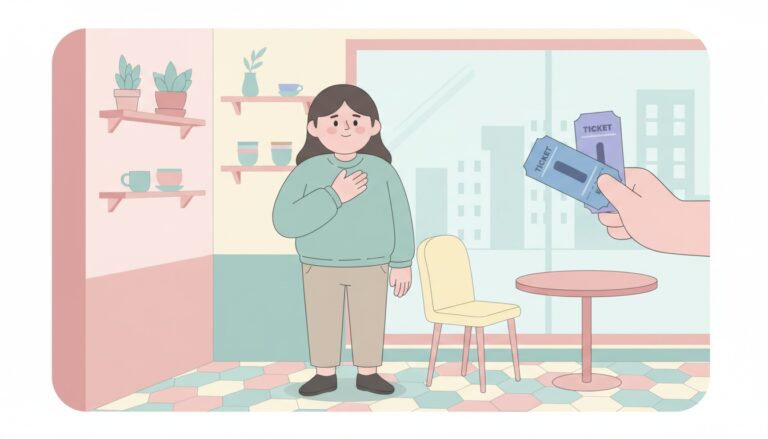
Saying ‘No’ Politely: Declining Invitations in Korean! 🙅♀️
👋 Hello! Welcome to [Daily Hangul]!
Hello, everyone! It’s your friendly Korean tutor, Daily Hangul! 😊 Ready to upgrade your Korean skills today?
Have you ever been invited to a party or a dinner, but you really couldn’t go? In K-Dramas, you often see a character trying to avoid a blind date or a company dinner by making polite excuses. Saying “No” directly can feel a bit harsh, right?
Today, we will learn how to decline invitations softly and politely by giving simple reasons. After this lesson, you can turn down offers without hurting anyone’s feelings, just like a polite K-Drama protagonist! Let’s dive in! 🚀
📚 Core Expressions
Here are 3 essential phrases to decline an invitation gracefully.
1. 약속이 있어요 (I have plans)
- Pronunciation: [Yaksogi isseoyo]
- Meaning: I have plans / I have an appointment.
- Explanation: This is the most common and polite way to say you are busy. In Korean, ‘appointment’ (약속) covers everything from a doctor’s visit to hanging out with friends.
- 💡 Pronunciation Tip: Notice how the ‘k’ sound in 약 (yak) slides over to 속 (sok)? It sounds a bit like Yak-so-gi. Linking sounds makes you sound much more natural!
2. 일이 좀 있어서요 (I have some work to do)
- Pronunciation: [Iri jom isseoseoyo]
- Meaning: Because I have some work/things to do.
- Explanation: If you want to sound a bit vague but professional, use this. Adding 좀 (jom), which means ‘a little’, softens the sentence and makes it sound less abrupt.
- 💡 Pronunciation Tip: The ‘l’ sound in 일 (il) moves to the next vowel. So it sounds like I-ri. Try saying it smoothly: I-ri-jom.
3. 다음에 봐요 (Let’s meet next time)
- Pronunciation: [Daeume bwayo]
- Meaning: See you next time / Let’s do it next time.
- Explanation: This is the perfect “softener.” It shows that even though you are saying no now, you still want to hang out later. It keeps the relationship friendly! 🥰
🗣️ Real-Life Conversation
Let’s see how these expressions work in a real chat between friends!
Situation: Min-su invites Kelly to a movie.
- Min-su: 켈리 씨, 내일 시간 있어요? 영화 보러 갈래요?
- (Kelly, do you have time tomorrow? Shall we go see a movie?)
- [Kelli ssi, naeil sigan isseoyo? Yeonghwa boreo gallaeyo?]
- Kelly: 미안해요, 민수 씨. 내일은 약속이 있어요.
- (Sorry, Min-su. I have plans tomorrow.)
- [Mianhaeyo, Minsu ssi. Naeireun yaksogi isseoyo.]
- Min-su: 아, 정말요? 아쉽네요.
- (Ah, really? That’s too bad.)
- [A, jeongmaryo? Aswimneyo.]
- Kelly: 네, 다음에 봐요!
- (Yes, let’s meet next time!)
- [Ne, daeume bwayo!]
🎭 Culture Tip & K-Drama Vibes
💡 The Art of the “Indirect No”
In Korea, saying “No” (아니요) directly to an invitation can be considered a bit rude or too strong. Koreans value Harmony (Inhwa).
So, instead of saying “I don’t want to go,” we almost always give a reason like “I have plans” (약속이 있어요) or say “It might be a bit difficult” (곤란해요). If you watch K-Dramas, notice how characters apologize first (“미안해요”) and then give a reason. It’s all about showing you care about the other person’s feelings! ❤️
📝 Wrap-up & Quiz
Today we learned how to say “No” without losing a friend! Remember to be soft and give a simple reason.
Let’s practice! Fill in the blanks:
- “Sorry, I have plans.”
👉 미안해요, ______이 있어요. -
“Let’s meet next time!”
👉 ______에 봐요!
Answers:
1. 약속 (Yaksok)
2. 다음 (Daeum)
Great job today! See you in the next post! 다음에 봐요! 👋
Frequently Asked Questions (FAQ)
Q: What does "약속이 있어요 (I have plans)" mean in Korean and how do you pronounce it?
A: In Korean, "약속이 있어요 (I have plans)" is pronounced [Yaksogi isseoyo] and means: I have plans / I have an appointment.
Q: What does "일이 좀 있어서요 (I have some work to do)" mean in Korean and how do you pronounce it?
A: In Korean, "일이 좀 있어서요 (I have some work to do)" is pronounced [Iri jom isseoseoyo] and means: Because I have some work/things to do.
Q: What does "다음에 봐요 (Let's meet next time)" mean in Korean and how do you pronounce it?
A: In Korean, "다음에 봐요 (Let's meet next time)" is pronounced [Daeume bwayo] and means: See you next time / Let's do it next time.







