

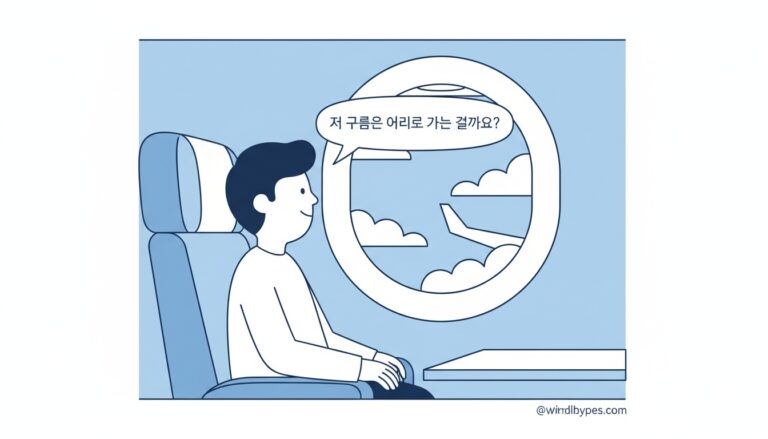
Are We There Yet? Asking Location on a Plane ✈️
2. Intro
Annyeonghaseyo! (안녕하세요!) 👋 It’s your friendly Korean tutor, Daily Hangul!
Imagine this: You are finally on a plane to Korea! 🇰🇷 You just woke up from a nap, looked out the window, and saw nothing but clouds. You wonder, “Where am I?” or “How much longer?”
In K-Dramas like Crash Landing on You or King the Land, scenes on airplanes often mark the beginning of a new adventure. Today, we will learn how to ask where you are and how much time is left, so you can travel like a pro! Let’s upgrade your Korean skills! 🚀
3. Core Expressions
Here are 3 essential phrases to use when you are curious about your flight status.
1. 지금 어디예요? (Where are we now?)
- Pronunciation: [Jigeum eodiyeyo?]
- Meaning: Where are we now?
- Detail:
- 지금 (Jigeum) means “now.”
- 어디 (Eodi) means “where.”
- 예요 (yeyo) is a polite ending meaning “is/am/are.”
- This is the most direct way to ask your current location.
💡 Pronunciation Tip:
When you say 어디예요 (eodiyeyo), try to flow the vowels together smoothly. It sounds like “Eo-di-ye-yo” without stopping between syllables!
2. 얼마나 남았어요? (How much time is left?)
- Pronunciation: [Eolmana namasseoyo?]
- Meaning: How much is left?
- Detail:
- 얼마나 (Eolmana) means “how much/how long.”
- 남았어요 (Namasseoyo) comes from the verb ‘namda’ (to remain).
- Use this when you are tired of sitting and want to know the remaining flight time!
💡 Pronunciation Tip:
Watch out for 남았어요 [namasseoyo]. The bottom consonant ‘ㅆ’ (ss) moves to the next empty circle ‘ㅇ’. So instead of sounding like ‘nam-at-eo-yo’, it sounds like [Na-ma-sseo-yo]. This is called the Liaison Rule!
3. 도착했어요? (Have we arrived?)
- Pronunciation: [Dochakhaesseoyo?]
- Meaning: Have we arrived?
- Detail:
- 도착 (Dochak) means “arrival.”
- Use this if the plane has landed or feels like it’s landing, and you want to confirm.
💡 Pronunciation Tip:
In 도착했어요, the ‘ㄱ’ (k) in ‘chak’ meets the ‘ㅎ’ (h) in ‘hae’. When they meet, the sound becomes stronger, like a ‘k’ sound. It sounds like [Do-cha-kae-sseo-yo].
4. Real-life Dialogue
Let’s see how to use these in a real situation between a Passenger (A) and a Flight Attendant (B).
A: 저기요! 지금 어디예요?
(Jeogiyo! Jigeum eodiyeyo?)
Excuse me! Where are we now?
B: 지금 일본 상공입니다.
(Jigeum Ilbon sanggong-imnida.)
We are currently over Japan.
A: 아, 그래요? 그럼 얼마나 남았어요?
(Ah, geuraeyo? Geureom eolmana namasseoyo?)
Ah, really? Then how much time is left?
B: 한 시간 정도 남았습니다.
(Han sigan jeongdo namasseumnida.)
About one hour is left.
A: 감사합니다!
(Gamsahamnida!)
Thank you!
5. Culture Tip & K-Drama Vibes 🎬
Calling the Flight Attendant: “Jeogiyo!”
In Korean culture, getting someone’s attention politely is important. When you need a flight attendant, you can gently raise your hand and say “저기요 (Jeogiyo)”, which means “Excuse me” (literally “over there”).
Also, have you noticed in K-Dramas that flight attendants are always super polite? They use very formal language (ending in -nida/-bnikka). As a passenger, using the -yo (요) ending (like we learned today) is polite enough and makes you sound friendly and respectful! 😊
6. Wrap-up & Quiz
Today we learned how to ask about our location on a plane. Now you can travel to Korea without worrying about being lost in the sky!
📝 Mini Quiz!
- Fill in the blank: “_______ eodiyeyo?” (Where are we now?)
- True or False: “Eolmana namasseoyo?” means “Did we arrive?”
Answers:
1. Jigeum (지금)
2. False (It means “How much is left?”)
See you in the next lesson! Annyeong! 👋
Frequently Asked Questions (FAQ)
Q: What does "얼마나 남았어요? (How much time is left?)" mean in Korean and how do you pronounce it?
A: In Korean, "얼마나 남았어요? (How much time is left?)" is pronounced [Eolmana namasseoyo?] and means: How much is left?
Q: What does "도착했어요? (Have we arrived?)" mean in Korean and how do you pronounce it?
A: In Korean, "도착했어요? (Have we arrived?)" is pronounced [Dochakhaesseoyo?] and means: Have we arrived?







