

1. Title
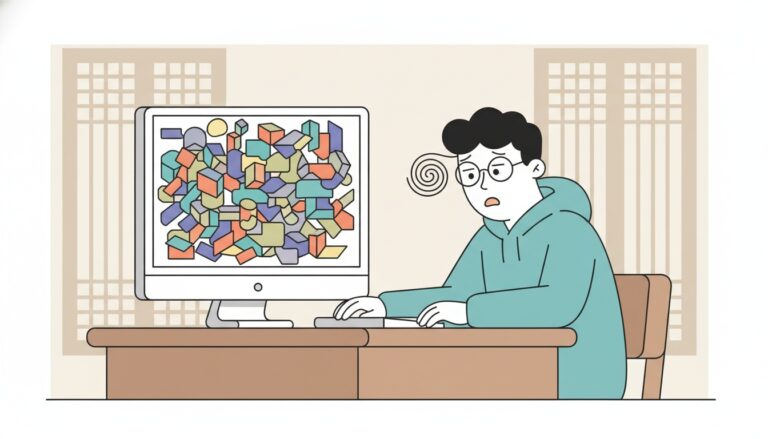
🧹 “My eyes are hurting!” Venting about Data Cleaning in Korean!
2. Introduction
Hello, data wizards! 👋 It’s your Korean tutor, Daily Hangul!
If you study Data Science, you know the painful truth: 80% of the job is Data Cleaning (making messy data usable), and only 20% is the cool AI stuff. 😭
Have you ever opened a dataset and wanted to scream because of all the typos and missing values? Today, we will learn how to complain about this tedious process like a real Korean developer. These expressions are super useful not just for coding, but anytime you have a difficult, repetitive task!
Let’s clear up this mess together! Sijak-haebolkkayo? (Shall we start?) 🚀
3. Core Expressions
1. 데이터가 엉망이에요.
- Pronunciation: [Deiteoga eongmang-ieyo]
- English Meaning: The data is a mess.
- Detail:
- ‘엉망’ (Eongmang) means a “mess” or “wreck.” You can use this for a messy room, a bad situation, or terrible data formatting.
- If you want to emphasize it more, you can say “엉망진창이에요” (It’s a total chaos/mess).
- 💡 Pronunciation Tip:
- 엉 (Eong) requires opening your mouth vertically. 망 (Mang) is a soft nasal sound. Connect them smoothly!
2. 끝이 없어요.
- Pronunciation: [Kkeuchi eopseoyo]
- English Meaning: There is no end (It’s endless).
- Detail:
- Used when you are doing repetitive work (like fixing typos row by row) and it feels like it will never finish.
- You often hear this in K-dramas when a protagonist has a pile of work to do!
- 💡 Pronunciation Tip:
- Linking Sound: The bottom consonant ㅌ (t) in ‘끝’ moves over to the empty ‘ㅇ’ in ‘이’. So it sounds like [Kkeu-chi], not [Kkeut-i]. This makes it easier to say fast!
3. 눈이 빠질 것 같아요.
- Pronunciation: [Nuni ppajil kkeot gatayo]
- English Meaning: My eyes are about to fall out.
- Detail:
- This is a funny and very common idiom! 😆 It doesn’t mean your eyes are actually falling out.
- It means you have been looking at something (like a monitor or small text) for so long that your eyes hurt intensely.
- Perfect for data analysts staring at Excel sheets all day!
- 💡 Pronunciation Tip:
- Double Consonant: 빠 (Ppa) is a tense sound. Tense your lips before releasing the air. It shouldn’t be breathy like ‘Pa’, but sharp like ‘Ppa’!
4. Real Dialogue
Situation: Minji and Jason are looking at a huge dataset with many errors.
👩 Minji: 제이슨, 데이터 정제 다 했어요?
(Jason, did you finish the data cleaning?)
[Jeiseun, deiteo jeongje da haesseoyo?]
👨 Jason: 아니요, 아직 멀었어요. 데이터가 완전 엉망이에요.
(No, not yet. The data is a total mess.)
[Aniyo, ajik meoreosseoyo. Deiteoga wanjeon eongmang-ieyo.]
👩 Minji: 진짜요? 결측치가 많아요?
(Really? Are there many missing values?)
[Jinjjayo? Gyeolcheukchiga manayo?]
👨 Jason: 네, 오타도 너무 많아서 수정하는데 끝이 없어요.
(Yes, there are too many typos too, so fixing them is endless.)
[Ne, otado neomu manaseo sujeonghaneunde kkeuchi eopseoyo.]
👩 Minji: 아이고… 좀 쉬면서 하세요.
(Oh no… Please take a break while working.)
[Aigo… jom swimyeonseo haseyo.]
👨 Jason: 네, 모니터를 너무 봤더니 눈이 빠질 것 같아요.
(Yeah, I stared at the monitor too much, so my eyes are about to fall out.)
[Ne, moniteoreul neomu bwatdeoni nuni ppajil kkeot gatayo.]
5. Culture Tip & Drama Context 🎬
🍬 “Dang tteoreojida” (Sugar is dropping)
When Korean office workers do tedious work like data cleaning (often called “Nogada” – slang for manual labor), they get exhausted quickly. In K-dramas, you might see a character slump in their chair and say, “아, 당 떨어져…” (Ah, my sugar is dropping…).
This means they have low energy and need something sweet (chocolate, mix coffee) to keep going. If your colleague is struggling with messy data, give them a chocolate and say “Dang chungjeon haseyo!” (Recharge your sugar!). You will become their favorite person instantly! 🍫
6. Wrap-up & Quiz
Today we learned how to vent about the endless struggle of cleaning bad data! Hopefully, your data is clean, but now your Korean is even cleaner! ✨
📝 Mini Quiz
- How do you say “The data is a mess” in Korean?
- 데이터가 (_______)이에요.
- What idiom do Koreans use when they stare at a screen for too long?
- (_______)이 빠질 것 같아요.
(Answers are at the bottom!)
Keep coding and keep studying Korean! Fighting! 💪
Answers:
1. 엉망 (Eongmang)
2. 눈 (Nun – Eyes)
Frequently Asked Questions (FAQ)
Q: What does "끝이 없어요." mean in Korean and how do you pronounce it?
A: In Korean, "끝이 없어요." is pronounced [Kkeuchi eopseoyo] and means: There is no end (It's endless).
Q: What does "눈이 빠질 것 같아요." mean in Korean and how do you pronounce it?
A: In Korean, "눈이 빠질 것 같아요." is pronounced [Nuni ppajil kkeot gatayo] and means: My eyes are about to fall out.







