

🛒 Shop Like a Local: Counting “Bags & Bundles” in Korean!
Hello, K-Culture lovers! Welcome back to Daily Hangul (매일한글)! 🍎
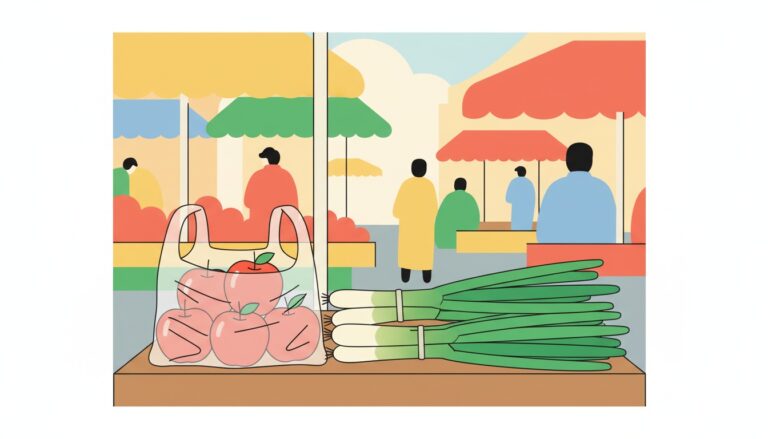
Imagine you are walking through a bustling traditional market in Seoul, just like in your favorite K-drama. You see delicious apples and fresh green onions. You want to buy them, but wait! In Korea, we don’t just say “two apples.” We use special counting units!
Today, we will learn how to count items sold in bags and bundles. This is super useful for grocery shopping or visiting a convenience store (Pyeonyjeom). Let’s master these expressions so you can shop confidently like a local! 😎
📚 Core Expressions
Here are the essential counters you need for shopping!
1. 한 봉지 (Han bongji)
- Pronunciation: [Han bongji]
- Meaning: One bag (of something)
- Detail: Used for items contained in plastic or paper bags, like snacks (gwaja), apples, or candy.
- Note: We use Native Korean Numbers (Hana, Dul, Set…) with these counters.
2. 한 묶음 (Han mukkeum)
- Pronunciation: [Han mukkeum]
- Meaning: One bundle / One bunch
- Detail: Used for items tied together, like green onions (pa), spinach, or multi-pack yogurts.
3. 주세요 (Juseyo)
- Pronunciation: [Juseyo]
- Meaning: Please give me
- Detail: The magic word! Put this after the item and count to order politely.
💡 Pronunciation Tip!
When you say 한 묶음 (Han mukkeum), try to link the sounds smoothly.
It sounds like [Han-mu-kkeum]. Remember, double consonants like ‘kk’ (ㄲ) in mukkeum need a stronger, tenser sound than a regular ‘k’. It’s like the ‘k’ in “sky”!
🗣️ Real-life Conversation
Let’s go to a Traditional Market (Sijang)!
Situation: You are buying apples and green onions from a friendly store owner (Ajumma).
🛒 Customer: 사과 한 봉지에 얼마예요?
(Sagwa han bongji-e eolmayeyo?)
(How much is one bag of apples?)
👩🦱 Owner: 5,000원이에요.
(O-cheon-won-ieyo.)
(It’s 5,000 won.)
🛒 Customer: 그럼, 사과 한 봉지랑 파 한 묶음 주세요.
(Geureom, sagwa han bongji-rang pa han mukkeum juseyo.)
(Then, please give me one bag of apples and one bundle of green onions.)
👩🦱 Owner: 네, 여기 있어요!
(Ne, yeogi isseoyo!)
(Yes, here you go!)
🎭 Culture Tip & K-Drama Moment
Have you heard of “Deom” (덤)? 🎁
In Korean markets, if you buy a lot or if the owner likes you, they might give you a little extra—maybe an extra apple or a handful of peppers. This is called “Deom” (덤). It represents the warm heart (Jeong/정) of Koreans.
In many dramas, you’ll see the main character bargaining or getting Deom from a grandma at the market. Now, if you use “Han bongji” or “Han mukkeum” correctly, you might just impress the owner enough to get some Deom! 😉
📝 Wrap-up & Quiz
Today we learned how to count items in bags and bundles using Native Korean Numbers (Hana, Dul…)!
Let’s practice! (Fill in the blanks)
- I want to buy a bag of chips. “Gwaja (Snack) ________ juseyo.”
- I need a bunch of flowers. “Kkot (Flower) one ________ juseyo.”
- The polite way to say “Please give me”: ________.
Good luck with your Korean shopping spree! See you next time! 👋
Answers:
1. Han bongji (한 봉지)
2. Mukkeum (묶음)
3. Juseyo (주세요)
Frequently Asked Questions (FAQ)
Q: What does "한 봉지 (Han bongji)" mean in Korean and how do you pronounce it?
A: In Korean, "한 봉지 (Han bongji)" is pronounced [Han bongji] and means: One bag (of something)
Q: What does "한 묶음 (Han mukkeum)" mean in Korean and how do you pronounce it?
A: In Korean, "한 묶음 (Han mukkeum)" is pronounced [Han mukkeum] and means: One bundle / One bunch
Q: What does "주세요 (Juseyo)" mean in Korean and how do you pronounce it?
A: In Korean, "주세요 (Juseyo)" is pronounced [Juseyo] and means: Please give me







