

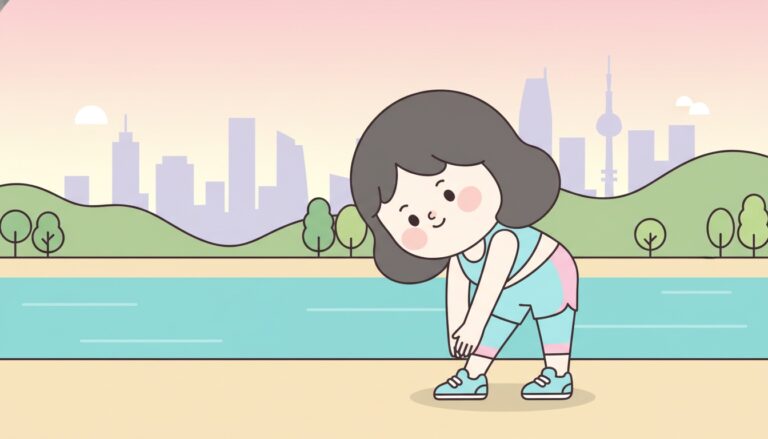
😫 Ouch! Sore Muscles? Active Recovery Tips!
👋 Hello! Welcome to [Daily Hangul]!
Annyeonghaseyo! (안녕하세요!) It’s your energetic Korean tutor, Daily Hangul! 😊
Have you ever watched the K-show “Physical: 100”? After intense challenges, the contestants are exhausted! But did you know that sitting still isn’t always the best way to recover?
Today, we are talking about Active Recovery! If you love working out or just started a new fitness routine in Korea, these expressions are essential. Let’s learn how to tell your friends, “My muscles hurt, let’s take it easy today!” 🏃♂️✨
📚 Key Expressions: Healing Your Muscles
1. 근육통이 왔어요 (I have muscle pain/DOMS)
- Pronunciation: [Geunyuktong-i wasseoyo]
- Meaning: I have muscle pain (DOMS).
- Explanation: “Geunyuk” means muscle, and “tong” means pain. When you have DOMS after a hard workout, you can say this phrase.
- 💡 Pronunciation Tip: Connect the sounds! It sounds like [Geu-nyuk-tong-i]. The ‘k’ sound in ‘nyuk’ carries over to ‘i’.
2. 알이 배겼어요 (My muscles are knotted/sore)
- Pronunciation: [Ari baegyeosseoyo]
- Meaning: My muscles are knotted / I have cramps.
- Explanation: This is a very common Korean idiom! Literally, it means “an egg is embedded.” It describes the hard, knotted feeling in your calves or arms after exercise. Use this, and you’ll sound like a native speaker! 🐣
3. 살살 운동해요 (Let’s exercise gently)
- Pronunciation: [Salsal undonghaeyo]
- Meaning: Let’s exercise gently / lightly.
- Explanation: This is the essence of Active Recovery! “Salsal” (살살) is an adverb for “gently” or “softly.” It’s perfect for suggesting a light recovery workout instead of a heavy one.
- 💡 Pronunciation Tip: The double ‘s’ in ‘Salsal’ is soft, not a strong hissing sound. Say it rhythmically!
💬 Real-Life Conversation: At the Gym
(Situation: Min-su sees his friend Jason walking like a zombie because of leg day.)
Jason: 아… 걷기가 힘들어요. 근육통이 왔어요. 😭
(Ah… It’s hard to walk. I have muscle pain.)
[A… geotgiga himdeureoyo. Geunyuktong-i wasseoyo.]
Min-su: 어제 하체 운동 했어요? 종아리에 알이 배겼어요?
(Did you do a leg workout yesterday? Are your calves knotted?)
[Eoje hache undong haesseoyo? Jongarie ari baegyeosseoyo?]
Jason: 네, 너무 아파요. 오늘은 쉴래요.
(Yes, it hurts so much. I want to rest today.)
[Ne, neomu apayo. Oneureun swillaeyo.]
Min-su: 안 돼요! 그럴 때는 살살 운동해요. 가볍게 걸으면 더 좋아요.
(No! At times like that, exercise gently. Walking lightly is better.)
[An dwaeyo! Geureol ttaeneun salsal undonghaeyo. Gabyeopge georeumyeon deo joayo.]
🇰🇷 Culture Tip & Drama Scene
🏃♂️ The Han River (Hangang) Recovery Culture
In many K-Dramas, when characters are stressed or need to clear their heads (or recover from a breakup!), they go to the Han River Park.
For fitness lovers, the Han River is the perfect spot for Active Recovery. You will see many Koreans walking briskly or riding bikes “Sal-sal” (gently) to loosen up their stiff muscles.
Also, have you heard of “O-Woon-Wan” (오운완)? It stands for “Today’s Workout Complete” (Oneul Undong Wanyo). Even on recovery days, Koreans love posting “Recovery O-Woon-Wan” photos on social media! 📸
📝 Wrap-up & Quiz
Today we learned how to deal with sore muscles in Korean! Remember, active recovery helps you feel better faster! 💪
Pop Quiz! (Fill in the blanks)
- My muscles are knotted/sore: “______ 배겼어요.” (Hint: Egg 🥚)
- Let’s exercise gently/softly: “______ 운동해요.” (Hint: Softly)
Answers:
1. 알이 (Ari)
2. 살살 (Salsal)
See you next time! Annyeong! 👋
Frequently Asked Questions (FAQ)
Q: What does "근육통이 왔어요 (I have muscle pain/DOMS)" mean in Korean and how do you pronounce it?
A: In Korean, "근육통이 왔어요 (I have muscle pain/DOMS)" is pronounced [Geunyuktong-i wasseoyo] and means: I have muscle pain (DOMS).
Q: What does "알이 배겼어요 (My muscles are knotted/sore)" mean in Korean and how do you pronounce it?
A: In Korean, "알이 배겼어요 (My muscles are knotted/sore)" is pronounced [Ari baegyeosseoyo] and means: My muscles are knotted / I have cramps.
Q: What does "살살 운동해요 (Let's exercise gently)" mean in Korean and how do you pronounce it?
A: In Korean, "살살 운동해요 (Let's exercise gently)" is pronounced [Salsal undonghaeyo] and means: Let's exercise gently / lightly.







