

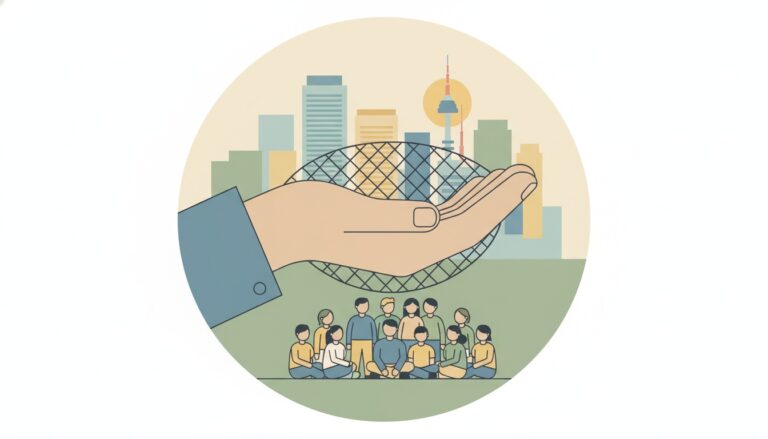
Speak Up in Korean: Why the ‘사회 안전망’ Matters!
Hello! It’s your favorite Korean guide, [Maeil Hangeul], here to upgrade your Korean skills!
Today, we’re moving beyond everyday conversation to tackle a topic you’ll often see in Korean news and dramas: social inequality. Specifically, we’ll learn how to argue for the necessity of a ‘social safety net’ (사회 안전망). Recently in Korea, discussions about the gap between the rich and poor and the need for stronger social support systems are more intense than ever. Understanding these expressions will not only boost your vocabulary but also give you a deeper insight into modern Korean society.
Let’s get started!
Core Expressions You Need to Know
Here are the essential phrases to voice your opinion on this important issue.
1. 사회 안전망 (Sahoe anjeonmang)
- Pronunciation [Romanization]: Sahoe anjeonmang
- English Meaning: Social safety net
- Detailed Explanation: This is the core term for systems that protect citizens from economic hardship, like unemployment benefits or public healthcare. It’s a compound noun made of 사회 (sahoe: society), 안전 (anjeon: safety), and 망 (mang: net). You’ll hear this term constantly in news reports and political debates in Korea.
- 💡 Pronunciation Tip: The word 사회 (sahoe) consists of two Sino-Korean characters: 社 (sa) meaning ‘group’ or ‘society’, and 會 (hoe) meaning ‘to meet’ or ‘gathering’. Recognizing these components can help you guess the meaning of other advanced words like 회사 (hoesa: company) or 국회 (gukhoe: National Assembly).
2. ~ㄹ/을 필요가 있다 (~l/eul piryoga itda)
- Pronunciation [Romanization]: ~l/eul piryoga itda
- English Meaning: It is necessary to… / There is a need to…
- Detailed Explanation: This is a crucial grammar pattern for making a strong argument or suggestion. You attach it to a verb stem. For example, to say “It is necessary to strengthen,” you take the verb 강화하다 (ganghwahada: to strengthen) and change it to 강화할 필요가 있다 (ganghwahal piryoga itda).
- 💡 Pronunciation Tip: When you say ‘필요가’, the sound changes! This is due to a rule called ‘linking sound’ (연음 법칙). The final consonant ‘ㄱ’ (g) of ‘필요’ moves over to the next syllable ‘가’. So, instead of a choppy ‘pilyo-ga’, it flows smoothly as [piryoga]. This makes your Korean sound much more natural!
3. 최소한의 인간다운 삶 (Choesohanui ingandaun salm)
- Pronunciation [Romanization]: Choesohan-ui ingandaun salm
- English Meaning: A minimum life worthy of a human being / A minimum standard of decent living.
- Detailed Explanation: This powerful phrase emphasizes the basic human dignity that a social safety net aims to protect. It’s composed of 최소한 (choesohan: at least/minimum), 인간다운 (ingandaun: human-like/decent), and 삶 (salm: life). It’s often used to argue that everyone deserves a basic standard of living, regardless of their economic situation.
- 💡 Pronunciation Tip: The possessive particle ‘의’ (ui) has a tricky pronunciation. While its official sound is [ui], in many contexts, especially after a consonant, it is pronounced as [에/e]. So, ‘최소한의’ [choesohan-ui] is often spoken naturally as [최소하네/choesohane]. Using this pronunciation will make you sound like a native speaker!
4. 양극화 심화 (Yanggeukhwa simhwa)
- Pronunciation [Romanization]: Yang-geuk-hwa sim-hwa
- English Meaning: Worsening polarization (of wealth)
- Detailed Explanation: This is a term you’ll frequently encounter in articles about the Korean economy. 양극화 (yanggeukhwa) means ‘polarization’ (the division into two extremes), and 심화 (simhwa) means ‘deepening’ or ‘worsening’. It directly points to the growing gap between the rich and the poor.
- 💡 Pronunciation Tip: The ‘ㄱ’ in ‘극’ (geuk) is a tense consonant. It’s pronounced with more tension in your throat than a regular ‘g’, almost like the ‘k’ in the English word ‘sky’ (unaspirated). Practice making a sharp, tight sound without a puff of air. This distinguishes it from ‘그’ (geu) and ‘크’ (keu).
Example Conversation
Let’s see how these expressions work in a real conversation.
A: 뉴스 봤어? 청년 실업률이 계속 오른대. (Bwasseo? Cheongnyeon sireomnyuri gyesok oreundae.)
Did you see the news? They say the youth unemployment rate keeps rising.
B: 응, 정말 심각해. 소득 양극화 심화가 큰 문제인 것 같아. (Eung, jeongmal simgakhae. Sodeuk yanggeukhwa simhwa-ga keun munjein geot gata.)
Yeah, it’s really serious. The worsening polarization of income seems to be a big problem.
A: 맞아. 이럴 때일수록 사회 안전망을 더 강화할 필요가 있어. (Maja. Ireol ttaeilsurok sahoe anjeonmang-eul deo ganghwahal piryoga isseo.)
Exactly. At times like this, it’s necessary to strengthen the social safety net.
B: 동의해. 모든 사람이 최소한의 인간다운 삶을 보장받아야지. (Donguihae. Modeun sarami choesohanui ingandaun salm-eul bojangbadayaji.)
I agree. Everyone deserves to be guaranteed a minimum decent human life.
Culture Tip: Inequality in the Spotlight
This topic isn’t just in the news; it’s a major theme in modern Korean culture. Global hits like the movie ‘Parasite’ (기생충) and the drama ‘Squid Game’ (오징어 게임) powerfully depict the struggles caused by social and economic inequality in Korea. These stories resonated with audiences worldwide, showing that this is a universal concern. Understanding the vocabulary we learned today allows you to engage with these famous works on a much deeper level and grasp the social commentary they are making.
Let’s Practice!
Time to put your knowledge to the test!
Practice Question: Fill in the blank using one of the expressions we learned today.
한국 사회는 빈부 격차 문제를 해결하기 위해 ________을/를 튼튼하게 만들어야 한다.
(Hanguk sahoeneun binbu gyeokcha munjereul haegyeolhagi wihae ________eul/leul teunteunhage mandeureoya handa.)
To solve the problem of the gap between the rich and poor, Korean society must make the ________ stronger.
Ready to share your thoughts? Try making your own sentence using ~ㄹ/을 필요가 있다 and tell us what you think is necessary for a better society. Leave your answers in the comments below!
Frequently Asked Questions (FAQ)
Q: What does "사회 안전망 (Sahoe anjeonmang)" mean in Korean and how do you pronounce it?
A: In Korean, "사회 안전망 (Sahoe anjeonmang)" is pronounced [Romanization] and means: Social safety net
Q: What does "~ㄹ/을 필요가 있다 (~l/eul piryoga itda)" mean in Korean and how do you pronounce it?
A: In Korean, "~ㄹ/을 필요가 있다 (~l/eul piryoga itda)" is pronounced [Romanization] and means: It is necessary to... / There is a need to...
Q: What does "최소한의 인간다운 삶 (Choesohanui ingandaun salm)" mean in Korean and how do you pronounce it?
A: In Korean, "최소한의 인간다운 삶 (Choesohanui ingandaun salm)" is pronounced [Romanization] and means: A minimum life worthy of a human being / A minimum standard of decent living.
Q: What does "양극화 심화 (Yanggeukhwa simhwa)" mean in Korean and how do you pronounce it?
A: In Korean, "양극화 심화 (Yanggeukhwa simhwa)" is pronounced [Romanization] and means: Worsening polarization (of wealth)







