

Hello! It’s your favorite Korean booster, Maeil Han-geul, here to upgrade your language skills!
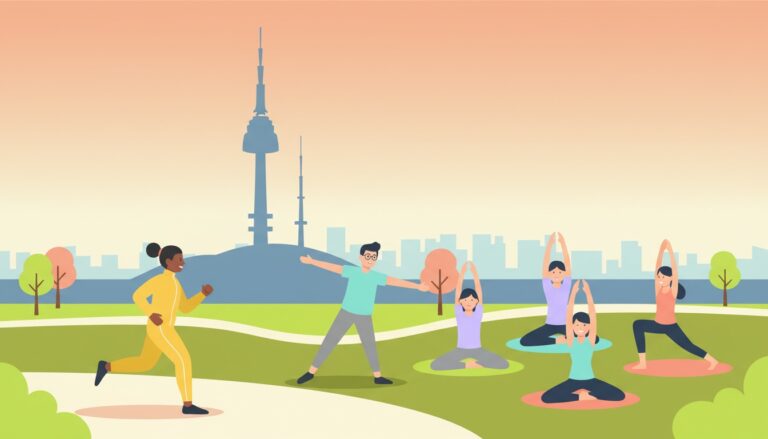
Today, we’re diving into a topic that’s not just healthy but also super trendy in Korea: exercise! Whether you’re a gym lover or enjoy a simple walk, you’ll be able to talk about your favorite activities after this lesson.
Speaking of trends, have you seen the hashtag #오운완 on Instagram? It’s everywhere in Korea right now! It’s a fun way people show they’ve finished their workout for the day. Stick around, and you’ll be able to join the trend, too!
1. 운동하다 (Undonghada)
- Pronunciation [Romanization]: Undonghada
- English Meaning: To exercise / to work out
- Detailed Explanation: This is your essential, all-purpose verb for any kind of physical exercise. From lifting weights to jogging, ‘운동하다’ covers it all. You can use it alone (저 운동해요 – I exercise) or with a specific type of exercise (저는 요가를 운동해요 – I do yoga as exercise).
- 💡 Pronunciation Tip: The first syllable ‘운’ is pronounced [un], not [woon]. The ‘ㅇ’ at the end of a syllable block makes an ‘ng’ sound, so ‘동’ is [dong]. Put it all together slowly: un-dong-ha-da.
2. ~는 것을 좋아해요 (~neun geoseul joahaeyo)
- Pronunciation [Romanization]: ~neun geo-seul jo-a-hae-yo
- English Meaning: I like doing…
- Detailed Explanation: This is a super useful grammar pattern to express what you like to do. Attach ‘~는 것’ to a verb stem to turn it into a noun. For example, the verb ‘운동하다’ (to exercise) becomes ‘운동하는 것’ (the act of exercising).
- 걷다 (geotda – to walk) → 걷는 것을 좋아해요 (geonneun geoseul joahaeyo – I like walking).
- 수영하다 (suyeonghada – to swim) → 수영하는 것을 좋아해요 (suyeonghaneun geoseul joahaeyo – I like swimming).
- 💡 Pronunciation Tip: Notice how ‘것을’ is pronounced [geoseul]. The final consonant ‘ㅅ’ (s) in ‘것’ moves over to the next syllable when it’s followed by a vowel like ‘으’. So, instead of a choppy ‘geot-eul’, it flows smoothly into [geo-seul]. This is a key Korean pronunciation rule called liaison!
3. 오운완 (O-un-wan)
- Pronunciation [Romanization]: O-un-wan
- English Meaning: Today’s workout is complete.
- Detailed Explanation: This is popular new slang (신조어) you’ll see all over Korean social media. It’s an acronym for 오늘 운동 완료 (Oneul Undong Wallyo). People post a picture of themselves after a workout with the hashtag #오운완 to show their achievement for the day.
- 💡 Pronunciation Tip: This one is easy to say once you know what it stands for! Just pronounce the first syllable of each word in the full phrase: [O] + [un] + [wan]. Try it!
Example Conversation
Let’s see these phrases in action!
A: 소미 씨, 주말에 뭐 해요? (Somi, what are you doing this weekend?)
B: 저는 헬스장에 갈 거예요. 운동하는 것을 좋아해요. (I’m going to the gym. I like working out.)
A: 와, 정말요? 멋있어요! (Wow, really? That’s cool!)
B: 네! 끝나고 인스타그램에 #오운완 포스트 올릴 거예요! (Yep! And I’m going to upload an #Ounwan post on Instagram after!)
Culture Tip & Trend Deep Dive
Why is #오운완 so popular? Health and fitness have become a massive part of modern Korean culture, especially for Millennials and Gen Z. It’s seen as a form of self-care and personal development.
This trend is also connected to the ‘Body Profile’ (바디 프로필) craze, where people train for months to take professional-quality photos of their physique. Sharing your daily progress with #오운완 is a way to stay motivated and connect with a community that shares your goals. So, when you use this phrase, you’re not just speaking Korean; you’re tapping directly into a modern cultural movement!
Let’s Practice!
Time to check your understanding.
- Fill in the blank: How would you say “I like to run” in Korean? (The verb ‘to run’ is 달리다 [dallida]).
저는 _________ 것을 좋아해요.
- Challenge: You just finished a great swim. What hashtag would you post on social media to join the trend?
Great job today! You’re now ready to talk about your fitness journey in Korean.
Leave a comment below telling us what you like to do using the ~는 것을 좋아해요 pattern!







