

Hello! This is [Daily Hangul], here to upgrade your Korean proficiency!
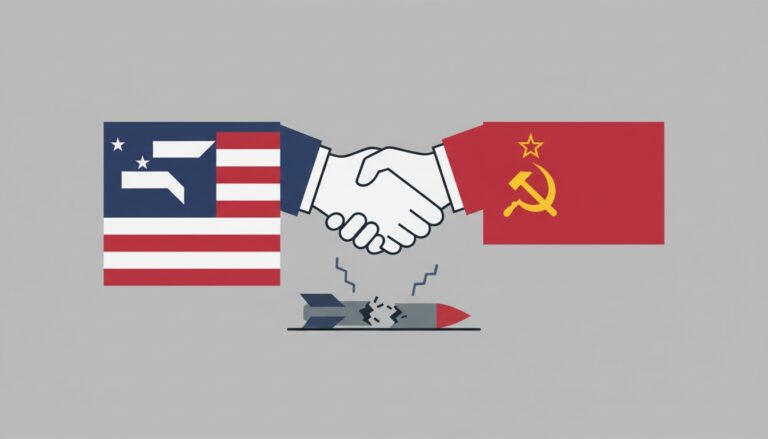
Welcome, advanced learners! Today, we’re diving deep into a topic that requires a sophisticated command of Korean: critically analyzing the major arms control negotiations of the Détente era. This is perfect for when you want to discuss international politics, history, or academic subjects with native speakers. In modern Korea, understanding the nuances of Cold War history is crucial for grasping the complexities of today’s geopolitical landscape, especially concerning the Korean peninsula. Let’s master the vocabulary to discuss this era like a true expert!
Core Expressions for Historical Analysis
Here are the key terms you’ll need to dissect the era of Détente.
1. 군축 협상 (Gunchuk Hyeopsang)
* Pronunciation [Romanization]: Gunchuk hyeopsang
* English Meaning: Arms Reduction Negotiation / Disarmament Talks
* Detailed Explanation: This is a compound noun combining ‘군축’ (軍縮, arms reduction) and ‘협상’ (協商, negotiation). It’s a formal, academic term used in news, historical texts, and political science to refer to official talks aimed at reducing military weapons. It carries a heavy, formal nuance appropriate for discussing international treaties.
* 💡 Pronunciation Tip: The word ‘협상’ is pronounced [협쌍/hyeopssang] due to consonant tensification. The ‘ㅅ’ (s) sound becomes a tense ‘ㅆ’ (ss) sound after the ‘ㅂ’ (p) batchim. This is a common rule that makes your pronunciation sound more natural and assertive.
2. 전략무기제한협정 (Jeollyangmugijehanhyeopjeong)
* Pronunciation [Romanization]: Jeol-lyang-mu-gi-je-han-hyeop-jeong
* English Meaning: Strategic Arms Limitation Talks (SALT)
* Detailed Explanation: This is the official Korean term for the SALT treaties. Let’s break it down: ‘전략’ (戰略, strategy) + ‘무기’ (武器, arms/weapons) + ‘제한’ (制限, limitation) + ‘협정’ (協定, agreement/treaty). Knowing this term allows you to specifically reference one of the most significant negotiations of the 20th century. It’s a highly specific, expert-level term.
* 💡 Pronunciation Tip: In ‘전략’, the ‘ㄴ’ (n) sound in ‘전’ influences the following ‘ㄹ’ (r/l), causing it to be pronounced as a liquid ‘l’ sound. So, it’s not ‘jeon-ryak’ but flows together as [jeol-lyak]. This is called ‘nasal assimilation’.
3. 상호확증파괴 (Sanghohwakjeungpagoe)
* Pronunciation [Romanization]: Sang-ho-hwak-jeung-pa-goe
* English Meaning: Mutually Assured Destruction (MAD)
* Detailed Explanation: This is the direct translation for the core Cold War doctrine of MAD. ‘상호’ (相互, mutual) + ‘확증’ (確證, confirmed proof) + ‘파괴’ (破壞, destruction). This term is essential for explaining the underlying terror and logic that drove the arms race and, paradoxically, the arms control talks. It encapsulates the grim reality of the nuclear age.
* 💡 Pronunciation Tip: This long word can be intimidating! Break it down syllable by syllable. Pay attention to the ‘ㅎ’ (h) in ‘확’. It’s an aspirated sound, so release a puff of air, making it sound like [hwak].
4. 공과(功過)를 따지다 (Gonggwareul ttajida)
* Pronunciation [Romanization]: Gong-gwa-reul tta-ji-da
* English Meaning: To weigh the merits and demerits; to assess the pros and cons.
* Detailed Explanation: ‘공과’ (功過) is a Sino-Korean word meaning ‘merits (功) and faults (過)’. ‘따지다’ means to question, calculate, or scrutinize. This idiomatic phrase is perfect for expressing a nuanced, critical perspective, moving beyond simple praise or blame. It signals a high level of analytical thinking.
* 💡 Pronunciation Tip: The ‘과’ (gwa) is a diphthong. Make sure you pronounce the ‘o’ and ‘a’ sounds quickly and smoothly together, not as two separate vowels. It should be a single, fluid sound: [gwa].
Example Dialogue
Let’s see these terms in a conversation between two history graduate students, Min-jun and Chloe.
A (Min-jun): 클로이 씨, 데탕트 시대의 군축 협상에 대한 발표 준비는 잘 되어가요?
Chloe, how are the preparations for your presentation on the arms reduction negotiations of the Détente era going?
B (Chloe): 네, 특히 전략무기제한협정(SALT I)의 공과를 따지는 데 집중하고 있어요. 상호확증파괴라는 공포 속에서 맺어진 조약이라 평가가 복잡하더라고요.
Yes, I’m focusing on weighing the merits and demerits of the Strategic Arms Limitation Talks (SALT I). It’s a treaty with a complex legacy, forged under the fear of Mutually Assured Destruction.
A (Min-jun): 맞아요. 핵탄두 수량 제한에는 실패해서 유명무실했다는 비판도 있지만, 미소 간의 대화 채널을 열었다는 점은 큰 성과죠.
Exactly. While some criticize it as being ineffective because it failed to limit the number of warheads, its achievement in opening a channel of dialogue between the US and the USSR was significant.
B (Chloe): 바로 그 지점이에요. 협정의 실질적 효과와 상징적 의미를 분리해서 분석해야 할 것 같아요.
That’s precisely the point. I think I need to analyze its practical effects and its symbolic meaning separately.
In-depth Analysis: The Cold War in the Korean Context
For South Korea, the history of the Cold War isn’t just an academic subject; it’s a living reality. The very terms we learned today, like ‘군축 (arms reduction)’ and ‘핵 억제 (nuclear deterrence)’, are constantly used in the news and political debates regarding North Korea. When you use a phrase like ‘공과를 따지다‘ to discuss historical treaties like SALT, you demonstrate an ability to engage in the same kind of high-level, critical discourse that happens in Korean academia and media. Understanding this historical context provides a deeper insight into why discussions about military power and international treaties carry such weight in modern Korean society.
Let’s Review & Practice!
Today, we learned advanced vocabulary to critically discuss the arms control negotiations of the Détente era. We covered 군축 협상, 전략무기제한협정 (SALT), 상호확증파괴 (MAD), and the analytical phrase 공과를 따지다.
✍️ Practice Question:
데탕트 시대의 군축 협상이 오늘날 국제 관계에 미친 가장 중요한 영향은 무엇이라고 생각하십니까? 오늘 배운 표현을 사용하여 여러분의 의견을 댓글로 남겨주세요!
(What do you believe is the most significant impact of the Détente-era arms control negotiations on today’s international relations? Please leave a comment with your opinion using the expressions learned today!)
Frequently Asked Questions (FAQ)
Q: What does "상호확증파괴" mean in Korean and how do you pronounce it?
A: In Korean, "상호확증파괴" is pronounced [MAD] and means: , and the analytical phrase







