

Hello! Welcome to [Maeil Hangul], here to upgrade your Korean skills!
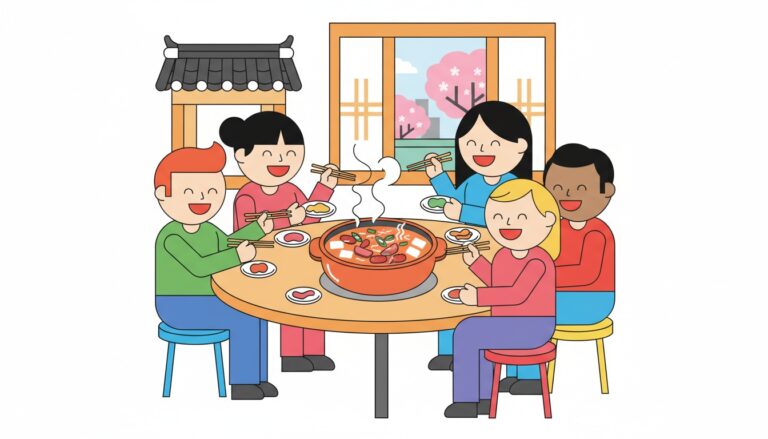
Today, we’re going to learn a super essential phrase for eating out in Korea: how to ask for an extra plate. Why is this so important? Lately in Korea, sharing big, delicious dishes like jjimdak (braised chicken) or budae-jjigae (army stew) with friends is a huge trend. To enjoy these meals together, you’ll definitely need your own little plate. Let’s get you ready to share like a local!
Core Expressions
Here are the key phrases you need to know.
1. 앞접시 (Ap-jeob-si)
* Pronunciation [Romanization]: Ap-jeob-si
* English Meaning: A small individual plate / sharing plate
* Detailed Explanation: This is a compound word. ‘앞 (ap)’ means ‘front,’ and ‘접시 (jeob-si)’ means ‘plate.’ So, it’s literally the ‘front plate’ you place in front of yourself to put food on from a large, shared dish. It’s the perfect word to use in this situation!
* 💡 Pronunciation Tip: The final consonant ‘ㅍ (p)’ in ‘앞’ is an aspirated sound, meaning you should release a strong puff of air, like the ‘p’ in ‘park’. When you say the full word ‘앞접시’, the sound of ‘ㅍ’ links to the next syllable but becomes a ‘ㅂ (b)’ sound, making it sound like [ap-jeob-si]. It’s a subtle change that will make you sound more natural.
2. … 주세요 (… ju-se-yo)
* Pronunciation [Romanization]: … ju-se-yo
* English Meaning: Please give me…
* Detailed Explanation: This is the magic phrase for politely asking for anything in Korea. You simply put the noun you want before ‘주세요’. It’s polite, versatile, and perfect for talking to restaurant staff.
* 💡 Pronunciation Tip: The ‘ㅅ (s)’ in ‘주세요’ is between two vowels. In this position, it often sounds softer, almost like a ‘z’ to English speakers. Try not to make a sharp ‘s’ sound; a gentler pronunciation is more natural.
3. 여기요! (Yeo-gi-yo!)
* Pronunciation [Romanization]: Yeo-gi-yo!
* English Meaning: Over here! / Excuse me!
* Detailed Explanation: This is the standard, polite way to get a server’s attention in a busy restaurant. You can say it with a clear voice and maybe raise your hand slightly. It’s much more common than shouting ‘저기요 (jeo-gi-yo)’ in a restaurant setting.
* 💡 Pronunciation Tip: The vowel ‘여 (yeo)’ can be tricky. It sounds like the ‘yo’ in the English word ‘yonder’. The ‘-요 (-yo)’ at the end is what makes the expression polite.
Example Dialogue
Let’s see how these phrases work in a real conversation. Friends A and B are at a tteokbokki restaurant.
- A: (Raises hand) 여기요! (Yeo-gi-yo! / Excuse me!)
- Server: 네, 필요하신 거 있으세요? (Ne, pil-yoha-sin geo i-sseu-se-yo? / Yes, what do you need?)
- A: 네, 앞접시 두 개 주세요. (Ne, ap-jeob-si du gae ju-se-yo. / Yes, please give us two small plates.)
- Server: 네, 잠시만요. (Ne, jam-si-man-yo. / Yes, just a moment.)
- B: 와, 저 떡볶이 정말 맛있겠다! (Wa, jeo tteokbokki jeongmal masitgetda! / Wow, that tteokbokki looks so delicious!)
Culture Tip & Trend Analysis
In Korea, sharing is a huge part of the dining experience! Many main dishes, like stews (jjigae), grilled meat (gogi-gui), or savory pancakes (pajeon), are placed in the center of the table for everyone to share from. That’s why knowing how to ask for an ‘앞접시’ is absolutely essential. It shows you understand and are ready to embrace Korean food culture!
You’ll see this constantly in Korean mukbang (eating shows) on YouTube. When streamers order huge platters of food to share with guests, the first thing they do is hand out an ‘앞접시’ to everyone. Now you can do it too!
Wrap-up & Practice Quiz
Great job! Today we learned how to get a server’s attention with 여기요! and politely ask for an extra plate with 앞접시 주세요. You’re now ready to share a meal with friends in Korea!
Now, let’s test your knowledge:
- Fill in the blank: You want to ask for one extra plate. What do you say?
“______ 한 개 주세요.”
- Sentence building: How would you politely get the attention of the staff at your table?
Let us know your answers in the comments using the phrases we learned today!







