

Hello! Welcome to [Maeil Hangul], here to upgrade your Korean skills!
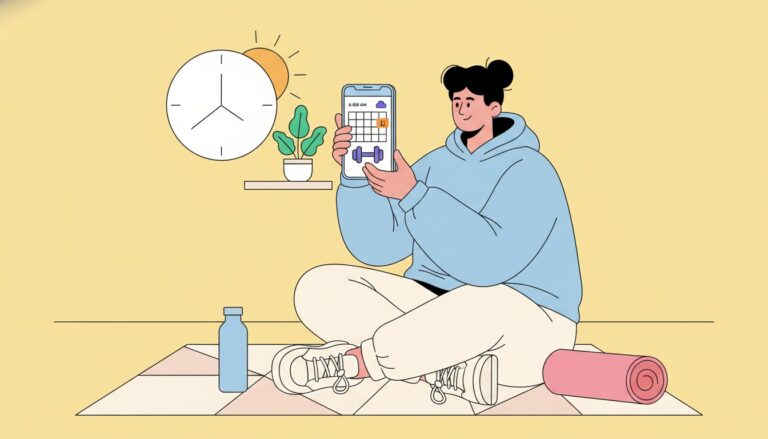
Ever feel like your schedule is too packed to breathe, let alone exercise? You’re not alone! But if you scroll through Korean social media, it seems like everyone is hitting the gym. In Korea these days, posting a workout selfie with the hashtag #오운완 (Today’s Workout Complete) is a huge trend.
So, how do they do it? Today, we’ll learn essential Korean phrases for effective time management, so you too can find time for a workout and proudly say, “O-un-wan!”
Core Expressions for Time-Hacking
Here are the key phrases you need to talk about your busy schedule and how you conquer it.
1. 짬을 내다 (jjam-eul naeda)
- Pronunciation [Romanization]: jjam-eul nae-da
- English Meaning: To make/find time (for something)
- Detailed Explanation: This is the perfect expression for when you intentionally carve out a small pocket of time from your busy schedule. ‘짬 (jjam)’ refers to a brief, spare moment or a lull in activity. ‘내다 (naeda)’ means ‘to make’ or ‘to produce’. So, you are literally “making a spare moment.” It’s a very common phrase used among busy students and professionals.
- 💡 Pronunciation Tip: The first character ‘짬’ starts with ‘ㅉ’ (jj), which is a tensed consonant. It sounds stronger and sharper than the regular ‘ㅈ’ (j). Make the sound at the front of your mouth with a burst of air, like the ‘j’ in ‘jeep’ but with more force.
2. ~ㄹ/을 틈이 없다 (~l/eul teum-i eopda)
- Pronunciation [Romanization]: ~l/eul teu-mi eop-da
- English Meaning: To have no time/leeway to do something
- Detailed Explanation: This grammar pattern emphasizes a complete lack of time or opportunity. ‘틈 (teum)’ means a ‘gap’ or ‘crack’. So, you’re saying there isn’t even a tiny crack in your schedule to do something. You attach it to a verb stem. For example, ‘쉴 틈이 없다 (swil teum-i eopda)’ means “I have no time to rest.”
- 💡 Pronunciation Tip: Notice how ‘틈이 (teum-i)’ is pronounced as [트미 (teumi)]. This is a basic rule of linking sounds (연음, yeoneum). When a syllable ending in a consonant is followed by a syllable starting with a vowel, the consonant sound moves over to the next syllable. So, instead of a pause, it flows smoothly: teum-i → [teu-mi].
3. 미리미리 (mirimiri)
- Pronunciation [Romanization]: mi-ri-mi-ri
- English Meaning: Well in advance; ahead of time
- Detailed Explanation: ‘미리 (miri)’ means ‘in advance’, but repeating it as ‘미리미리 (mirimiri)’ adds emphasis. It implies being very proactive and preparing for something long before it’s due. It’s the secret weapon of effective time managers!
- 💡 Pronunciation Tip: This one is straightforward! Just remember that the Korean ‘ㅣ’ (i) vowel is a pure, bright sound, similar to the ‘ee’ in ‘see’. Say it twice clearly: [mi-ri-mi-ri].
Example Dialogue
Let’s see how these expressions are used in a real conversation.
- A: 와, 요즘 몸이 정말 좋아 보이네요! 바쁘신데 운동할 시간이 있어요?
(Wa, yojeum mom-i jeongmal joa boineyo! Bappeusinde undonghal sigan-i isseoyo?)
Wow, you look so fit these days! Are you able to find time to exercise even though you’re busy? -
B: 아니요, 정말 쉴 틈도 없이 바쁜데, 일부러 짬을 내서 운동하고 있어요.
(Aniyo, jeongmal swil teumdo eopsi bappeunde, ilbureo jjam-eul naeseo undonghago isseoyo.)
Not at all, I’m so busy I have no time to rest, but I’m intentionally making time to work out. -
A: 대단해요! 비결이 뭐예요?
(Daedanhaeyo! Bigyeor-i mwoyeyo?)
That’s amazing! What’s your secret? -
B: 운동 계획을 미리미리 세워둬요. 그리고 SNS에 #오운완 인증하는 게 큰 동기부여가 돼요!
(Undong gyehoeg-eul mirimiri sewodwoyo. Geurigo SNS-e #Ounwan injeunghaneun ge keun donggibuyeo-ga dwaeyo!)
I set up my workout plan well in advance. And posting my #Ounwan proof shot on social media is a big motivator!
Culture Tip: The #오운완 and Body Profile Trend
‘오운완 (O-un-wan)‘ is a massively popular hashtag in Korea. It’s an abbreviation of ‘오늘 운동 완료’ (Oneul Undong Wanlyo), meaning “Today’s workout complete.” People post photos of themselves at the gym or after a run to prove their consistency and motivate each other.
This is closely related to another trend: the ‘바디 프로필 (badi peuropeel)‘ or ‘body profile’ photoshoot. Many young Koreans will train intensely for several months with the goal of taking professional-quality photos of their physique. This has become a powerful motivator for people to stick to their fitness goals. So, when you use phrases like ‘짬을 내다’, you’re tapping into a very current and relevant aspect of modern Korean culture!
Let’s Practice!
Time to check your understanding. Try these short exercises!
- Fill in the Blank: I was so busy studying for the test that I had no time to sleep! (시험공부 때문에 너무 바빠서 잠을 ___ __ __ 없었어요!)
- Your Turn: How do you ‘make time’ (짬을 내다) to study Korean in your busy schedule? Write a short sentence!
Great job today! Don’t forget to make time to practice. Leave your answers and your own sentences in the comments below!
Frequently Asked Questions (FAQ)
Q: What does "짬을 내다 (jjam-eul naeda)" mean in Korean and how do you pronounce it?
A: In Korean, "짬을 내다 (jjam-eul naeda)" is pronounced [Romanization] and means: To make/find time (for something)
Q: What does "~ㄹ/을 틈이 없다 (~l/eul teum-i eopda)" mean in Korean and how do you pronounce it?
A: In Korean, "~ㄹ/을 틈이 없다 (~l/eul teum-i eopda)" is pronounced [Romanization] and means: To have no time/leeway to do something
Q: What does "미리미리 (mirimiri)" mean in Korean and how do you pronounce it?
A: In Korean, "미리미리 (mirimiri)" is pronounced [Romanization] and means: Well in advance; ahead of time







