

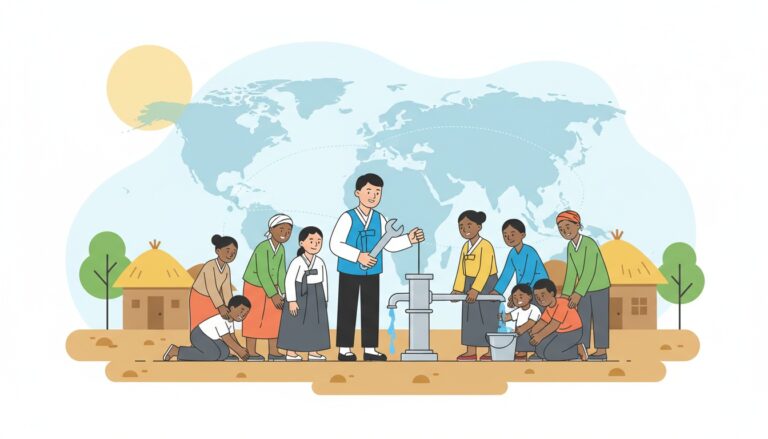
Hello! Welcome to Maeil Hangeul, your go-to source for upgrading your Korean skills!
Have you ever dreamed of using your Korean skills to make a real-world impact? Today, we’re moving beyond everyday conversation and into the professional world of international development. We’ll tackle a crucial topic: how to propose a project in the WASH (Water, Sanitation, and Hygiene) sector. Recently, Korea’s role in global Official Development Assistance (ODA) has been growing, with organizations like KOICA leading projects worldwide. Mastering this specialized vocabulary will not only elevate your Korean to a professional level but also open doors to impactful careers. Let’s learn how to talk about building a better future, in Korean!
Key Expressions for Your Proposal
Here are some essential phrases you’ll need to draft a convincing and professional project proposal.
1. 지속가능한 발전을 도모하다 (Jisokganeunghan baljeoneul domohada)
- English Meaning: To promote sustainable development.
- Detailed Explanation: This is a cornerstone phrase in the world of international aid. ‘지속가능한 발전’ (jisokganeunghan baljeon) means ‘sustainable development,’ a concept that meets the needs of the present without compromising the ability of future generations to meet their own. The verb ‘도모하다’ (domohada) is a formal and sophisticated way to say ‘to promote,’ ‘to plan for,’ or ‘to work towards.’ It’s perfect for official documents, reports, and presentations, carrying more weight than a simpler verb like ‘만들다’ (to make).
- 💡 Pronunciation Tip: In ‘발전을’ [baljeoneul], the final consonant ‘ㄴ’ (n) of ‘전’ links to the following vowel ‘으’. This is a liaison rule called ‘연음’ (yeoneum). Instead of a choppy ‘baljeon-eul,’ it flows smoothly as [bal-jeo-neul].
2. 주민 참여를 기반으로 한 (Jumin chamyeoreul gibaneuro han)
- English Meaning: Based on community participation.
- Detailed Explanation: This phrase emphasizes a bottom-up approach, which is highly valued in modern development projects. ‘주민 참여’ (jumin chamyeo) means ‘resident/community participation.’ The grammatical structure ‘-을/를 기반으로 한’ (eul/reul gibaneuro han) means ‘to be based on’ or ‘founded upon.’ Using this shows that your project is not a top-down order but a collaborative effort, which increases project ownership and success.
- 💡 Pronunciation Tip: The ‘ㅊ’ (ch) sound in ‘참여’ [chamyeo] is an aspirated consonant. This means you should release a strong puff of air as you say it, making it distinct from the unaspirated ‘ㅈ’ (j). Practice by holding a piece of paper in front of your mouth; it should flutter when you say ‘참여’.
3. 식수 접근성 향상 (Siksu jeopgeunseong hyangsang)
- English Meaning: Improvement of access to drinking water.
- Detailed Explanation: This is a standard technical term for a key objective in any WASH project. Let’s break it down: ‘식수’ (siksu) is ‘drinking water,’ ‘접근성’ (jeopgeunseong) means ‘accessibility,’ and ‘향상’ (hyangsang) means ‘improvement’ or ‘enhancement.’ Combining them creates a clear, professional goal statement for your proposal.
- 💡 Pronunciation Tip: Notice the sound of ‘접근성’ [접끈썽, jeopkkeunseong]. The initial ‘ㄱ’ (g) in ‘근’ becomes a tensed (or ‘double’) consonant sound, [ㄲ] (kk), after a stop consonant like ‘ㅂ’ (p). This is a consonant tensing rule known as ‘경음화’ (gyeongeumhwa), making the pronunciation stronger and more defined.
4. 기대 효과는 다음과 같습니다 (Gidae hyogwaneun daeumgwa gatsseumnida)
- English Meaning: The expected effects/outcomes are as follows.
- Detailed Explanation: This is the perfect sentence to introduce the anticipated positive results of your project. ‘기대 효과’ (gidae hyogwa) means ‘expected effects.’ The formal structure ‘-는 다음과 같습니다’ (-neun daeumgwa gatsseumnida) is a set phrase used in presentations and documents to mean ‘…are as follows.’ It signals to your audience that you are about to list the key outcomes.
- 💡 Pronunciation Tip: The pronunciation of ‘같습니다’ is more like [가씀니다, gasseumnida]. The final ‘ㅌ’ (t) sound in ‘같’ changes to a ‘ㅅ’ (s) sound before ‘습니다’. Then, the ‘ㅂ’ (b) in ‘습’ is nasalized to an ‘ㅁ’ (m) sound before the ‘ㄴ’ (n). This complex assimilation is key to sounding fluent in formal Korean.
Example Dialogue
Let’s see how these expressions work in a meeting between an NGO project manager (A) and a local community leader (B).
A: 저희는 마을의 식수 접근성 향상을 위한 신규 사업을 제안하고자 합니다.
(We would like to propose a new project for the improvement of access to drinking water in the village.)
B: 구체적으로 어떤 방식의 사업인가요?
(Specifically, what kind of project is it?)
A: 주민 참여를 기반으로 한 식수 관리 시스템 구축 사업입니다. 이것이 장기적으로 지속가능한 발전을 도모하는 최선의 방법이라고 생각합니다.
(It’s a project to establish a water management system based on community participation. We believe this is the best way to promote sustainable development in the long run.)
B: 아주 좋은 생각이네요. 그래서 기대 효과는 다음과 같습니까?
(That’s an excellent idea. So, are the expected effects as follows?)
A: 네, 기대 효과는 다음과 같습니다. 첫째, 수인성 질병 발생률 감소. 둘째, 물을 길어오는 데 필요한 시간과 노동력 절감입니다.
(Yes, the expected effects are as follows. First, a reduction in the incidence of waterborne diseases. Second, a decrease in the time and labor required for fetching water.)
Cultural Tip & Deeper Insight
In Korean professional culture, especially in development, the concept of ‘주인의식’ (juinuisik), or ‘ownership mindset,’ is extremely important. When you propose a project that is ‘주민 참여를 기반으로 한’ (based on community participation), you are implicitly arguing that it will foster this ‘주인의식’ among the community members. This makes them feel the project is truly theirs, which is the most powerful argument for its long-term sustainability. Mentioning this concept in your discussions can make your proposal much more persuasive to Korean partners or donors.
Let’s Practice!
Time to put your knowledge to the test!
- Fill in the blank: 이 프로젝트의 궁극적인 목표는 지역사회의 ( )을/를 ( ) 것입니다.
(The ultimate goal of this project is to promote the sustainable development of the community.)
Answer: 지속가능한 발전, 도모하는 -
Make a sentence: Create a short sentence describing a project goal using the phrase ‘식수 접근성 향상’.
Great job today! You’ve taken a huge step towards using Korean in a highly specialized and meaningful field. Now, it’s your turn. What kind of project would you propose using today’s expressions? Leave a comment below with your ideas!
Frequently Asked Questions (FAQ)
Q: What does "'지속가능한 발전'" mean in Korean and how do you pronounce it?
A: In Korean, "'지속가능한 발전'" is pronounced [jisokganeunghan baljeon] and means: means 'sustainable development,' a concept that meets the needs of the present without compromising the ability of future generations to meet their own. The verb
Q: What does "'도모하다'" mean in Korean and how do you pronounce it?
A: In Korean, "'도모하다'" is pronounced [domohada] and means: is a formal and sophisticated way to say 'to promote,' 'to plan for,' or 'to work towards.' It's perfect for official documents, reports, and presentations, carrying more weight than a simpler verb like '만들다' (to make).
Q: What does "'발전을'" mean in Korean and how do you pronounce it?
A: In Korean, "'발전을'" is pronounced [baljeoneul] and means: , the final consonant 'ㄴ' (n) of '전' links to the following vowel '으'. This is a liaison rule called
Q: What does "'연음'" mean in Korean and how do you pronounce it?
A: In Korean, "'연음'" is pronounced [yeoneum] and means: . Instead of a choppy 'baljeon-eul,' it flows smoothly as [bal-jeo-neul].







