

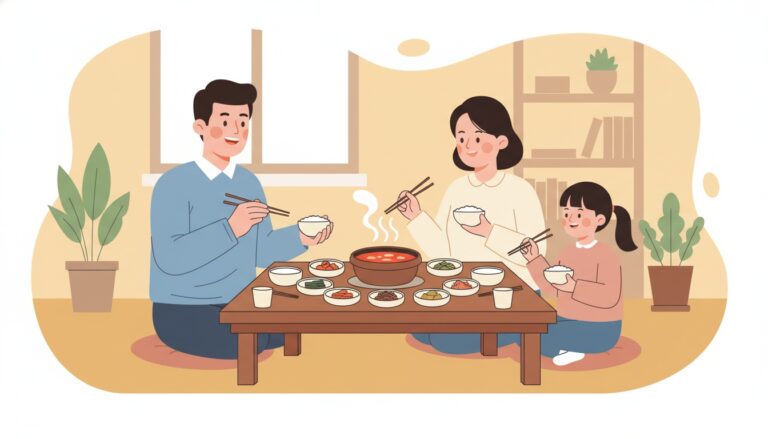
Our Family Eats Kimchi Every Day! Korean Habits 101
Hello! Welcome to [Maeil Hangul], here to upgrade your Korean skills!
Have you ever watched a K-drama and noticed how important meal times are for the family? Today, we’re going to learn how to talk about those daily routines, especially family meal habits, using the simple present tense. It’s super useful for making small talk and sharing a bit about your life. Lately in Korea, from mukbang (eating shows) to heartwarming family dramas, food and shared meals are everywhere. Let’s learn the expressions so you can join the conversation!
Core Expressions You Need to Know
Here are some essential words and grammar points to talk about your habits.
1. The Present Tense: -아요/어요 (-ayo/eoyo)
- Korean Expression: 먹어요
- Pronunciation [Romanization]: Meogeoyo
- English Meaning: (I/you/we/they) eat.
- Detailed Explanation: This is the most common and basic polite ending for verbs and adjectives in the present tense. You attach it to the verb stem. If the last vowel of the stem is ‘ㅏ’ or ‘ㅗ’, you add -아요. For all other vowels, you add -어요. The verb ‘하다’ (hada, to do) is a special case and becomes 해요 (haeyo).
- 가다 (gada, to go) → 가 + 아요 → 가요 (gayo)
- 먹다 (meokda, to eat) → 먹 + 어요 → 먹어요 (meogeoyo)
- 💡 Pronunciation Tip (연음 – Linking Sound): In ‘먹어요’, the final consonant ‘ㄱ’ (k/g) from ‘먹’ moves to the next syllable, which starts with a vowel. So, instead of a choppy ‘meok-eoyo’, it sounds like a smooth [meo-geo-yo]. This linking rule is key to sounding natural!
2. Every Day: 매일 (maeil)
- Korean Expression: 매일
- Pronunciation [Romanization]: Maeil
- English Meaning: Every day
- Detailed Explanation: This is a simple but powerful adverb you can place in your sentence (usually before the verb) to say you do something every single day. It’s perfect for talking about habits!
- 💡 Pronunciation Tip: The Korean vowel ‘ㅐ’ (ae) is pronounced like the ‘e’ in the English word “bed.” Try to make it one clean sound, not two separate ones.
3. Together: 같이 (gachi)
- Korean Expression: 같이
- Pronunciation [Romanization]: Gachi
- English Meaning: Together
- Detailed Explanation: Use this word when you’re doing an activity with someone else. It emphasizes the shared experience, which is very important in Korean culture, especially for meals.
- 💡 Pronunciation Tip (구개음화 – Palatalization): This is a fun one! The word is written as ‘gat-i’, but we pronounce it [gachi]. When the final consonant ‘ㅌ’ (t) is followed by a syllable starting with ‘ㅣ’ (i), it transforms into a ‘ㅊ’ (ch) sound. This makes the pronunciation smoother. Another example is ‘굳이’ (gud-i), which is pronounced [구지, guji].
Example Dialogue
Let’s see how these expressions are used in a real conversation!
- A: 수진 씨, 가족하고 저녁을 자주 먹어요?
- (Sujin-ssi, gajokhago jeonyeogeul jaju meogeoyo?)
- Sujin, do you often eat dinner with your family?
- B: 네, 우리는 매일 저녁을 같이 먹어요.
- (Ne, urineun maeil jeonyeogeul gachi meogeoyo.)
- Yes, we eat dinner together every day.
- A: 와, 정말요? 보통 뭐 먹어요?
- (Wa, jeongmallyo? Botong mwo meogeoyo?)
- Wow, really? What do you usually eat?
- B: 김치찌개를 자주 먹어요. 정말 맛있어요!
- (Gimchi-jjigaereul jaju meogeoyo. Jeongmal masisseoyo!)
- We often eat Kimchi Jjigae. It’s really delicious!
Culture Tip & Trend Deep Dive
In Korea, the phrase “밥 먹었어요?” (Bap meogeosseoyo? – Have you eaten?) is often used as a greeting, similar to “How are you?”. This shows how central food and shared meals are to Korean culture. This concept is called ‘밥심’ (bapsim), which literally means ‘rice power’ and refers to the idea that a good meal gives you the strength to get through the day.
In many recent K-dramas like “Crash Course in Romance” or “Hometown Cha-Cha-Cha”, you’ll see that the most important conversations and emotional moments happen around the dinner table. When a character says “우리 같이 밥 먹어요” (Uri gachi bap meogeoyo – Let’s eat together), it’s often an expression of care and a desire to build a closer relationship. So, when you use this phrase, you’re not just talking about food; you’re tapping into a deep cultural value!
Let’s Practice!
Time to review what we’ve learned!
- Fill in the blank: How would you say “I study Korean every day”?
- 저는 ______ 한국어를 공부해요. (Jeoneun ______ hangugeoreul gongbuhaeyo.)
- Sentence Building: Using the words below, make a sentence that means “My family and I watch TV together.”
- (가족하고 / 봐요 / 같이 / 저는 / TV를)
Great job today! You’re now ready to talk about your daily habits in Korean.
Why not try it out? Leave a comment below and tell us about one of your daily habits using the expressions you learned today!
Frequently Asked Questions (FAQ)
Q: What does "The Present Tense: -아요/어요 (-ayo/eoyo)" mean in Korean and how do you pronounce it?
A: In Korean, "The Present Tense: -아요/어요 (-ayo/eoyo)" is pronounced [Romanization] and means: (I/you/we/they) eat.
Q: What does "Every Day: 매일 (maeil)" mean in Korean and how do you pronounce it?
A: In Korean, "Every Day: 매일 (maeil)" is pronounced [Romanization] and means: Every day
Q: What does "Together: 같이 (gachi)" mean in Korean and how do you pronounce it?
A: In Korean, "Together: 같이 (gachi)" is pronounced [Romanization] and means: Together







