

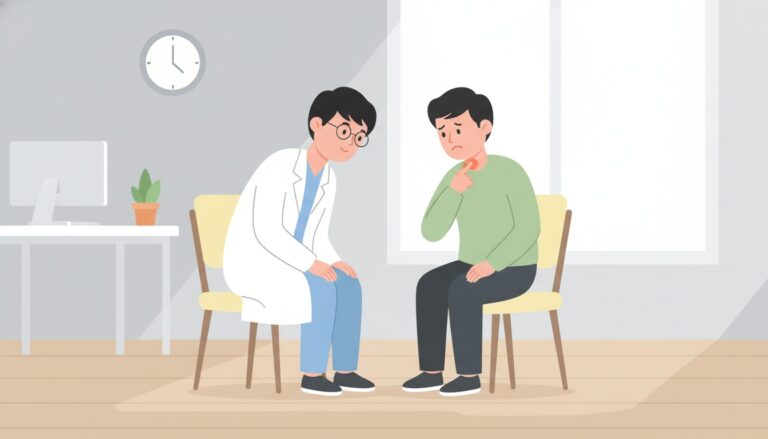
Ouch! How to Say ‘I Have a Fever’ in Korean
Hello! This is Maeil Hangul, here to upgrade your Korean skills!
Ever felt sick while in Korea and struggled to explain how you feel? Don’t worry! Today, we’re going to learn some essential phrases to describe common cold symptoms. Especially as the seasons change, many people in Korea catch colds, so knowing these expressions will be super helpful whether you need to visit a pharmacy or a hospital. Let’s get started!
Core Expressions You Must Know
Here are three key phrases to tell someone you’re not feeling well.
1. 열이 나요 (Yeori nayo)
* Pronunciation [Romanization]: Yeori nayo
* English Meaning: I have a fever.
* Detailed Explanation: This literally means “fever is coming out.” The verb 나요 (nayo) is used for things that occur or emerge from the body, like a fever, a cough, or a runny nose. It’s the standard, polite way to say you have a fever.
* 💡 Pronunciation Tip: The Korean letter ‘ㄹ’ (rieul) at the end of a syllable followed by a vowel often sounds like a soft ‘r’. So, 열이 is pronounced [yeo-ri], not ‘yeol-i’. It flows smoothly together!
2. 목이 아파요 (Mogi apayo)
* Pronunciation [Romanization]: Mogi apayo
* English Meaning: My throat hurts / I have a sore throat.
* Detailed Explanation: 목 (mok) means “throat” or “neck,” and 아파요 (apayo) is the polite form of the verb “to hurt.” You can use 아파요 for any body part! For example, 머리가 아파요 (Meoriga apayo) means “I have a headache.”
* 💡 Pronunciation Tip: The letter ‘ㄱ’ (giyeok) sounds like a ‘g’ when it’s between two vowels, as in 목이 [mo-gi]. It’s softer than the hard ‘k’ sound it makes at the beginning of a word like in 기침 (gichim).
3. 기침이 나요 (Gichimi nayo)
* Pronunciation [Romanization]: Gichimi nayo
* English Meaning: I have a cough.
* Detailed Explanation: Just like with a fever, Koreans say a cough “comes out.” 기침 (gichim) means “cough.” So, 기침이 나요 is the natural way to say you are coughing.
* 💡 Pronunciation Tip: The ‘ㅊ’ (chieut) sound in 기침 [gichim] is an aspirated ‘ch’ sound. It should come out with a stronger puff of air than a simple ‘j’ sound, almost like the ‘ch’ in “chart.”
Example Dialogue at the Clinic
Let’s see how these phrases work in a real conversation at a doctor’s office in Korea.
- A: 의사 (Doctor): 안녕하세요. 어디가 불편하세요? (Annyeonghaseyo. Eodiga bulpyeonhaseyo?)
- Hello. What’s bothering you?
- B: 환자 (Patient): 어제부터 열이 나고 목이 아파요. 기침도 조금 나요. (Eojebuteo yeori nago mogi apayo. Gichimdo jogeum nayo.)
- Since yesterday, I have a fever and a sore throat. I also have a slight cough.
Culture Tip & Trend Analysis
In Korea, it’s very common to see people wearing face masks, even before the pandemic. It’s considered good manners to wear one when you have a cold to avoid spreading germs to others. So, if you’re coughing or sneezing, don’t be surprised if someone kindly offers you a mask!
Also, for symptoms like these, many Koreans first visit a local clinic called 이비인후과 (ibiinhugwa), which is an ENT (Ear, Nose, and Throat) specialist. They are very efficient and you can usually get a check-up and a prescription in a short amount of time. Knowing the word 이비인후과 can be very useful!
Let’s Review & Practice!
Great job today! You’ve learned how to talk about having a fever, a sore throat, and a cough in Korean.
Now, try this quick quiz!
Fill in the blank: How would you say “I have a headache” in Korean? (Hint: “head” is 머리 (meori)).
머리가 _______.
Leave your answer and try making your own sentence with today’s expressions in the comments below! We’d love to see them!
Frequently Asked Questions (FAQ)
Q: What does "A: 의사" mean in Korean and how do you pronounce it?
A: In Korean, "A: 의사" is pronounced [Doctor] and means: 안녕하세요. 어디가 불편하세요? (Annyeonghaseyo. Eodiga bulpyeonhaseyo?)
Q: What does "B: 환자" mean in Korean and how do you pronounce it?
A: In Korean, "B: 환자" is pronounced [Patient] and means: 어제부터
Q: What does "이비인후과" mean in Korean and how do you pronounce it?
A: In Korean, "이비인후과" is pronounced [ibiinhugwa] and means: , which is an ENT (Ear, Nose, and Throat) specialist. They are very efficient and you can usually get a check-up and a prescription in a short amount of time. Knowing the word







