

Hello! This is Maeil Hangul, here to upgrade your Korean skills!
Today, we’re moving beyond simple conversations and into the world of critical thinking in Korean. Have you ever bought an appliance and wondered if the energy efficiency label was telling the whole truth? In Korea, where there’s a huge push for carbon neutrality and eco-friendly products, being able to discuss this topic is a fantastic way to show off your advanced skills. Let’s learn how to critically analyze information like a native speaker!
Key Expressions for Critical Analysis
Here are some sophisticated phrases to help you question and analyze the information around you.
1. -는다고 알려져 있다 (neun-da-go al-lyeo-jyeo it-da)
* English Meaning: It is known that… / It is said that…
* Detailed Explanation: This is a passive voice structure used to state a commonly held belief, a reported fact, or a claim. It’s perfect for introducing a topic you are about to analyze or question. It carries a slightly formal and objective nuance, as if you’re quoting general knowledge.
* 💡 Pronunciation Tip: The magic here is in the smooth connection. In a phrase like ‘높다고 알려져 있다’ (It is known to be high), the pronunciation becomes [놉따고 알녀저 읻따 / nop-tta-go al-lyeo-jeo it-tta]. The ㅈ sound in 져 links with the ㅇ in the next syllable, creating a smooth flow.
2. 명목상이 아닌 실질적인 (myeong-mok-sang-i a-nin sil-jil-jeo-gin)
* English Meaning: Not nominal, but substantial/actual.
* Detailed Explanation: This is a powerful phrase for distinguishing between something’s name/label (명목상) and its true nature or effect (실질적). It’s an excellent way to express the idea of looking past the surface level. For example, ‘명목상의 1등급’ (a nominal Grade 1) vs. ‘실질적인 효율’ (actual efficiency).
* 💡 Pronunciation Tip: The syllable 상 (sang) flows directly into 이 (i), so it sounds like [상이 / sang-i], not sang-i. For ‘실질적인’ [sil-jil-jjeo-gin], notice the ㄱ becomes a tense sound ㄲ after the ㄹ 받침. This is called ‘tensification’ and makes your pronunciation sound much more natural.
3. 의문을 제기하다 (ui-mun-eul je-gi-ha-da)
* English Meaning: To raise a question / To raise a doubt.
* Detailed Explanation: This is a formal and slightly academic phrase used when you want to officially question or challenge a claim or statement. It’s more formal than simply saying ‘궁금하다’ (to be curious) or ‘물어보다’ (to ask).
* 💡 Pronunciation Tip: The diphthong ‘의 (ui)’ can be tricky. When it’s at the beginning of a word like here, it’s pronounced close to its full ‘ui’ sound. However, when it’s a possessive particle (like 나의, my), it’s often simplified to [에/e]. Practice saying [의문 / ui-mun] clearly.
4. 꼼꼼히 따져보다 (kkom-kkom-hi tta-jyeo-bo-da)
* English Meaning: To check/examine meticulously; to weigh the pros and cons carefully.
* Detailed Explanation: This common phrase describes the action of scrutinizing something in detail before making a decision, especially a purchase. It implies careful consideration of all factors, not just a quick look.
* 💡 Pronunciation Tip: The ‘ㅎ’ in ‘꼼꼼히’ [꼼꼬미 / kkom-kko-mi] is often silent when followed by a vowel, making the pronunciation smoother. The ‘ㄸ’ in ‘따져보다’ is a tense consonant, so make sure to produce a sharp, strong ‘tt’ sound with no puff of air.
Example Dialogue
Let’s see these expressions in a real-life conversation between two colleagues, Ji-hoon and Su-jin.
A (Ji-hoon): “I’m thinking of buying this new air conditioner. It has a Grade 1 energy efficiency rating.”
“새로 나온 에어컨을 사려고 하는데, 에너지 효율 1등급이더라고요.”
B (Su-jin): “Oh, Grade 1 products are known to be efficient, but I read an article that raised questions about the testing standards. We should look at the actual, not just nominal, power consumption.”
“아, 1등급 제품이 효율이 높다고 알려져 있긴 한데, 얼마 전 테스트 기준에 대해 의문을 제기하는 기사를 봤어요. 명목상이 아닌 실질적인 전력 소비량을 봐야 해요.”
A (Ji-hoon): “You’re right. It’s an expensive purchase, so I should examine it meticulously before deciding.”
“맞아요. 비싸게 사는 거니까, 결정하기 전에 꼼꼼히 따져봐야겠네요.”
Culture Tip & Trend Analysis
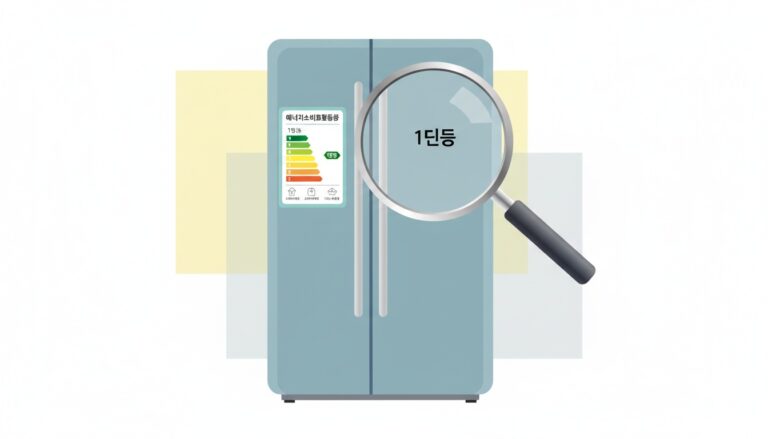
In Korea, achieving ‘1등급’ (Grade 1) is a huge marketing point for everything from appliances to beef quality! However, consumer awareness is growing. Recently, the Korean government had to tighten the standards for energy efficiency ratings because technology had improved so much that almost every new product was getting Grade 1, making the label less meaningful. This has led to a rise in consumer skepticism and the phenomenon of ‘그린워싱 (geu-rin-wo-sing / Greenwashing)’, where companies exaggerate their eco-friendly credentials. So, when you see a Korean friend carefully comparing labels, you’ll know they are being a smart, critical consumer by ‘꼼꼼히 따져보는 중’ (in the middle of examining meticulously)!
Let’s Practice!
Ready to test your skills? Try these short exercises.
- Fill in the blank: The company’s claim sounds great, but we need to analyze its ______ benefits. (Hint: Not nominal, but actual)
- Sentence Making: Using ‘의문을 제기하다’, write a short sentence in Korean about a product or service you were once skeptical about.
Great job today! You’ve learned some incredibly useful expressions for thinking and speaking critically in Korean. Try using one in the comments below!
Frequently Asked Questions (FAQ)
Q: What does "'실질적인'" mean in Korean and how do you pronounce it?
A: In Korean, "'실질적인'" is pronounced [sil-jil-jjeo-gin] and means: , notice the
Q: What does "'꼼꼼히'" mean in Korean and how do you pronounce it?
A: In Korean, "'꼼꼼히'" is pronounced [꼼꼬미 / kkom-kko-mi] and means: is often silent when followed by a vowel, making the pronunciation smoother. The
Q: What does "'1등급'" mean in Korean and how do you pronounce it?
A: In Korean, "'1등급'" is pronounced [Grade 1] and means: is a huge marketing point for everything from appliances to beef quality! However, consumer awareness is growing. Recently, the Korean government had to tighten the standards for energy efficiency ratings because technology had improved so much that almost every new product was getting Grade 1, making the label less meaningful. This has led to a rise in consumer skepticism and the phenomenon of







