

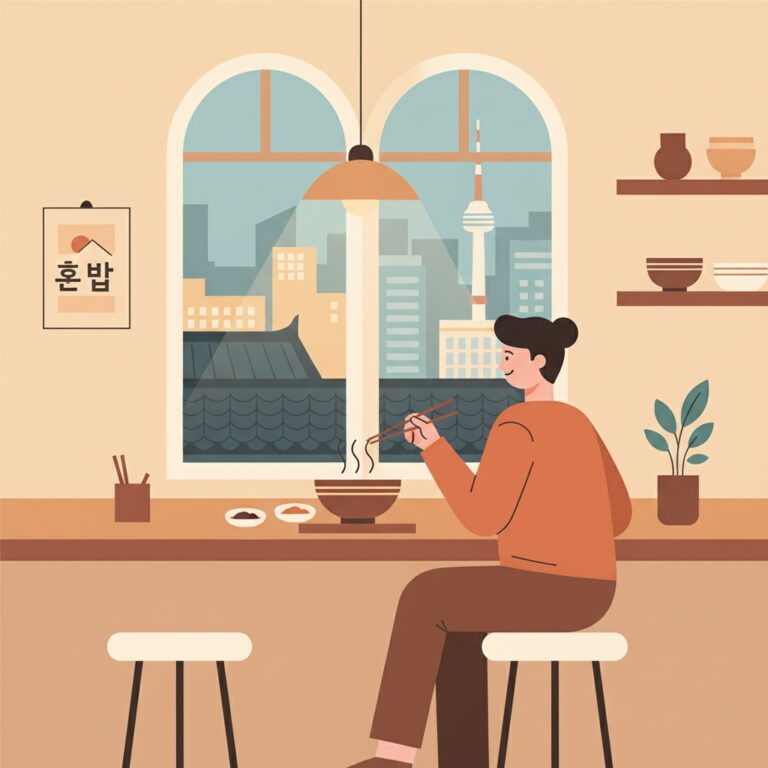
Korea’s Solo Trend: How to Say “I Went Alone”!
Hello! This is Maeil Hangeul, here to upgrade your Korean skills!
Have you ever enjoyed a coffee, watched a movie, or visited a museum all by yourself? Today, we’re going to learn how to talk about those awesome solo adventures in Korean.
Lately in Korea, spending quality time alone is a huge trend! It’s called “Honjok” (혼족), which means the “solo tribe.” From eating out to traveling, doing things by yourself is seen as cool and independent. So, let’s learn the essential phrases you need to talk about your weekend, “Honjok” style!
Core Expressions You Need to Know
Here are three key expressions to talk about your solo activities.
1. 혼자 갔어요 (Honja gasseoyo)
- Pronunciation [Romanization]: Honja gasseoyo
- English Meaning: I went alone.
- Detailed Explanation: This is your go-to phrase! 혼자 (honja) means “alone” or “by oneself.” 갔어요 (gasseoyo) is the past tense of the verb 가다 (gada), which means “to go.” You can use this to talk about going anywhere—a café, the cinema, a park, you name it! It’s in the standard polite
–요 (-yo)form, so you can use it in most daily conversations. -
💡 Pronunciation Tip:
Notice the double consonant ‘ㅆ’ in 갔어요 (gasseoyo)? In Korean, ‘ㅆ’ (ssangsiot) is a “tense” sound. You make it by tightening your throat muscles slightly and pushing out the air with more force than the regular ‘ㅅ’ (s) sound. It sounds like the “ss” in “hiss,” not the “s” in “see.” Practice saying it with a bit of power: ga-SSEOYO!
2. 혼자 먹었어요 (Honja meogeosseoyo)
- Pronunciation [Romanization]: Honja meogeosseoyo
- English Meaning: I ate alone.
-
Detailed Explanation: This follows the same pattern. 혼자 (honja) means “alone,” and 먹었어요 (meogeosseoyo) is the past tense of 먹다 (meokda), “to eat.” This phrase is perfect for when you want to talk about grabbing a delicious meal by yourself.
-
💡 Pronunciation Tip:
This phrase has a super important pronunciation rule called linking sound or “yeon-eum” (연음). The final consonant of a syllable, like the ‘ㄱ’ (g) in 먹 (meok), moves over to the next syllable if it starts with a vowel (like ‘어’, eo). So, instead of pronouncing it as “meok – eosseoyo,” the ‘ㄱ’ sound links to the next syllable, making it sound like [머거써요, meo-geo-sseo-yo]. This makes your Korean sound much more natural and smooth!
3. 재미있었어요? (Jaemiisseosseoyo?)
- Pronunciation [Romanization]: Jaemiisseosseoyo?
- English Meaning: Was it fun? / Was it interesting?
-
Detailed Explanation: This is the perfect question to ask after someone tells you what they did. 재미있다 (jaemiitda) means “to be fun” or “to be interesting.” By adding the past tense ending -었어요 (-eosseoyo), you can ask if a past experience was enjoyable.
-
💡 Pronunciation Tip:
This word is another great example of the linking sound (연음) rule! The ‘ㅆ’ (ss) in 있 (it) links to the next syllable. So, you don’t say “jaemi-it-eosseoyo.” Instead, you say it smoothly as [재미이써써요, jae-mi-i-sseo-sseo-yo]. It might look complicated, but just let the sounds flow together!
Example Dialogue
Let’s see how these phrases work in a real conversation. Imagine two friends, A (Andy) and B (Sujin), talking about their weekend.
A: 수진 씨, 주말에 뭐 했어요?
(Sujin, what did you do on the weekend?)
[Sujin ssi, jumare mwo haesseoyo?]
B: 요즘 유행하는 라멘 가게에 갔어요.
(I went to a trendy ramen place.)
[Yojeum yuhaenghaneun ramen gage-e gasseoyo.]
A: 와! 누구랑 갔어요?
(Wow! Who did you go with?)
[Wa! Nugurang gasseoyo?]
B: 혼자 갔어요. 그리고 라멘도 혼자 먹었어요.
(I went alone. And I ate ramen alone, too.)
[Honja gasseoyo. Geurigo ramendo honja meogeosseoyo.]
A: 정말요? 재미있었어요?
(Really? Was it fun?)
[Jeongmallyo? Jaemiisseosseoyo?]
B: 네, 아주 좋았어요!
(Yes, it was great!)
[Ne, aju joasseoyo!]
Culture Tip: Welcome to the World of “Honjok” (혼족)!
As we mentioned, the “Honjok” (혼족) or “solo tribe” culture is a big deal in Korea right now. It’s about embracing and enjoying your time alone. This has created some cool new words:
- 혼밥 (Honbap): A mix of 혼자 (alone) and 밥 (rice/meal). It simply means “eating alone.” In the past, this was sometimes seen as sad, but now it’s completely normal. Many Korean restaurants, especially in cities like Seoul, have counter seats or small tables specifically for honbap diners!
- 혼술 (Honsul): A mix of 혼자 (alone) and 술 (alcohol). It means “drinking alone.” This often means enjoying a quiet beer or soju at home or at a bar after a long day.
So, if you tell a young Korean person “어제 혼자 밥 먹었어요” (I ate alone yesterday), they won’t think you’re lonely. They’ll probably think you’re independent and cool!
Let’s Practice!
Ready to test your new skills?
- Fill in the blank: How would you say, “I watched a movie alone”? (Hint: The verb for “to see/watch” is 보다 [boda]. The past tense is 봤어요 [bwasseoyo]).
영화를 ______ _______. (I watched a movie alone.)
- Your Turn: What is something you did alone recently? Try to make a sentence using “혼자 + [verb in past tense] + -어요.”
Leave your answers and your own sentences in the comments below! We’d love to see what you’ve learned. Great job today
Frequently Asked Questions (FAQ)
Q: What does "혼자" mean in Korean and how do you pronounce it?
A: In Korean, "혼자" is pronounced [honja] and means: means "alone" or "by oneself."
Q: What does "갔어요" mean in Korean and how do you pronounce it?
A: In Korean, "갔어요" is pronounced [gasseoyo] and means: is the past tense of the verb
Q: What does "가다" mean in Korean and how do you pronounce it?
A: In Korean, "가다" is pronounced [gada] and means: , which means "to go." You can use this to talk about going anywhere—a café, the cinema, a park, you name it! It's in the standard polite
Q: What does "혼자" mean in Korean and how do you pronounce it?
A: In Korean, "혼자" is pronounced [honja] and means: means "alone," and







