

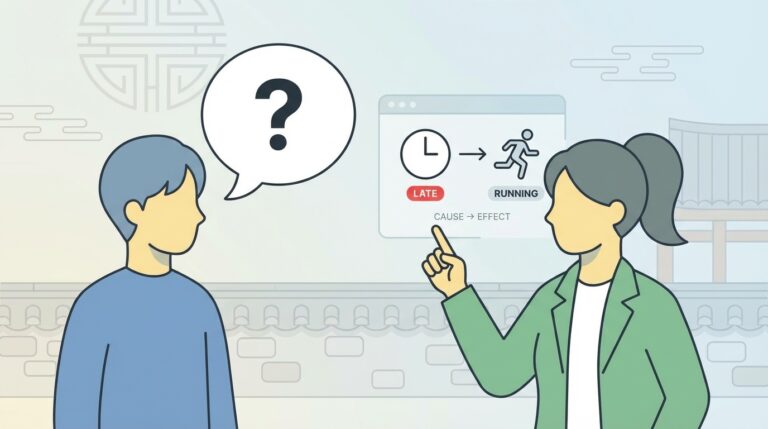
Hello! Welcome back to [Maeil Hangul], your key to unlocking the next level of Korean fluency!
Ever feel like your explanations in Korean are a bit… long? Do you want to connect your ideas more smoothly and sound like a native speaker? You’re in the right place! Today, we’re diving into an advanced grammar topic that is a total game-changer: using participle clauses to explain reasons and causes.
Lately in Korea, if you watch any fast-paced variety show or a live stream with your favorite idol, you’ll notice they explain situations in a flash. The secret isn’t just speaking quickly; it’s using efficient grammar. Mastering this will make your Korean sound incredibly natural and sophisticated.
Let’s get started!
Core Expressions: The ‘Why’ Connectors
Here are three essential grammar forms that all mean ‘because’ or ‘so’, but carry very different nuances.
1. -아/어서 (a/eoseo)
- Korean Expression: 너무 피곤해서 일찍 잤어요.
- Pronunciation [Romanization]: Neomu pigonhaeseo iljjik jasseoyo.
- English Meaning: Because I was so tired, I went to bed early.
- Detailed Explanation: This is your most common, neutral connector for cause-and-effect. The first clause presents a state or action that naturally and logically leads to the result in the second clause. A crucial rule: you cannot use imperative (commands) or propositive (suggestions) sentences after -아/어서. It’s purely for stating a factual sequence.
- 💡 Pronunciation Tip: The choice between -아서 and -어서 depends on the last vowel of the verb/adjective stem. If it’s ‘ㅏ’ (a) or ‘ㅗ’ (o), use -아서 (e.g., 좋다 → 좋아서 [joaseo]). For all other vowels, use -어서 (e.g., 먹다 → 먹어서 [meogeoseo]). For all ‘하다’ verbs, it becomes 해서 (haeseo), like in our example 피곤하다 → 피곤해서 [pigonhaeseo].
2. -(으)니까 (-(eu)nikka)
- Korean Expression: 날씨가 좋으니까 공원에 갈까요?
- Pronunciation [Romanization]: Nalssiga joeunikka gongwone galkkayo?
- English Meaning: Since the weather is nice, shall we go to the park?
- Detailed Explanation: This also means ‘because,’ but it’s often based on the speaker’s personal discovery or judgment. Think of it as, “Now that I realize/see that [Clause 1], let’s do [Clause 2].” This is the key difference: -(으)니까 is the correct form to use when you want to follow up with a command (e.g., -으세요) or a suggestion (e.g., -을까요? or -ㅂ시다).
- 💡 Pronunciation Tip: When the verb stem ends in a consonant, like ‘좋다’ (jota), you use -으니까, and the final consonant of the stem links to the vowel ‘으’. So, ‘좋다’ becomes [joeunikka], not [jot-eunikka]. This linking sound (연음) is essential for a natural flow.
3. -느라(고) (-neura(go))
- Korean Expression: 회의 준비하느라 전화를 못 받았어요.
- Pronunciation [Romanization]: Hoeui junbihaneura jeonhwareul mot badasseoyo.
- English Meaning: I couldn’t answer the phone because I was busy preparing for the meeting.
- Detailed Explanation: This is a special one! It’s used when being occupied with the action in the first clause results in a negative consequence or an inability to do something else (the second clause). It implies you were investing time and effort. The subject of both clauses must be the same, and the verb in the first clause must be an action verb. The ‘고’ is often dropped in casual speech.
- 💡 Pronunciation Tip: The pronunciation is quite straightforward: [haneura]. Just remember that even though it’s written with four syllables (하-느-라-고), in its common spoken form (하느라), it’s three smooth syllables. Focus on saying it as one fluid phrase.
Example Dialogue
Let’s see how these are used in a real conversation about a popular drama.
- A: 지수 씨, 어제 새로 시작한 드라마 ‘서울의 밤’ 봤어요? 주인공 연기가 정말 인상 깊던데요.
(Jisoo, did you watch the new drama ‘Seoul Nights’ that started yesterday? The main actor’s performance was really impressive.) - B: 아니요, 어제는 급한 보고서 마무리하느라 못 봤어요. 너무 피곤해서 집에 가자마자 바로 잠들었거든요.
(No, I couldn’t watch it because I was busy finishing an urgent report. Because I was so tired, I fell asleep as soon as I got home.) - A: 아, 정말요? 오늘 재방송하니까 꼭 보세요. 정말 재미있어서 후회 안 하실 거예요.
(Oh, really? They’re re-airing it today, so you should definitely watch it. You won’t regret it because it’s so fun.)
Culture Tip & Trend Deep Dive
In Korea’s fast-paced ‘ppalli-ppalli’ (빨리빨리, hurry-hurry) culture, concise communication is key. This is why these grammatical forms are so prevalent. On variety shows, you’ll hear hosts say, “시간이 없으니까 바로 다음 코너로 넘어가겠습니다!” (Since we’re out of time, we’ll move right on to the next segment!). When an idol apologizes for being late to a live stream, they might say, “교통체증 때문에 차가 막혀서 늦었어요.” (I was late because the traffic was bad due to congestion). Notice the logical reason uses -아서/어서. Using the right connector for the right context is a hallmark of an advanced speaker.
Let’s Review & Practice!
To sum up:
* -아/어서: General, logical reason → Factual result.
* -(으)니까: Speaker’s judgment/discovery → Command or suggestion.
* -느라(고): Busy with an action → Negative consequence.
Now, test yourself!
1. Fill in the blank with the most appropriate form:
이 책이 재미있___ 친구에게 추천했어요. (재미있다)
2. Choose the correct option:
어제 친구와 이야기 (하느라 / 해서) 시간 가는 줄 몰랐어요.
Think you know the answers? Try making your own sentences using today’s grammar and share them in the comments below. We’d love to see your progress! Happy learning!
Frequently Asked Questions (FAQ)
Q: What does "-아/어서 (a/eoseo)" mean in Korean and how do you pronounce it?
A: In Korean, "-아/어서 (a/eoseo)" is pronounced [Romanization] and means: Because I was so tired, I went to bed early.
Q: What does "-(으)니까 (-(eu)nikka)" mean in Korean and how do you pronounce it?
A: In Korean, "-(으)니까 (-(eu)nikka)" is pronounced [Romanization] and means: Since the weather is nice, shall we go to the park?
Q: What does "-느라(고) (-neura(go))" mean in Korean and how do you pronounce it?
A: In Korean, "-느라(고) (-neura(go))" is pronounced [Romanization] and means: I couldn't answer the phone because I was busy preparing for the meeting.







