

Hello! This is Maeil Hangul, here to upgrade your Korean skills!
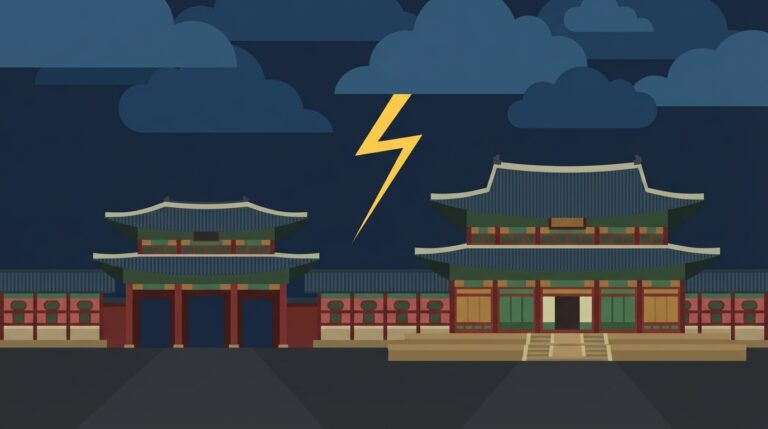
Have you ever been watching a K-drama and a dramatic storm rolls in, perfectly matching the characters’ intense emotions? Or maybe you’ve looked out the window in Seoul during the summer and seen the sky turn dark in minutes. Today, we’re going to learn how to describe a stormy sky in Korean, so you can sound just like a native speaker!
Lately in Korea, the summer monsoon season (장마, jangma) has been bringing some truly spectacular and intense weather. Knowing these phrases will not only help you describe what you see, but also understand daily weather forecasts and, of course, all that K-drama drama!
Core Expressions
Here are some essential phrases to describe a stormy sky.
1. 먹구름이 끼다 (meokgureumi kkida)
* Pronunciation [Romanized]: meok-kku-reu-mi kki-da
* English Meaning: Dark clouds are gathering.
* Detailed Explanation: This is a very common and descriptive phrase. ‘먹구름’ literally means ‘ink clouds,’ painting a picture of dark, ink-stained clouds filling the sky. ‘끼다’ means to be stuck in or to gather. You use this right before a storm begins.
* 💡 Pronunciation Tip: The ‘ㄲ’ in ‘끼다’ is a tensed sound. It’s stronger and tighter than the regular ‘ㄱ’ (g). To make this sound, press the back of your tongue against your soft palate firmly and release the air without a strong puff, like the ‘k’ in the English word ‘sky’.
2. 천둥(이) 치다 (cheondung(i) chida)
* Pronunciation [Romanized]: cheon-dung-(i) chi-da
* English Meaning: To thunder / Thunder strikes.
* Detailed Explanation: ‘천둥’ means thunder, and ‘치다’ means to hit or strike. So, you’re literally saying ‘thunder strikes.’ The ‘이’ is a subject particle that is often omitted in casual conversation.
* 💡 Pronunciation Tip: The ‘ㅊ’ (ch) in ‘치다’ is an aspirated sound. You should feel a strong puff of air escape your mouth when you say it. It’s much stronger than the ‘ㅈ’ (j) sound. Think of the ‘ch’ in ‘chart’!
3. 번개가 치다 (beongaega chida)
* Pronunciation [Romanized]: beon-gae-ga chi-da
* English Meaning: Lightning strikes.
* Detailed Explanation: Just like with thunder, ‘번개’ means lightning and ‘치다’ means to strike. These two phrases, ‘천둥 치다’ and ‘번개 치다’, are almost always used together to describe a thunderstorm.
* 💡 Pronunciation Tip: Notice the ‘ㅐ’ (ae) and ‘ㅔ’ (e) vowels. While they historically had different sounds, in modern standard Seoul Korean, their pronunciation is nearly identical. So, don’t stress too much about distinguishing them!
4. 폭풍우가 몰아치다 (pokpung-uga morachida)
* Pronunciation [Romanized]: pok-pung-u-ga mo-ra-chi-da
* English Meaning: A storm is raging / A rainstorm is sweeping in.
* Detailed Explanation: This is a powerful and dramatic expression. ‘폭풍우’ (pokpung-u) means ‘storm with heavy rain’ (typhoon). ‘몰아치다’ is a strong verb meaning to surge or sweep in fiercely. You’d use this for a very intense storm, not just a light shower.
* 💡 Pronunciation Tip: Listen to how the sounds link together in ‘몰아치다’ [morachida]. The final consonant of ‘몰’ (ㄹ, l/r) doesn’t just stop. It smoothly connects to the next vowel ‘아’ (a), creating a fluid [mora] sound. This is called ‘연음’ (yeon-eum) or ‘liaison’ and is key to sounding natural.
Example Dialogue
A: 와, 하늘 좀 봐. 먹구름이 잔뜩 꼈어.
(Wa, haneul jom bwa. Meokgureumi jantteuk kkyeosseo.)
(Wow, look at the sky. The dark clouds have really gathered.)
B: 그러게. 곧 천둥이랑 번개도 칠 것 같아.
(Geureoge. Got cheondung-irang beongaedo chil geot gata.)
(I know. It looks like it’s going to thunder and lightning soon.)
A: 오늘 등산은 못 가겠다. 폭풍우가 몰아칠 것 같아.
(Oneul deungsaneun mot gagetda. Pokpung-uga morachil geot gata.)
(We can’t go hiking today. It feels like a storm is going to rage.)
B: 맞아. 그냥 집에서 드라마나 보자.
(Maja. Geunyang jibeseo deuramana boja.)
(You’re right. Let’s just stay home and watch a drama.)
Culture Tip & Trend Deep Dive
In Korea, the summer monsoon season, called ‘장마’ (jangma), is a major part of the year. This is when you’ll hear these expressions constantly! But beyond the weather forecast, this vocabulary is deeply embedded in Korean culture, especially in media.
In K-dramas, a sudden storm (폭풍우) is almost never just a storm. It’s a classic trope used to symbolize emotional turmoil, a dramatic plot twist, or a fateful encounter between the main characters. The next time you see a character crying in the pouring rain, listen for these phrases! You’ll often hear them say things like, “내 마음에도 폭풍우가 몰아쳐” (A storm is raging in my heart, too) to express their inner feelings.
Let’s Practice!
Time to check your understanding! Fill in the blanks with the correct word from today’s lesson.
- When you see a bright flash in the sky, you can say: “앗! ______가 쳐요!” (Ah! Lightning is striking!)
- When the sky is full of dark, heavy clouds, you can say: “______이/가 꼈어요.”
Great job today! You’re now ready to describe a stormy day like a pro. Try making your own sentence using one of today’s expressions in the comments below!
Frequently Asked Questions (FAQ)
Q: What does "'장마'" mean in Korean and how do you pronounce it?
A: In Korean, "'장마'" is pronounced [jangma] and means: , is a major part of the year. This is when you'll hear these expressions constantly! But beyond the weather forecast, this vocabulary is deeply embedded in Korean culture, especially in media.







