

Agree to Disagree: Navigating Political Discourse in Korea
Hello! Welcome back to [Maeil Hangul], here to upgrade your Korean proficiency!
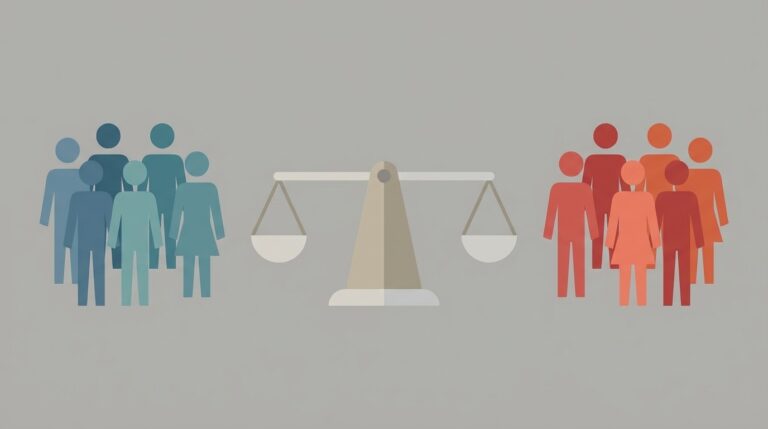
As you advance to a C2 level, you’re moving beyond everyday conversation and into the complex, nuanced discussions that shape a society. Today, we’re tackling a challenging but essential topic: political discourse. In Korea, like in many parts of the world, political polarization (양극화) is a significant and widely discussed trend. Understanding the language used to navigate these conversations is crucial for comprehending news, participating in high-level debates, and truly grasping the pulse of modern Korean society. Let’s dive in!
Key Expressions for Advanced Discourse
Here are some essential terms and grammar points you’ll need.
1. 양극화 (Yanggeukhwa)
- Pronunciation [Romanization]: Yang-geuk-hwa
- English Meaning: Polarization
- Detailed Explanation: This is a core concept in modern Korean social and political commentary. Derived from Hanja (兩極化), it literally means ‘two-poles-ization’. It describes the widening gap between two opposing sides, whether in politics (e.g., progressives vs. conservatives), economics (the rich vs. the poor), or public opinion. You will hear this word constantly in news reports, academic papers, and serious discussions.
- 💡 Pronunciation Tip: The syllable ‘극’ (geuk) can be tricky. It’s not a hard ‘g’ sound like in ‘go’. Think of it as an unaspirated ‘k’ sound, produced at the back of your throat without a strong puff of air. Practice saying ‘yang-geuk-hwa’ with clear, distinct syllables.
2. 입장 차이 (Ipjang chai)
- Pronunciation [Romanization]: Ip-jjang cha-i
- English Meaning: A difference in stance/opinion
- Detailed Explanation: This is a sophisticated and neutral way to state a disagreement. ‘입장’ (立場) means ‘stance’ or ‘position’, and ‘차이’ (差異) means ‘difference’. Instead of saying someone is wrong (틀렸어요), acknowledging an ‘입장 차이’ shows that you understand they simply have a different perspective. It’s a key phrase for respectful debate.
- 💡 Pronunciation Tip: Notice the pronunciation is [입짱 차이 | ipjjang chai], not ‘ip-jang’. This is due to a consonant tensing rule. When a plain consonant like ‘ㅈ’ (j) follows a stop consonant batchim like ‘ㅂ’ (p), it becomes a tensed consonant, ‘ㅉ’ (jj). This makes your pronunciation sound much more natural.
3. -(으)ㄴ/는 반면에 (-(eu)n/neun banmyeone)
- Pronunciation [Romanization]: -neun ban-myeo-ne
- English Meaning: On the other hand; Whereas; While
- Detailed Explanation: This is an essential grammar pattern for presenting a balanced argument. You attach it to a verb or adjective stem to contrast two facts or ideas. It’s the equivalent of saying “While A is true, B is also true.” Using this structure demonstrates your ability to see an issue from multiple angles.
- Example: 그 정책은 경제 성장에 도움이 되는 반면에, 환경 문제를 야기할 수 있다. (While that policy is helpful for economic growth, on the other hand, it could cause environmental problems.)
- 💡 Pronunciation Tip: The key here is smooth linkage. Don’t pause between the verb and ‘반면에’. Let the phrase flow naturally as a single unit. For example, ‘도움이 되는반면에’ should sound like one connected thought.
4. 중도적 관점 (Jungdojeok gwanjeom)
- Pronunciation [Romanization]: Jung-do-jeok gwan-jeom
- English Meaning: A centrist/moderate point of view
- Detailed Explanation: ‘중도’ (中道) means ‘the middle way’ or ‘centrism’, ‘-적’ is a suffix that turns a noun into an adjective-like word, and ‘관점’ (觀點) is ‘viewpoint’. This phrase is used to describe a neutral or moderate stance that avoids leaning too far to either extreme of the political spectrum.
- 💡 Pronunciation Tip: Pay attention to the vowels. The ‘ㅜ’ (u) in ‘중’ is a rounded vowel like the ‘oo’ in ‘moon’. The ‘ㅓ’ (eo) in ‘적’ and ‘점’ is an unrounded vowel, similar to the ‘u’ in ‘uh-oh’. Differentiating these sounds is key to clear pronunciation.
Example Dialogue
Let’s see these expressions in action.
- A: 요즘 뉴스 봤어? 새로운 부동산 정책 때문에 또 양극화가 심해지는 것 같아.
(Have you seen the news lately? It seems the new real estate policy is worsening the polarization.) - B: 맞아. 정부를 지지하는 쪽은 시장 안정에 꼭 필요하다고 주장하는 반면에, 반대하는 쪽은 개인의 재산권을 침해한다고 하잖아.
(Right. Whereas the side supporting the government argues it’s necessary for market stability, the opposition says it infringes on private property rights.) - A: 이렇게 서로 입장 차이가 명확하니 합의점을 찾기가 어렵겠다.
(With such a clear difference in stance, it will be difficult to find a point of agreement.) - B: 그래서 중도적 관점에서 양쪽의 의견을 모두 고려하는 해결책이 필요한 것 같아.
(That’s why I think a solution that considers both sides from a centrist point of view is needed.)
Culture Tip & Trend Analysis
In Korea, political discourse is not just for politicians. It’s a vibrant, and sometimes heated, part of daily life, especially online. The concept of 양극화 is frequently discussed in relation to generational divides, regionalism, and of course, political affiliation. On online forums and social media, you’ll see this divide play out in real-time. As an advanced learner, understanding these terms allows you to read the room and grasp the underlying tensions in public opinion. A pro tip: before jumping into a political debate, it’s often wise to observe the nuances of the conversation first (a practice Koreans call ‘눈팅’ – ‘eye-ting’, or lurking).
Wrap-up & Practice
Today, we learned four crucial expressions—양극화, 입장 차이, -는 반면에, and 중도적 관점—to help you engage in high-level political and social discourse in Korean. Mastering these will elevate your Korean to a truly advanced level.
Quick Quiz:
Fill in the blank with the most appropriate expression from today’s lesson.
그 법안은 장점이 많은 __________, 심각한 단점도 존재한다.
(The bill has many advantages, __________, serious disadvantages also exist.)
Ready to test your skills? Try answering the quiz or creating your own sentence using one of today’s expressions in the comments below!
Frequently Asked Questions (FAQ)
Q: What does "양극화 (Yanggeukhwa)" mean in Korean and how do you pronounce it?
A: In Korean, "양극화 (Yanggeukhwa)" is pronounced [Romanization] and means: Polarization
Q: What does "입장 차이 (Ipjang chai)" mean in Korean and how do you pronounce it?
A: In Korean, "입장 차이 (Ipjang chai)" is pronounced [Romanization] and means: A difference in stance/opinion
Q: What does "-(으)ㄴ/는 반면에 (-(eu)n/neun banmyeone)" mean in Korean and how do you pronounce it?
A: In Korean, "-(으)ㄴ/는 반면에 (-(eu)n/neun banmyeone)" is pronounced [Romanization] and means: On the other hand; Whereas; While
Q: What does "중도적 관점 (Jungdojeok gwanjeom)" mean in Korean and how do you pronounce it?
A: In Korean, "중도적 관점 (Jungdojeok gwanjeom)" is pronounced [Romanization] and means: A centrist/moderate point of view






