

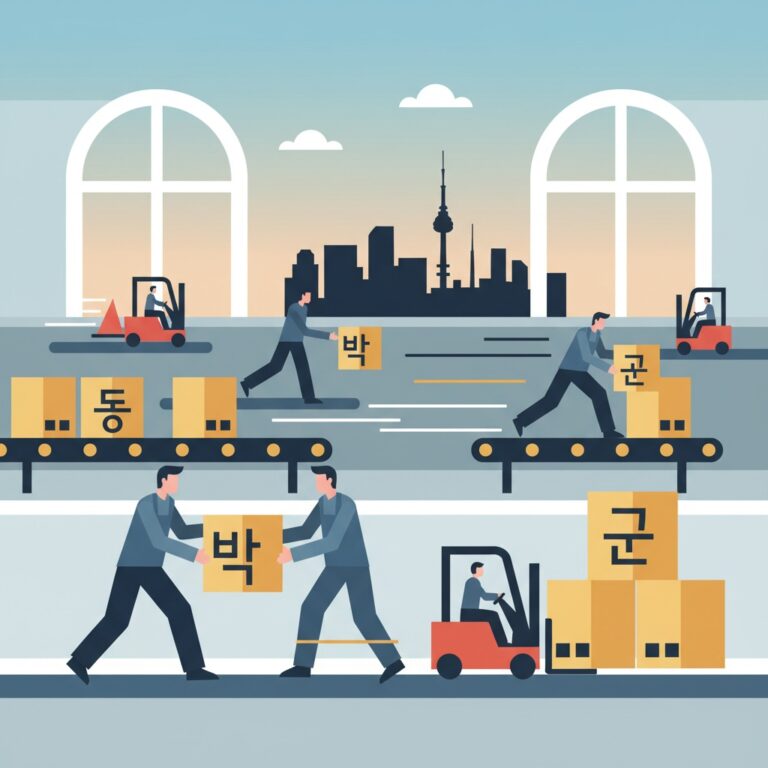
Unlock K-Trade Secrets: Master Korean Warehouse Terms!
Hello! Welcome to [Maelel Hangeul], your go-to blog for upgrading your Korean skills!
Today, we’re stepping into the fast-paced world of Korean logistics. Ever wondered how your favorite K-pop album or skincare product gets from a warehouse in Korea to your doorstep? We’ll learn the essential Korean vocabulary to describe warehouse procedures for imported goods. This is super useful if you’re working in trade, logistics, or e-commerce with a Korean company.
Lately in Korea, with the explosive growth of global e-commerce and the high demand for K-products, the logistics industry is booming! Understanding this vocabulary will not only boost your business Korean but also give you a peek into the “palli-palli” (fast-fast) culture that makes Korea’s delivery system one of the best in the world. Let’s get started!
Core Expressions You Need to Know
Here are the key terms that will make you sound like a pro in any Korean warehouse or logistics meeting.
1. 입고 (Ipgo)
- Pronunciation [Romanization]: [Ipgo]
- English Meaning: Goods receipt; arrival of goods into the warehouse.
- Detailed Explanation: This is a crucial business term derived from Hanja (Sino-Korean characters): 입 (入) meaning ‘to enter’ and 고 (庫) meaning ‘warehouse’. So, it literally means “entering the warehouse.” It’s used formally to describe the process of receiving a new shipment. You’ll see and hear this word constantly in logistics documents and conversations.
- 💡 Pronunciation Tip:
The ‘ㅂ’ (b/p) sound in ‘입’ is what we call an “unreleased stop.” This means you close your lips to make the ‘p’ sound, but you don’t release a puff of air. It’s a very short, clipped sound. So, instead of “i-peu-go,” think of it as [ip-go], where the ‘p’ sound is cut off right before you say ‘go’.
2. 검수하다 (Geomsuhada)
- Pronunciation [Romanization]: [Geomsuhada]
- English Meaning: To inspect goods.
- Detailed Explanation: This isn’t just a simple check. 검수하다 refers to the official inspection process when goods arrive. This includes checking if the quantity is correct, looking for any damage, and ensuring the quality matches the order. It’s a more formal and thorough term than the general word for checking, 확인하다 (hwaginhada).
- 💡 Pronunciation Tip:
This word is pronounced just as it’s written! Break it down into syllables to practice: [geom-su-ha-da]. The key is to give each syllable equal stress, a common feature of the Korean language.
3. 재고 관리 (Jaego gwalli)
- Pronunciation [Romanization]: [Jaego gwalli]
- English Meaning: Inventory management; stock control.
- Detailed Explanation: Let’s break this one down. 재고 (在庫) means ‘inventory’ or ‘stock’, and 관리 (管理) means ‘management’. Together, they form the essential business concept of managing what’s in the warehouse. Good 재고 관리 is key to any successful business!
- 💡 Pronunciation Tip:
The tricky part here can be the ‘gw’ sound in 관리 [gwalli]. The letter ‘ㄱ’ (g) is followed by the vowel ‘ㅘ’ (wa). To make this sound, start by saying ‘g’ and immediately transition into a ‘wa’ sound, like in the word “Guatemala.” Practice saying [gwan], then add [li]. Put it together: [gwalli].
4. 출고되다 (Chulgodoe-da)
- Pronunciation [Romanization]: [Chulgodoe-da]
- English Meaning: To be shipped out; to be dispatched (from a warehouse).
- Detailed Explanation: This is the opposite of 입고. It comes from 출 (出) meaning ‘to exit’ and 고 (庫) meaning ‘warehouse’. The grammar particle -되다 (-doe-da) makes it passive, meaning the goods are shipped out (by someone). The active form is 출고하다 (chulgohada), which means “to ship goods out.”
- 💡 Pronunciation Tip:
The first letter, ‘ㅊ’ (ch), is an aspirated consonant. This means you need to release a strong puff of air when you say it. Hold your hand in front of your mouth—you should feel the air when you say [chul]. It’s the ‘ch’ sound in “chart,” not the ‘j’ in “jar.”
Example Dialogue
Let’s see how these words are used in a real conversation between two warehouse managers, Park and Kim, who are handling a shipment of a new, popular K-pop group’s merchandise.
A (Manager Park): 팀장님, 방금 아이돌 굿즈가 입고되었습니다.
[Timjangnim, banggeum aidol gutjeu-ga ipgodoeeot-seumnida.]
(Manager, the idol merchandise has just been received into the warehouse.)
B (Manager Kim): 좋습니다. 바로 검수하고 보고해주세요. 인기가 많은 제품이라 재고 관리를 잘해야 합니다.
[Joseumnida. Baro geomsuhago bogohaejuseyo. Ingi-ga maneun jepum-ira jaego gwalli-reul jalhaeya hamnida.]
(Great. Please inspect it immediately and report back. They are very popular items, so we need to do the inventory management carefully.)
A (Manager Park): 알겠습니다. 이 상품들은 언제 온라인 스토어로 출고될 예정인가요?
[Algesseumnida. I sangpum-deureun eonje ollain seuto-eo-ro chulgodoel yejeong-ingayo?]
(Understood. When are these products scheduled to be shipped out to the online store?)
B (Manager Kim): 내일 오전까지는 출고되어야 합니다. 팬들이 기다리고 있어요!
[Naeil ojeon-kkajineun chulgodoe-eoya hamnida. Paen-deuri gidarigo isseoyo!]
(They must be dispatched by tomorrow morning. The fans are waiting!)
Culture Tip & Trend Deep Dive
Have you ever heard of Korea’s “빨리빨리 (palli-palli)” culture? It means “quickly, quickly!” and it’s the driving force behind the country’s incredible efficiency. This mindset is the secret weapon of the Korean logistics industry.
Companies like Coupang have built entire empires on this principle with their “Rocket Delivery” (로켓배송), which often guarantees next-day or even same-day delivery. For this to work, the warehouse procedures we learned today—입고, 검수, 재고 관리, 출고—must happen with lightning speed and perfect accuracy. So, when you use these words, you’re not just speaking business Korean; you’re tapping into a core cultural value that shapes modern Korean society and its global business success!
Let’s Review & Practice!
Great job today! You’ve learned four essential Korean words for talking about warehouse and logistics procedures.
Now, let’s see what you’ve remembered with a quick quiz!
- Fill in the blanks:
When a new shipment arrives, the first step is _______________. After that, you must _______________ the items for any damage.
(A) 출고되다, 입고
(B) 입고, 검수하다 -
Make a sentence:
Using the phrase 재고 관리 (inventory management), try to make a short English or Korean sentence explaining why it’s important for an online store.
Leave your answers in the comments below! We’d love to see you practice using today’s expressions. Keep up the fantastic work
Frequently Asked Questions (FAQ)
Q: What does "입" mean in Korean and how do you pronounce it?
A: In Korean, "입" is pronounced [入] and means: meaning 'to enter' and
Q: What does "고" mean in Korean and how do you pronounce it?
A: In Korean, "고" is pronounced [庫] and means: meaning 'warehouse'. So, it literally means "entering the warehouse." It's used formally to describe the process of receiving a new shipment. You'll see and hear this word constantly in logistics documents and conversations.
Q: What does "재고" mean in Korean and how do you pronounce it?
A: In Korean, "재고" is pronounced [在庫] and means: means 'inventory' or 'stock', and
Q: What does "관리" mean in Korean and how do you pronounce it?
A: In Korean, "관리" is pronounced [管理] and means: means 'management'. Together, they form the essential business concept of managing what's in the warehouse. Good







