

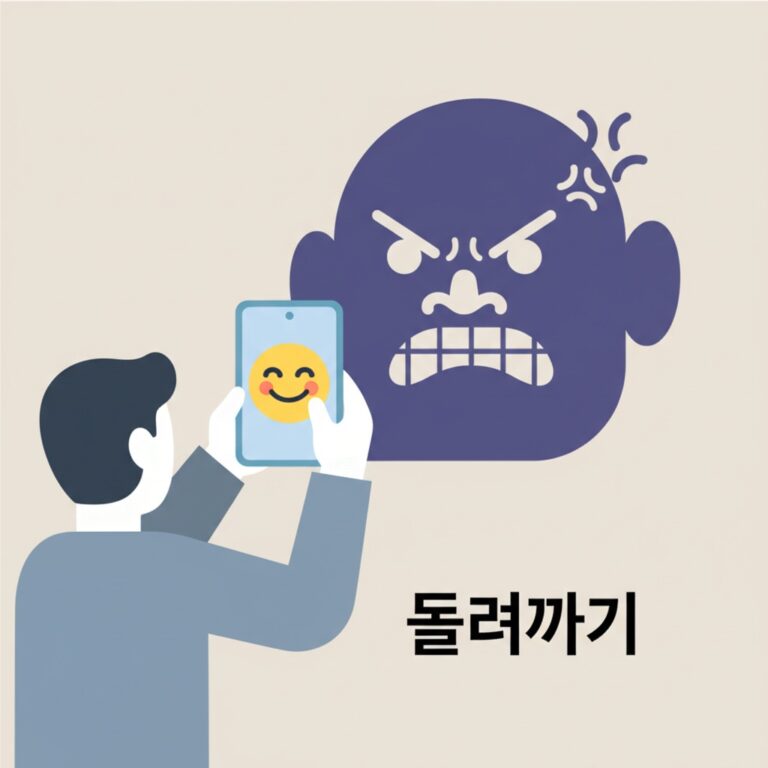
Decode Korean Sarcasm: The Art of ‘돌려까기’ Online!
Hello! It’s your favorite Korean language guide, [Maeil Hangeul], here to level up your skills!
Today, we’re diving into a very advanced but crucial topic for anyone who wants to truly understand modern Korean culture: the art of satire and sarcasm in online discourse. This is the key to unlocking the real meaning behind YouTube comments, webtoon dialogues, and social media posts.
Lately in Korea, short-form comedy sketches on platforms like YouTube Shorts and TikTok are exploding in popularity. Many of them are full of subtle jokes and critiques of society. But if you take them literally, you might miss the entire point! To truly understand this witty, sharp humor, you need to master the art of reading between the lines. Let’s get started!
Core Expressions for Understanding Satire
Here are three essential terms that will make you a master of Korean internet humor.
1. 돌려까기 (dol-lyeo-kka-gi)
- Pronunciation [Romanization]: Dol-lyeo-kka-gi
- English Meaning: Indirect criticism; to roast or critique in a roundabout way.
- Detailed Explanation: This is a compound word combining 돌리다 (dollida – to turn, to spin) and 까다 (kkada – to peel, but in slang, to criticize or diss someone). So, it literally means “to criticize by spinning it around.” It’s a sophisticated and very common way to express dissent or make a point without being confrontational. This is the foundational concept of much of Korean satire.
- 💡 Pronunciation Tip:
The key here is the ‘ㄲ’ (kk) sound. This is a tense consonant (경음/된소리). Unlike the regular ‘ㄱ’ (g/k), you should make the sound at the back of your throat with a burst of air, but without aspiration. It’s tight and sharp. Think of the difference between 가다 (gada – to go) and 까다 (kkada – to peel/criticize). Mastering this will make your Korean sound much more native.
2. 반어법 (ban-eo-beop)
- Pronunciation [Romanization]: Ban-eo-beop
- English Meaning: Irony; the technique of using ironic or sarcastic language.
- Detailed Explanation: This is the more formal, literary term for irony. 반 (反) means ‘anti-‘ or ‘opposite,’ and 어법 (語法) means ‘way of speaking’ or ‘diction.’ So, it’s the “opposite way of speaking.” When someone makes a huge mistake and their friend says, “와, 참 잘했다!” (Wow, you did so well!), that is a perfect example of 반어법. Online, you’ll see this used constantly in comment sections to sarcastically praise something that is obviously bad.
- 💡 Pronunciation Tip:
Pay attention to the vowel ‘ㅓ’ (eo). For many English speakers, this can be tricky. It is an open-mid back unrounded vowel, similar to the ‘o’ sound in the English word ‘ought’ (in some accents). It’s crucial not to confuse it with ‘ㅗ’ (o). Practice with minimal pairs: 벌 (beol – punishment) vs. 볼 (bol – cheek).
3. 킹받네 (king-bad-ne)
- Pronunciation [Romanization]: King-bad-ne
- English Meaning: “I’m king-annoyed”; “This is ridiculously frustrating/annoying.”
- Detailed Explanation: This is a very trendy piece of slang (신조어) you’ll hear from the MZ generation. It’s a creative mix of the English word “King” (used as an intensifier for anything) and the Korean phrase 열받네 (yeol-bad-ne – I’m getting pissed off/annoyed). While it expresses annoyance, it’s often used in a humorous, exaggerated, or even satirical way to point out a frustrating but funny situation.
- 💡 Pronunciation Tip:
This word demonstrates a key Korean phonetic rule: nasalization (비음화). The final consonant in 받 (bat) is ‘ㄷ’ (t-sound). When it’s followed by a nasal consonant like ‘ㄴ’ (n) from 네 (ne), the ‘ㄷ’ sound assimilates and becomes an ‘ㄴ’ sound. Therefore, you don’t pronounce it “king-bat-ne,” but rather [king-ban-ne]. This rule applies everywhere, like in 믿는 (mit-neun) -> [민는/min-neun].
Example Dialogue
Here’s how these expressions might appear in a real conversation between two friends watching a satirical YouTube sketch about Korean corporate culture.
- A: “Did you see that new ‘MZ Office’ video? The manager says, ‘We don’t force anyone to attend the company dinner,’ right after saying attendance will affect their performance review.”
(“새로 나온 ‘MZ 오피스’ 영상 봤어? 부장님이 회식은 강요 아니라고 하면서, 참석 여부가 인사고과에 반영될 거라고 하잖아.”) - B: “Haha, a classic example of 돌려까기. The comments section is hilarious. Everyone is writing, ‘Wow, such a democratic company!’ That’s pure 반어법.”
(“ㅋㅋ, 전형적인 돌려까기네. 댓글 창이 진짜 웃겨. 다들 ‘와, 정말 민주적인 회사네요!’ 이러고 있더라. 완전 반어법이지.”) - A: “Exactly. It’s so ridiculously out of touch. Seriously, 킹받네.”
(“그러니까. 너무 비현실적이라 어이가 없다. 아, 진짜 킹받네.”)
Culture Tip & Trend Analysis
So, why is indirect communication like 돌려까기 so prevalent in Korea? It’s deeply connected to the cultural concepts of 눈치 (nunchi)—the ability to read the room and understand social cues—and maintaining social harmony. Direct confrontation is often avoided, so satire becomes a powerful and socially acceptable tool for criticism and social commentary.
For Korea’s MZ generation, this has evolved into a unique form of online humor. Using slang like 킹받네 and mastering 반어법 in comments is a way to build community. It’s an inside joke; if you understand the underlying satirical meaning, you’re part of the in-group. When you see a K-pop idol do something slightly clumsy and fans comment “우리 오빠 천재다” (Our Oppa is a genius), they’re not delusional—they’re affectionately using irony. Understanding this nuance is the final step to digital fluency in Korean!
Wrap-up & Practice!
Today, we’ve unlocked the complex but fascinating world of Korean online satire with 돌려까기, 반어법, and the trendy slang 킹받네. Recognizing these will transform how you experience Korean digital content!
Now, let’s test your skills:
- A YouTuber posts a video with a very clickbait-y title, but the content is completely different. A user comments: “The title and content are so perfectly aligned. Thank you for the great information.” This comment is a clear example of ___________.
-
Imagine you’re watching a mukbang streamer who accidentally spills sauce all over their new white shirt. In a joking, friendly way, what new slang word could you use to express the humorous frustration of the situation?
Have you ever encountered Korean satire online that you didn’t understand at first? Share your experience in the comments using one of the expressions we learned today! We’d love to hear from you
Frequently Asked Questions (FAQ)
Q: What does "까다" mean in Korean and how do you pronounce it?
A: In Korean, "까다" is pronounced [kkada - to peel, but in slang, to criticize or diss someone] and means: . So, it literally means "to criticize by spinning it around." It’s a sophisticated and very common way to express dissent or make a point without being confrontational. This is the foundational concept of much of Korean satire.
Q: What does "까다" mean in Korean and how do you pronounce it?
A: In Korean, "까다" is pronounced [kkada - to peel/criticize] and means: . Mastering this will make your Korean sound much more native.
Q: What does "반" mean in Korean and how do you pronounce it?
A: In Korean, "반" is pronounced [反] and means: means 'anti-' or 'opposite,' and
Q: What does "어법" mean in Korean and how do you pronounce it?
A: In Korean, "어법" is pronounced [語法] and means: means 'way of speaking' or 'diction.' So, it's the "opposite way of speaking." When someone makes a huge mistake and their friend says, "와, 참 잘했다!" (Wow, you did






