

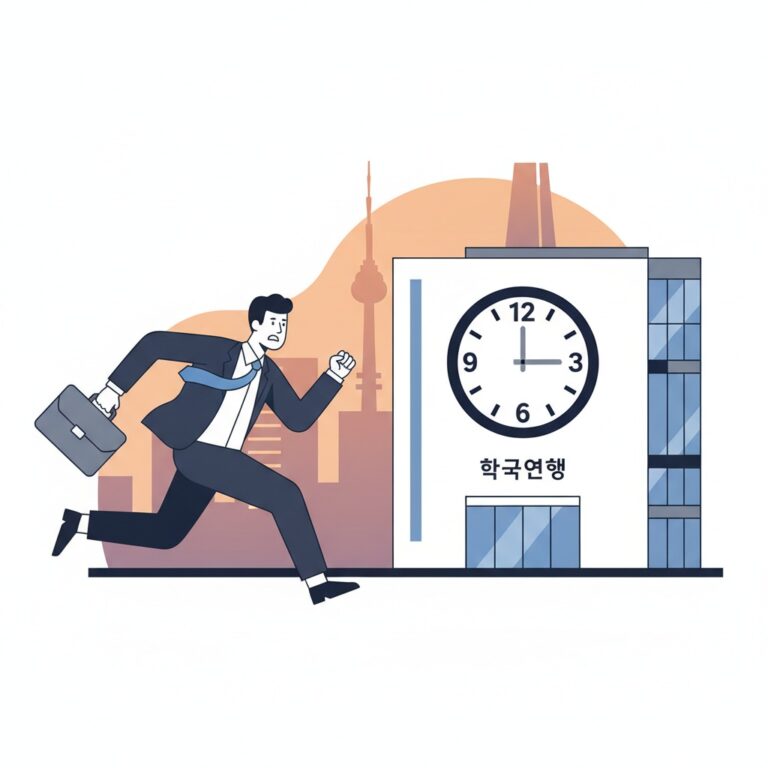
Beat the Clock! Master Korean Bank Hours Like a K-Drama Star
Hello! It’s your favorite Korean teacher from [Daily Hangul] here to upgrade your Korean skills!
Ever needed to run an errand in Korea, only to find the store closed? It happens to the best of us! Today, we’re going to tackle a super practical skill: asking about business hours, specifically for banks. You know, in Korea these days, there’s a lot of buzz online about how early banks close! Even in the latest hit K-drama, the main character had a dramatic race against time to get to the bank before it shut. Let’s learn the essential phrases so you can handle your banking like a pro and avoid any K-drama-level panic!
Core Expressions You Need to Know
Here are the key phrases to ask about when and until what time a place is open.
1. 몇 시? (Myeot si?)
- Pronunciation [Myeot ssi?]
- English Meaning: What time?
- Detailed Explanation: This is the most fundamental way to ask for the time. “몇 (myeot)” means “how many” or “what” when used with counters, and “시 (si)” is the counter for “hour” or “o’clock.” You can use this phrase on its own or as part of a longer sentence.
- 💡 Pronunciation Tip:
Even though it’s written as ‘Myeot si’, the final ‘ㅌ(t)’ sound of ‘몇’ and the ‘ㅅ(s)’ of ‘시’ blend together to create a stronger, tensed sound, like [Myeot-ssi]. Making that ‘ssi’ sound a bit stronger will make you sound much more natural!
2. 문을 열어요 (Muneul yeoreoyo)
- Pronunciation [Mu-neul yeo-reo-yo]
- English Meaning: It opens / to open the door.
- Detailed Explanation: Literally, this means “to open the door.” “문 (mun)” is “door,” and “열어요 (yeoreoyo)” is the present tense form of the verb “to open.” It’s the standard, polite way to say a store or business is opening.
- 💡 Pronunciation Tip:
Notice how the ‘ㄴ(n)’ sound at the bottom of ‘문’ smoothly connects to the next syllable ‘을’? This is a super common Korean pronunciation rule called liaison (연음 – yeoneum). Instead of a choppy “Mun. Eul,” it flows together like [Mu-neul].
3. 문을 닫아요 (Muneul dadayo)
- Pronunciation [Mu-neul da-da-yo]
- English Meaning: It closes / to close the door.
- Detailed Explanation: This is the opposite of the expression above! “닫아요 (dadayo)” is the present tense form of the verb “to close.” It’s the perfect phrase to ask when a bank, shop, or restaurant is closing for the day.
- 💡 Pronunciation Tip:
Here’s another great example of liaison! The ‘ㄷ(d)’ sound at the bottom of the syllable ‘닫’ doesn’t stay silent. It “jumps over” to the empty placeholder ‘ㅇ’ in the next syllable ‘아’. So, instead of “dat-a-yo,” it becomes [da-da-yo]. It’s like the consonant is looking for a new home!
4. ~까지 (~kkaji)
- Pronunciation [~kka-ji]
- English Meaning: Until / to / by
- Detailed Explanation: This is a particle you attach directly to a noun (like a time or a place) to mean “until” or “to.” For example, “4시까지 (ne-si-kkaji)” means “until 4 o’clock.” It’s incredibly useful for talking about deadlines and closing times.
- 💡 Pronunciation Tip:
The ‘ㄲ(kk)’ sound is a tensed consonant. It’s different from the regular ‘ㄱ(g/k)’. To make this sound, try to tighten the back of your throat as if you’re holding your breath for a split second before saying “kaji.” It should be a short, sharp sound with no puff of air. Practice saying ‘가(ga)’ and then ‘까(kka)‘ to feel the difference!
Example Dialogue
Let’s see how these phrases work in a real conversation. Imagine Mina is talking to her friend Ji-hun.
A (Mina): I need to go to the bank today.
오늘 은행에 가야 해요. (Oneul eunhaeng-e gaya haeyo.)
B (Ji-hun): Oh! You should hurry. Korean banks close really early!
아! 서둘러요. 한국 은행은 일찍 문을 닫아요! (A! Seodulleoyo. Hanguk eunhaeng-eun iljjik muneul dadayo!)
A (Mina): Really? 몇 시에 문을 닫아요? (Myeot sie muneul dadayo?)
정말요? What time does it close?
B (Ji-hun): Usually at four o’clock. It’s open 4시까지. (B통 4시까지 해요.)
보통 네 시예요. It’s open until 4 o’clock. (Botong ne si-yeyo. Ne si-kkaji haeyo.)
A (Mina): Wow, that’s so early! Thanks for telling me!
와, 정말 빠르네요! 알려줘서 고마워요! (Wa, jeongmal ppareuneyo! Allyeojwoseo gomawoyo!)
Culture Tip & Trend Deep Dive
Ji-hun isn’t kidding! One of the biggest surprises for foreigners in Korea is that most banks close at 3:30 or 4:00 PM on weekdays. This is very different from many Western countries where banks stay open until 5:00 or 6:00 PM.
This is why the recent K-drama scene where the hero frantically sprints to the bank at 3:55 PM became such a relatable and talked-about moment online! The search term “은행 마감 시간” (eunhaeng magam sigan – bank closing time) even started trending. So, here’s a pro-tip for your life in Korea: always plan your bank trips for the morning or right after lunch. If you know how to ask “몇 시까지 해요? (Myeot si-kkaji haeyo? – Until what time are you open?),” you’ll be a true Korea expert and avoid any last-minute drama!
Let’s Review & Practice!
Great job today! You’ve learned how to ask about opening and closing times, which is a vital skill for living in or traveling to Korea.
Now, let’s test your knowledge!
1. Fill in the blank:
A coffee shop opens at 9 AM. How would you say that?
카페는 아침 9시에 문을 _______. (Kape-neun achim ahop-si-e muneul _______.)
(Answer: 열어요)
2. Make a sentence:
You want to ask a librarian, “Until what time are you open?” Using the expressions we learned, how would you ask this?
(Answer: 몇 시까지 해요? / Myeot si-kkaji haeyo?)
Feeling confident? Try using one of today’s expressions to make your own sentence in the comments below! See you next time at [Daily Hangul]
Frequently Asked Questions (FAQ)
Q: What does "까" mean in Korean and how do you pronounce it?
A: In Korean, "까" is pronounced [kka] and means: ' to feel the difference!
Q: What does ""은행 마감 시간"" mean in Korean and how do you pronounce it?
A: In Korean, ""은행 마감 시간"" is pronounced [eunhaeng magam sigan - bank closing time] and means: even started trending. So, here’s a pro-tip for your life in Korea: always plan your bank trips for the morning or right after lunch. If you know how to ask "
Q: What does "몇 시까지 해요?" mean in Korean and how do you pronounce it?
A: In Korean, "몇 시까지 해요?" is pronounced [Myeot si-kkaji haeyo? - Until what time are you open?] and means: ," you'll be a true Korea expert and avoid any last-minute drama!







