

Where Do You Live? Your First Korean Chat!
Hello! This is Daily Hangeul, here to upgrade your Korean skills!
Today, we’re going to learn one of the most fundamental and useful questions you’ll ever need in Korean: “Where do you live?” This is a perfect conversation starter for making new friends, and you’ll be asked this question a lot when you meet people in Korea.
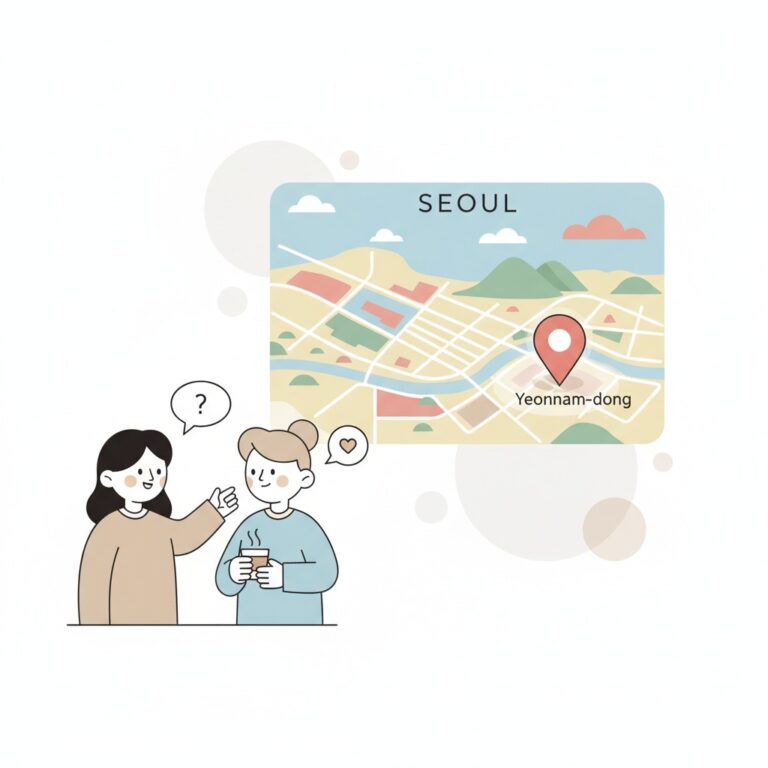
These days in Korea, everyone is obsessed with the hit K-drama “Seoul Love Story,” and people can’t stop talking about the beautiful neighborhood, Yeonnam-dong, where the main characters live. You might hear people asking each other, “Do you live near there?” So today, let’s learn how to have this exact conversation and sound like you’re up-to-date with the latest trends!
Core Expressions You Need to Know
Here are the key phrases to master for today’s mission!
1. 어디에 살아요? (Eodie sarayo?)
- Pronunciation [Romanization]: Eodie sarayo?
- English Meaning: Where do you live?
- Detailed Explanation: This is the standard, polite way to ask someone their place of residence. Let’s break it down:
어디 (eodi)means “where.”에 (e)is a location particle, similar to “in” or “at” in English.살아요 (sarayo)is the polite present tense form of the verb살다 (salda), which means “to live.”
You can use this phrase with anyone you’ve just met, from a new classmate to a friendly shopkeeper.
- 💡 Pronunciation Tip:
The Korean어 (eo)sound can be tricky for English speakers. It’s not ‘o’ or ‘uh’. Try saying “uh” as in “up,” but open your mouth a little wider and don’t round your lips. It’s the sound in어디 (eo-di). Practice making it a relaxed, open sound!
2. 저는 [Place]에 살아요. (Jeoneun [Place]-e sarayo.)
- Pronunciation [Romanization]: Jeoneun [Place]-e sarayo.
- English Meaning: I live in [Place].
- Detailed Explanation: This is your perfect answer!
저는 (jeoneun)is the polite way to say “I” (with a topic marker).[Place]is where you insert your city, neighborhood, or country.에 살아요 (e sarayo)means “live in.”
For example: 저는 서울에 살아요. (Jeoneun Seoul-e sarayo.) -> “I live in Seoul.”
- 💡 Pronunciation Tip:
Liaison, or linking sounds, is key to sounding natural in Korean! When a syllable ending in a consonant is followed by a vowel (like in살아요), the consonant sound often moves over to the next syllable. So, instead of saying살-아-요 (sal-a-yo), it sounds more like [사라요 (sa-ra-yo)]. Theㄹ (l/r)sound slides right into the아 (a)vowel. This makes your speech much smoother!
3. 근처 (geuncheo)
- Pronunciation [Romanization]: geuncheo
- English Meaning: nearby / the vicinity
- Detailed Explanation: This is a super useful word! Instead of giving your exact address, it’s very common in Korea to say you live near a famous landmark, subway station, or university. Just put the landmark before
근처.- Example: 홍대 근처 (Hongdae geuncheo) -> “near Hongdae”
- You can put this right into your main sentence: 저는 홍대 근처에 살아요. (Jeoneun Hongdae geuncheo-e sarayo.) -> “I live near Hongdae.”
- 💡 Pronunciation Tip:
Theㅊ (ch)sound in처 (cheo)is an “aspirated” consonant. This means you should release a stronger puff of air than you would for a ‘j’ sound in English. It’s like the “ch” in “chart.” Hold your hand in front of your mouth when you say [cheo]—you should feel a distinct puff of air!
Example Dialogue
Let’s see how these phrases work in a real conversation between two new friends, A and B.
A: 안녕하세요! 처음 뵙겠습니다. (Annyeonghaseyo! Cheoeum boepgetseumnida.)
Hello! Nice to meet you for the first time.
B: 네, 안녕하세요! (Ne, annyeonghaseyo!)
Yes, hello!
A: 혹시 어디에 살아요? (Hoksi eodie sarayo?)
If you don’t mind me asking, where do you live?
B: 아, 저는 연남동 근처에 살아요. 요즘 드라마 ‘서울 러브스토리’ 때문에 유명해졌어요. (Ah, jeoneun Yeonnam-dong geuncheo-e sarayo. Yojeum deurama ‘Seoul Love Story’ ttaemune yumyeonghaejyeosseoyo.)
Ah, I live near Yeonnam-dong. It’s gotten famous recently because of the drama ‘Seoul Love Story’.
A: 와, 정말요? 저는 강남역 근처에 살아요. (Wa, jeongmallyo? Jeoneun Gangnam-yeok geuncheo-e sarayo.)
Wow, really? I live near Gangnam Station.
Culture Tip & Trend Deep Dive
In Korea, asking where someone lives is a very common and friendly way to find a connection. It’s not considered too personal, especially among young people. It helps people find common ground, like “Oh, you live on subway line 2? Me too!”
Right now, thanks to the fictional drama “Seoul Love Story,” the Yeonnam-dong (연남동) neighborhood is the trendiest place to be. If you tell someone you live there, they’ll immediately think of cool cafes, unique restaurants, and artistic vibes. Using a trendy location in your introduction is a great way to show you’re in the know! So, if you say, “저는 연남동 근처에 살아요,” be ready for the follow-up question: “Wow! Can you recommend a good cafe there?” It’s a fantastic way to keep the conversation going!
Let’s Wrap It Up & Practice!
Awesome work today! You’ve learned how to ask 어디에 살아요? and answer with 저는 [Place]에 살아요, and even use the pro-level word 근처!
Now, it’s time to test your skills.
- Fill in the blank: How would you say “I live in New York”?
저는 _________에 살아요. -
Make a sentence: You live near City Hall (
시청, sicheong). How would you tell a new friend this? (Hint: Use근처!)
Now it’s your turn! Tell us where you live using the phrases you learned today. Leave a comment below! We’d love to hear from you. Happy learning







