

Hello! This is [매일한글] Daily Hangeul, here to upgrade your Korean skills!
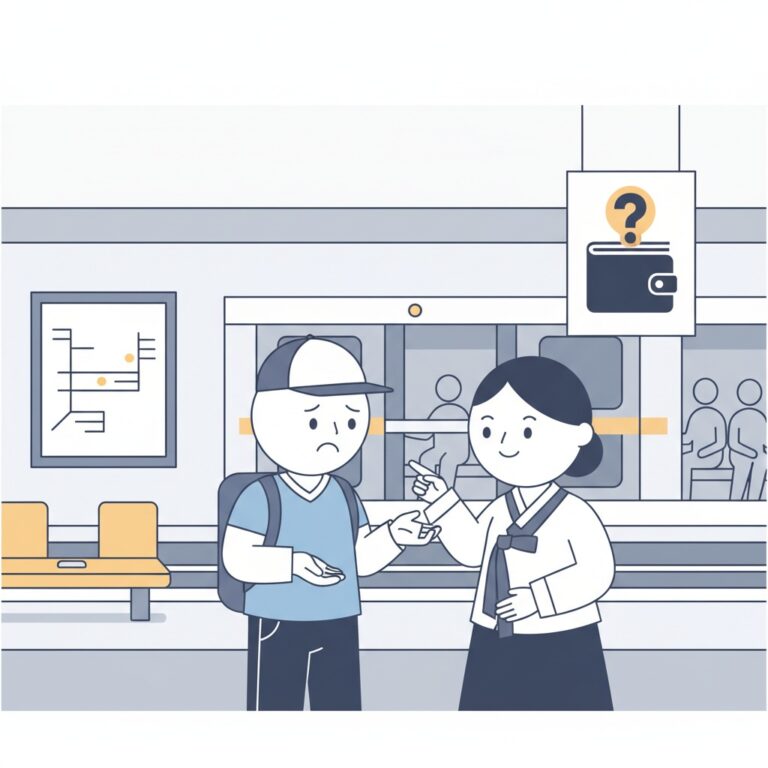
Imagine this: you’re having the time of your life in Seoul, enjoying delicious street food and exploring beautiful palaces. But then, you reach for your wallet or phone, and… it’s gone. Panic sets in! 😨
Don’t worry! Losing something is stressful, but it doesn’t have to ruin your trip. Lately in Korea, with travel booming, knowing how to handle this situation is a real superpower. Korea is famous for being incredibly safe, and people are generally very helpful. Today, we’ll learn the essential Korean phrases to find your lost items and turn a potential crisis into a minor hiccup. Let’s get started!
Core Expressions You MUST Know
Here are three key phrases that will be your lifesavers.
1. 잃어버렸어요 (ireobeoryeosseoyo)
- Pronunciation [Romanization]: i-reo-beo-ryeot-seo-yo
- English Meaning: I lost (it).
- Detailed Explanation: This is the most direct and essential phrase. It’s the past tense of the verb
잃어버리다(ireobeorida), which means “to lose.” You can use it on its own, or you can specify what you lost by putting the object before it. For example, “지갑을 잃어버렸어요” (Jigabeul ireobeoryeosseoyo) means “I lost my wallet.” The-어요(-eoyo) ending makes it polite and suitable for talking to staff or strangers. -
💡 Pronunciation Tip:
The first character잃has a silentㅎ(h) sound in this context. Whenㅎis in the final position of a syllable (the 받침) and is followed by a vowel, it often disappears! So, instead of “il-heo,” it sounds more like [i-reo]. It makes the pronunciation much smoother.
2. 혹시 제 [물건] 못 보셨어요? (Hoksi je [mulgeon] mot bosyeosseoyo?)
- Pronunciation [Romanization]: hok-si je [mul-geon] mot bo-syeot-seo-yo?
- English Meaning: By any chance, have you seen my [item]?
-
Detailed Explanation: This is a very polite and natural way to ask someone if they’ve seen your lost item.
혹시(hoksi) means “by any chance” or “perhaps.” It softens the question and makes you sound more considerate.제(je) means “my.”못 보셨어요?(mot bosyeosseoyo?) is the polite past tense question form of “to not see.” It’s more polite than asking “안 보셨어요?” (an bosyeosseoyo?).
- 💡 Pronunciation Tip:
The word못(mot) ends with aㅅ(s) sound, but when it comes before a consonant likeㅂ(b) in보셨어요, it changes. Theㅅsound is pronounced like aㄷ[d] sound. So,못 보셨어요sounds like [몯뽀셔써요 / mot-ppo-syeo-sseo-yo], with a tensed ‘ppo’ sound. This is a common sound change rule in Korean!
3. 분실물 센터가 어디에 있어요? (Bunsilmul senteoga eodie isseoyo?)
- Pronunciation [Romanization]: bun-sil-mul sen-teo-ga eo-di-e i-sseo-yo?
- English Meaning: Where is the lost and found center?
-
Detailed Explanation: This is your go-to question in public places like subway stations, airports, or department stores.
분실물 센터(bunsilmul senteo) literally means “Lost Item Center.”분실물means lost property, and센터is the English word “center.”어디에 있어요?(eodie isseoyo?) is the standard way to ask “Where is…?”
- 💡 Pronunciation Tip:
Notice the word센터(senteo). While it starts withㅅ(s), Koreans often pronounce it as a tensed sound,ㅆ(ss), when it’s from an English word. So, it sounds more like [쎈터 / ssen-teo] than [sen-teo]. This will make you sound much more like a native speaker!
Example Dialogue
Let’s see how these phrases work in a real conversation at a café.
- A: (Traveler) 저기요… 제가 혹시 여기에 핸드폰을 두고 간 것 같아요. 핸드폰을 잃어버렸어요.
- Jeogiyo… jega hoksi yeogie haendeuponeul dugo gan geot gatayo. Haendeuponeul ireobeoryeosseoyo.
- Excuse me… I think I might have left my phone here. I lost my phone.
- B: (Staff) 핸드폰이요? 잠시만요, 확인해 볼게요. 아, 여기 있네요!
- Haendeuponiyo? Jamsimanyo, hwaginhae bolgeyo. Ah, yeogi inneyo!
- Your phone? One moment, let me check. Ah, here it is!
- A: (Traveler) 우와, 정말 감사합니다! 혹시 제 핸드폰 못 보셨어요? 라고 물어보려고 했어요.
- Uwa, jeongmal gamsahamnida! Hoksi je haendeupon mot bosyeosseoyo? rago mureoboryeogo haesseoyo.
- Wow, thank you so much! I was just about to ask, “By any chance, have you seen my phone?”
- B: (Staff) 다른 손님이 카운터에 맡겨주셨어요. 다음에 오시면 분실물 센터로 바로 가보세요.
- Dareun sonnimi kaunteoe matgyeojusyeosseoyo. Daeume osimyeon bunsilmul senteoro baro gaboseyo.
- Another customer left it at the counter for you. If it happens again, try going straight to the lost and found center.
Culture Tip & Trend Deep Dive 💡
Pro-Tip: Korea’s High-Tech Lost & Found System!
One amazing thing about Korea is how seriously they take finding lost items. You’re not just relying on the kindness of strangers (though that helps!).
- Nationwide Police Portal (Lost112): The Korean National Police Agency runs a website called Lost112 (www.lost112.go.kr). It’s a national database where found items from all over the country are registered. If you lose something, you can search the site! It’s available in English, too.
- Subway Efficiency: The lost and found centers in Seoul’s subway stations are incredibly efficient. Items found on trains are collected, cataloged, and sent to a central office. Knowing the phrase
분실물 센터is your key to unlocking this amazing system.
So, if you lose something, don’t despair! Using these phrases and knowing about these systems will make you look like a seasoned Korea expert and dramatically increase your chances of finding your belongings.
Let’s Review & Practice!
Great job today! You’ve learned how to handle one of the most stressful travel situations with confidence.
Remember these key phrases:
* [Item]을/를 잃어버렸어요. – I lost my [item].
* 혹시 제 [item] 못 보셨어요? – By any chance, have you seen my [item]?
* 분실물 센터가 어디에 있어요? – Where is the lost and found center?
Now, it’s your turn!
- Fill in the blank: You left your bag on the bus. You want to ask the driver if he’s seen it.
“기사님, 혹시 제 ______ 못 보셨어요?” (Gisanim, hoksi je ______ mot bosyeosseoyo?)
(Hint: bag = 가방 [gabang]) - Make a sentence: How would you tell a police officer, “I lost my passport”?
(Hint: passport = 여권 [yeogwon])
Leave your answers in the comments below! We’d love to see you practice. Fighting! 💪







