

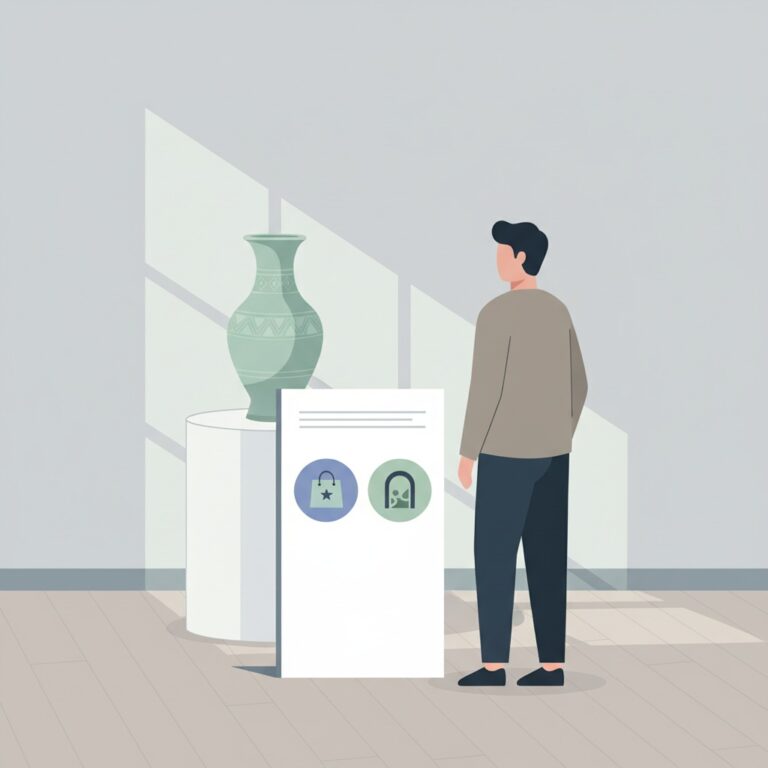
From Art to Amenities: Your Guide to Korean Museum Phrases!
Hello! Welcome to Maeil Hangeul, here to upgrade your Korean skills!
Have you ever been captivated by a beautiful piece of art in a museum, only to be snapped out of it by a sudden urge to find the restroom or the gift shop? You’re not alone! Today, we’re going to learn essential Korean phrases to help you navigate museums like a local.
Lately in Korea, there’s a huge trend of “museum hopping” (박물관 투어 – bangmulgwan tueo) and sharing aesthetic photos on Instagram. But to fully enjoy the experience, you need to know how to ask for what you need. Let’s get you ready for your next cultural adventure in Korea!
Core Expressions You Need to Know
Here are three key expressions that will make your museum visit smooth and stress-free.
1. …은/는 어디에 있어요? (…eun/neun eodie isseoyo?)
- Korean Expression: …은/는 어디에 있어요?
- Pronunciation [Romanization]: …eun/neun eodie isseoyo?
- English Meaning: Where is the…?
- Detailed Explanation: This is the most fundamental and polite way to ask for a location. You simply put the place you’re looking for in the blank. Use 은 (eun) if the word ends in a consonant (like
박물관은– bangmulgwaneun) and 는 (neun) if it ends in a vowel (like카페는– kapeneun). - 💡 Pronunciation Tip: The location particle 에 (e) in 어디에 (eodie) is often pronounced very quickly and smoothly, blending right into 어디 (eodi). Instead of saying “eo-di-E,” try to make it sound like one fluid word: [eodie].
2. 기념품 가게 (ginyeompum gage)
- Korean Expression: 기념품 가게
- Pronunciation [Romanization]: ginyeompum gage
- English Meaning: Gift shop / Souvenir shop
- Detailed Explanation: Let’s break it down! 기념품 (ginyeompum) means “souvenir,” and 가게 (gage) means “shop.” Put them together, and you have the place to buy all those cool museum goods! You can use this word with the pattern we just learned: “기념품 가게는 어디에 있어요?”
- 💡 Pronunciation Tip: When a plain consonant like ‘ㄱ (g/k)’ appears twice in a row as in 가게 (gage), the second one is often pronounced without a strong puff of air. So, it sounds more like a soft [gage] than a sharp [ka-ke].
3. 저쪽으로 쭉 가세요 (Jeojjogeuro jjuk gaseyo)
- Korean Expression: 저쪽으로 쭉 가세요.
- Pronunciation [Romanization]: Jeojjogeuro jjuk gaseyo.
- English Meaning: Please go straight that way.
- Detailed Explanation: This is a very common response you’ll hear. 저쪽 (jeojjok) means “that way” (far from both you and the speaker). -으로 (-euro) is a particle indicating direction. 쭉 (jjuk) means “straight” or “continuously,” and 가세요 (gaseyo) is the polite command “please go.”
- 💡 Pronunciation Tip: The double consonants ㅉ (jj) in 쪽 (jjok) and 쭉 (jjuk) have a “tense” sound. To make this sound, make your tongue tense and block the airflow completely for a moment before releasing the sound. It’s a stronger, sharper sound than the regular ‘ㅈ (j)’. Think of it as putting extra emphasis on the ‘j’ sound!
Example Dialogue in a Museum
Let’s see how these phrases work in a real conversation at the National Museum of Modern and Contemporary Art (MMCA) in Seoul!
- A (Visitor): 실례합니다. 기념품 가게는 어디에 있어요?
- (Sillyehamnida. Ginyeompum gageneun eodie isseoyo?)
- Excuse me. Where is the gift shop?
- B (Staff): 아, 기념품 가게는 1층에 있어요. 저쪽으로 쭉 가세요. 그럼 오른쪽에 바로 보일 거예요.
- (A, ginyeompum gageneun ilcheung-e isseoyo. Jeojjogeuro jjuk gaseyo. Geureom oreunjjoge baro boil geoyeyo.)
- Ah, the gift shop is on the first floor. Please go straight that way. You will see it immediately on your right.
- A (Visitor): 감사합니다!
- (Gamsahamnida!)
- Thank you!
Culture Tip & Trend Deep Dive
In Korea, visiting a museum is often a social event. It’s a popular activity for dates and for creating content for social media. You’ll see many young Koreans taking artistic photos of themselves with the artwork, which they call an 인증샷 (injeungshot), or a “proof shot.”
This means that facilities like the museum café (카페 - kape) or a designated photo zone (포토존 - potojon) are just as popular as the exhibitions themselves! If you want to sound like a true local enjoying the trend, you can ask:
- “혹시, 포토존은 어디에 있어요?” (Hoksi, potojoneun eodie isseoyo?) – “By any chance, where is the photo zone?”
Knowing how to find these spots will not only help you navigate but also let you participate in a modern part of Korean culture!
Let’s Review and Practice!
Great job today! We learned how to ask for locations in a museum with …은/는 어디에 있어요?, find the 기념품 가게, and understand directions like 저쪽으로 쭉 가세요.
Now it’s your turn to practice!
- Fill in the blank: You need to find the restroom. How would you ask? (Hint: Restroom = 화장실 (hwajangsil))
___________________ 어디에 있어요?
- Challenge: Imagine you’re at a museum café. How would you ask where the exhibition hall is? (Hint: Exhibition hall = 전시장 (jeonsijang))
Leave your answers in the comments below using the phrases you learned today! We can’t wait to see you use your new Korean skills
Frequently Asked Questions (FAQ)
Q: What does "은" mean in Korean and how do you pronounce it?
A: In Korean, "은" is pronounced [eun] and means: if the word ends in a consonant (like
Q: What does "는" mean in Korean and how do you pronounce it?
A: In Korean, "는" is pronounced [neun] and means: if it ends in a vowel (like
Q: What does "어디에" mean in Korean and how do you pronounce it?
A: In Korean, "어디에" is pronounced [eodie] and means: is often pronounced very quickly and smoothly, blending right into
Q: What does "어디" mean in Korean and how do you pronounce it?
A: In Korean, "어디" is pronounced [eodi] and means: . Instead of saying "eo-di-E," try to make it sound like one fluid word:







