

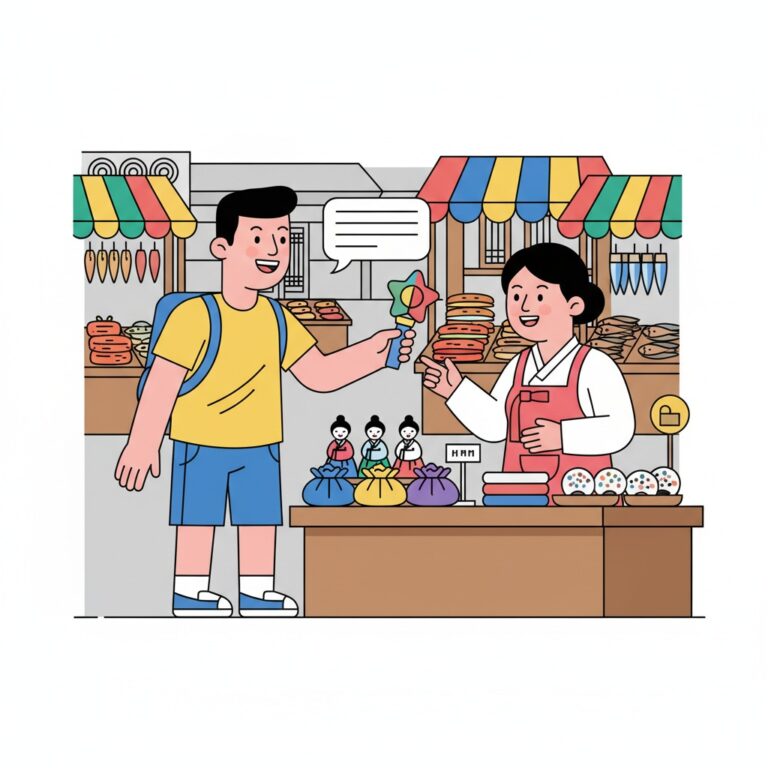
Hello! Welcome to [Maeil Hangeul], here to upgrade your Korean skills!
Are you planning a trip to Korea and dreaming of all the amazing souvenirs you’ll bring back? Today, we’re going to learn the most essential phrases for every shopper: how to ask for the price! In Korea these days, K-pop and K-drama merchandise is incredibly popular. Imagine finding the perfect postcard of your favorite idol or a cute souvenir from a drama filming location. With today’s lesson, you’ll be able to ask “How much is this?” with confidence and shop like a local. Let’s get started!
Key Expressions for Shopping
Here are the must-know phrases for your next Korean shopping spree!
1. 이거 얼마예요? (Igeo eolmayeyo?)
- Romanization: Igeo eolmayeyo?
- English Meaning: How much is this?
- Detailed Explanation: This is the golden phrase of shopping! ‘이거’ (igeo) means “this thing,” and ‘얼마예요?’ (eolmayeyo?) means “how much is it?”. It’s a polite and standard expression you can use in any store, from a bustling market to a modern department store. Just point at what you want and say this phrase!
- 💡 Pronunciation Tip:
The pronunciation is quite straightforward. Just remember to say it with a questioning intonation at the end, making it sound like a real question: Igeo eolmayeyo? ⤴
2. 너무 비싸요. (Neomu bissayo.)
- Romanization: Neomu bissayo.
- English Meaning: It’s too expensive.
- Detailed Explanation: Sometimes the price might be a little more than you expected. ‘너무’ (neomu) means “too” or “very,” and ‘비싸요’ (bissayo) means “it’s expensive.” You can use this phrase to express your reaction to the price, often with a slightly sad or surprised face. It can also be the first step to bargaining in a traditional market!
- 💡 Pronunciation Tip:
Pay attention to the ‘ㅆ’ (ss) sound in ‘비싸요’ [bissayo]. It’s a tensed consonant. To make this sound, press your tongue against the roof of your mouth and push the air out forcefully without a puff, like the ‘ss’ in “hiss.” It’s stronger and shorter than a single ‘ㅅ’ (s).
3. 깎아 주세요. (Kkakk-a juseyo.)
- Romanization: Kkakk-a juseyo.
- English Meaning: Please give me a discount.
- Detailed Explanation: This phrase is your secret weapon in traditional markets! ‘깎다’ (kkakda) literally means “to cut” or “to shave,” but in this context, it means “to discount.” ‘주세요’ (juseyo) means “please give me.” Use this with a friendly smile, and you might just get a better price!
- 💡 Pronunciation Tip:
The double consonant ‘ㄲ’ (kk) is another tensed sound, like in ‘비싸요’. Make a ‘k’ sound at the back of your throat but without releasing any air. Also, notice the linking sound rule here. When ‘깎’ is followed by the vowel ‘아’, the final consonant sound moves over, so ‘깎아’ is pronounced as [까까 – kkakka], not kkakk-a.
Example Dialogue
Let’s see how these phrases work in a real conversation! Imagine you (B) are in a souvenir shop in Myeongdong and see a postcard of your favorite K-drama, “Queen of Tears.”
- A (Shopkeeper): 어서 오세요! (Eoseo oseyo! – Welcome!)
- B (You): 안녕하세요. (Annyeonghaseyo. – Hello.)
- B (You): (Pointing at a postcard) 이거 얼마예요? (Igeo eolmayeyo? – How much is this?)
- A (Shopkeeper): 그 엽서는 2,000원이에요. (Geu yeopseo-neun icheon-won-ieyo. – That postcard is 2,000 won.)
- B (You): 아, 예쁘네요! 이거 하나 주세요. (A, yeppeuneyo! Igeo hana juseyo. – Oh, it’s pretty! Please give me one of this.)
Culture Tip & Trend Deep Dive
Shopping for souvenirs in Korea is so much fun! In popular tourist spots like Hongdae or Insadong, you’ll find countless shops selling everything from K-pop albums to traditional crafts.
Here’s a key tip to sound like a local: While using “깎아 주세요” (Kkakk-a juseyo) is perfectly fine and even expected at traditional markets like Namdaemun or Gwangjang Market, it’s not used in places with fixed prices like convenience stores, department stores, or official brand shops. Using it in the wrong place can be a bit awkward, so save your bargaining skills for the markets!
K-Pop Trend Alert! You’ll see many fans buying multiple copies of the same album. Why? To get the random photo card (‘포카 – poka’) of their favorite member! This trend, known as ‘포카 드래곤볼’ (poka deuraegonbol – collecting photo cards like Dragon Balls), makes shopping for albums an exciting treasure hunt. Now you know what to say when you find the album you’ve been looking for!
Wrap-up & Practice Time!
Great job today! You’ve learned the most essential phrases for shopping in Korea. Now you can confidently ask for prices and buy all the cute souvenirs your heart desires.
Let’s practice what you’ve learned!
- Fill in the blank: You see a cool T-shirt you want to buy. You point at it and ask:
“________ 얼마예요?” -
What would you say? You’re at a traditional market, and the price of a beautiful fan is a little high. What phrase can you use with a smile to ask for a discount?
Leave your answers in the comments below using the phrases we learned today! We can’t wait to see you practice. Happy shopping
Frequently Asked Questions (FAQ)
Q: What does "'이거'" mean in Korean and how do you pronounce it?
A: In Korean, "'이거'" is pronounced [igeo] and means: means "this thing," and
Q: What does "'얼마예요?'" mean in Korean and how do you pronounce it?
A: In Korean, "'얼마예요?'" is pronounced [eolmayeyo?] and means: means "how much is it?". It's a polite and standard expression you can use in any store, from a bustling market to a modern department store. Just point at what you want and say this phrase!
Q: What does "'너무'" mean in Korean and how do you pronounce it?
A: In Korean, "'너무'" is pronounced [neomu] and means: means "too" or "very," and
Q: What does "'비싸요'" mean in Korean and how do you pronounce it?
A: In Korean, "'비싸요'" is pronounced [bissayo] and means: means "it's expensive." You can use this phrase to express your reaction to the price, often with a slightly sad or surprised face. It can also be the first step to bargaining in a traditional market!







