

Seoul Here I Come! Korean for Airport Travel
Hello! It’s 매일한글 (Maeil Hangeul) here to upgrade your Korean skills!
Welcome to Korea! You’ve just landed, grabbed your luggage, and you’re filled with excitement. But wait… how do you get to your hotel in the heart of Seoul? Don’t worry! Today, we’re tackling that exact mission. We’ll learn the essential Korean phrases to navigate from the airport to the city like a pro.
Lately in Korea, everyone from students to travel bloggers is sharing their “꿀팁” (kkul-tip, or “honey tips”) online about the fastest and most comfortable ways to get from Incheon Airport into the city. Today, you’ll learn the language to use those tips yourself!
Core Expressions for Your Airport Escape
Here are the key phrases that will make your journey smooth and stress-free.
1. ~ 어디에 있어요? (Where is ~?)
- Pronunciation [Romanization]: ~ eodie isseoyo?
- English Meaning: Where is ~?
- Detailed Explanation: This is your magic key to finding anything! It’s a polite and universally understood question. Just put the noun for what you’re looking for in the blank. For example: “버스터미널 어디에 있어요?” (Bus terminal eodie isseoyo?).
- 💡 Pronunciation Tip: The Korean vowel ‘어’ (eo) can be tricky. It’s not “oh.” Think of the sound in the English word “uh-oh” or “uncle.” It’s a short, open sound made in the back of your throat.
2. ~에 어떻게 가요? (How do I get to ~?)
- Pronunciation [Romanization]: ~e eotteoke gayo?
- English Meaning: How do I get to ~?
- Detailed Explanation: This is the perfect question to ask when you know your destination but not the method. You can use it for specific places like “명동에 어떻게 가요?” (Myeongdong-e eotteoke gayo? / How do I get to Myeongdong?). The particle ‘에’ (e) is attached to a place to mean ‘to’.
- 💡 Pronunciation Tip: The word ‘어떻게’ looks like it should be pronounced [eo-tteoh-ge], but that’s not how it sounds! The 받침 (final consonant) ‘ㅎ’ (h) and the following ‘ㄱ’ (g) blend together to make an aspirated ‘ㅋ’ (k) sound. So, you should pronounce it as [어떠케 / eotteoke]. This sound-change rule makes you sound much more natural!
3. 이거요? (This one?)
- Pronunciation [Romanization]: Igeoyo?
- English Meaning: This one?
- Detailed Explanation: So simple, yet so powerful! When someone points you to a bus or a ticket counter, you can point back and ask “이거요?” to confirm. The ‘요’ (yo) at the end makes this simple word polite and respectful.
- 💡 Pronunciation Tip: The pronunciation is quite straightforward. ‘이거’ (igeo) means “this thing.” When you ask it as a question, let your intonation rise at the end, just like you would in English: “Igeoyo? ⤴”
4. 얼마예요? (How much is it?)
- Pronunciation [Romanization]: Eolmayeyo?
- English Meaning: How much is it?
- Detailed Explanation: You’ll need this when buying your bus or train ticket. It’s the most fundamental phrase for any kind of shopping or transaction in Korea.
- 💡 Pronunciation Tip: Pay attention to the ‘ㄹ’ (l) sound in ‘얼마’ (eolma). It’s a light ‘l’ sound, not a strong American ‘r’. Lightly tap the tip of your tongue just behind your front teeth as you say it.
Example Dialogue at the Airport
Here’s how you can use these phrases at an airport information desk.
- A: Airport Staff
- B: You (The Traveler)
B: 저기요. 공항버스 타는 곳 어디에 있어요?
(Jeogiyo. Gonghang-beoseu taneun got eodie isseoyo?)
(Excuse me. Where is the airport bus stop?)
A: 밖으로 나가서 오른쪽으로 가세요. 어디로 가시나요?
(Bakkeuro nagaseo oreunjjogeuro gaseyo. Eodiro gasinayo?)
(Please go outside and turn right. Where are you headed?)
B: 홍대에 어떻게 가요?
(Hongdae-e eotteoke gayo?)
(How do I get to Hongdae?)
A: 6002번 버스를 타시면 돼요.
(Yuk-cheon-i-beon beoseureul tasimyeon dwaeyo.)
(You can take bus number 6002.)
B: (Pointing at the bus sign) 이거요?
(Igeoyo?)
(This one?)
A: 네, 맞아요.
(Ne, majayo.)
(Yes, that’s right.)
B: 감사합니다! 표는 얼마예요?
(Gamsahamnida! Pyoneun eolmayeyo?)
(Thank you! How much is the ticket?)
A: 만 칠천 원입니다.
(Man chil-cheon won-imnida.)
(It’s 17,000 won.)
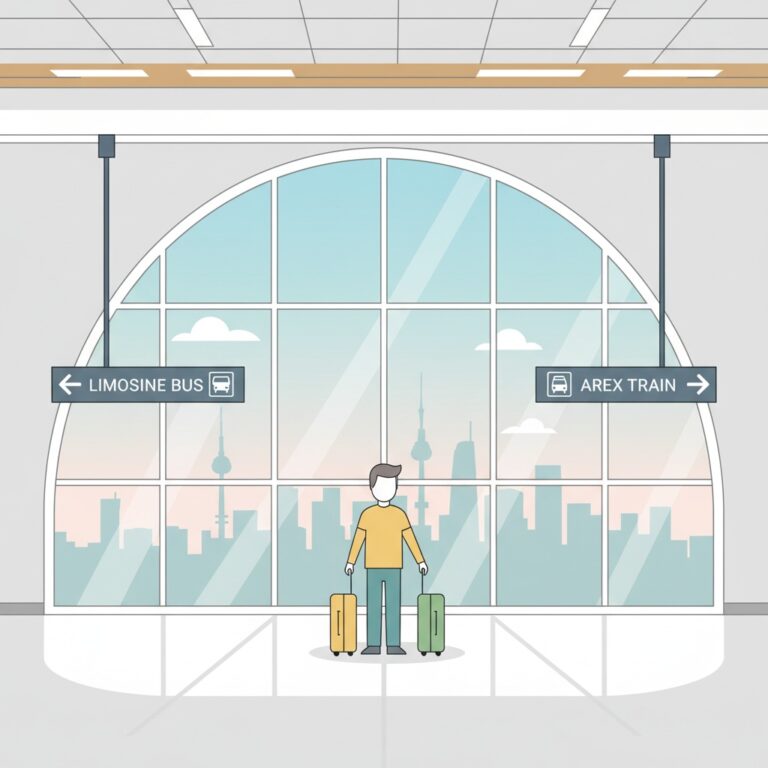
Culture Tip: AREX vs. Limousine Bus?
The trend we mentioned earlier is the big debate: which is better, the Airport Railroad (AREX) or the Airport Limousine Bus? Here’s the inside scoop so you can travel like a local.
- Airport Limousine Bus (공항 리무진 버스): These are super comfortable coach buses.
- Pros: Guaranteed seating, lots of space for luggage, and they have routes that stop directly in front of major hotels.
- Cons: Can be slow if there’s heavy traffic.
- AREX (공항철도): This is the train line connecting the airport to Seoul. There are two types!
- Express Train (직통열차 / Jik-tong-yeol-cha): This is the fast, non-stop train that goes directly to Seoul Station. It’s like a VIP ride!
- All-Stop Train (일반열차 / Il-ban-yeol-cha): This train makes several stops and connects directly to the Seoul subway system. It’s cheaper and more convenient if your destination is on the subway line.
Insider Tip: Most Koreans use a T-money card (티머니 카드) for all public transportation. You can buy one at any convenience store at the airport. Just load it with money and tap it to pay for buses and subways. It’s the ultimate Korean travel hack!
Let’s Practice!
You did an amazing job today! You’re now ready to conquer the Korean airport system. Let’s check what you’ve learned.
- Fill in the blank: You want to find the subway. How do you ask, “Where is the subway station?”
지하철역 ___________? (Jihacheollyeok ________?)
- Make a sentence: You want to go to the famous Gangnam district. How would you ask a local, “How do I get to Gangnam?”
Leave your answers in the comments below! We’d love to see you try using these new phrases. Happy travels in Korea
Frequently Asked Questions (FAQ)
Q: What does "매일한글" mean in Korean and how do you pronounce it?
A: In Korean, "매일한글" is pronounced [Maeil Hangeul] and means: here to upgrade your Korean skills!







