

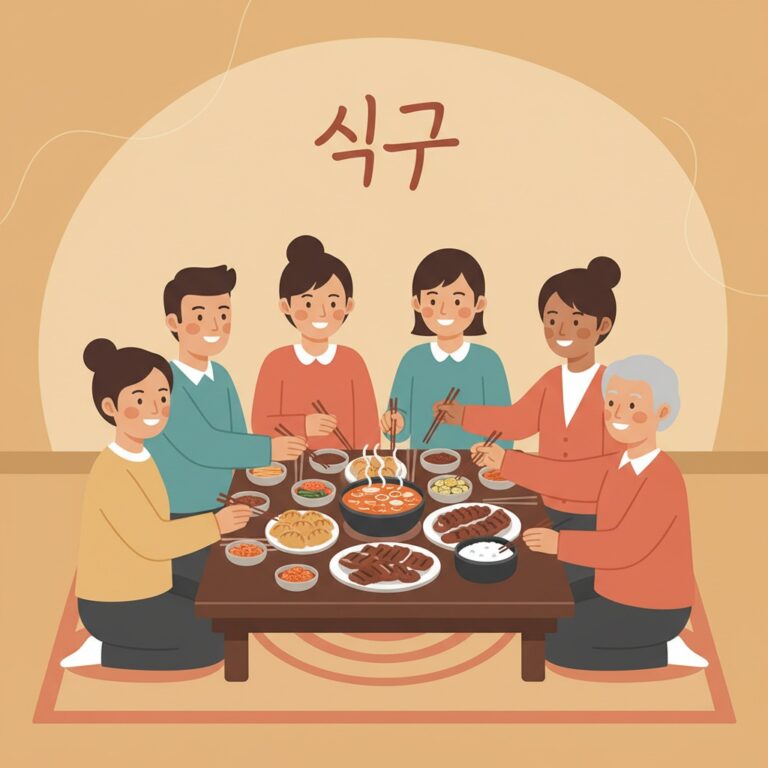
Hello! Welcome to [Daily Hangul], your go-to source for upgrading your Korean skills! Today, we’re moving beyond simple vocabulary and grammar to explore a concept that lies at the very heart of Korean society: commensality, the practice of eating together. You might know how to order food, but do you know why sharing a meal is one of the most important social rituals in Korea? These days in Korea, while the culture of honbap (혼밥 – eating alone) is growing, the deep-seated significance of sharing a meal remains incredibly powerful. Understanding this will not only improve your fluency but also give you a profound insight into the Korean psyche. Let’s dive in! ### Core Expressions You Need to Know Here are some key terms that unlock the cultural importance of eating together. #### 1. 식구 (Sikgu) * Pronunciation [Romanization]: [Sikgu] * English Meaning: Family; “eating mouths.” * Detailed Explanation: This is a truly beautiful and essential Korean word. The Hanja characters are 食 (sik), meaning ‘to eat,’ and 口 (gu), meaning ‘mouth.’ So, literally, sikgu means “eating mouths.” It refers to the people you share meals with. While it commonly means your blood-related family, its meaning extends to any close-knit group you belong to—your team at work, your close friends, or your housemates. Calling your colleagues your sikgu implies a deep bond of shared experience and mutual care, far beyond a simple professional relationship. * 💡 Pronunciation Tip: The ‘ㄱ’ in ‘구(gu)’ is pronounced as a ‘k’ sound in English, but it’s unaspirated. However, the ‘ㄲ’ in a word like ‘꿀’ (honey) is a tensed, stronger sound with no puff of air. The ‘ㄱ’ in sikgu is the standard, softer version. Think of the ‘g’ in “go,” but a bit lighter. #### 2. 한솥밥을 먹다 (Hansotbabeul meokda) * Pronunciation [Romanization]: [Hansotbabeul meokda] * English Meaning: To eat rice from the same pot. * Detailed Explanation: This idiom is the action form of being sikgu. “To eat rice from the same pot” is a powerful metaphor for being on the same team, sharing the same destiny, and going through thick and thin together. You can use this to describe a sports team fighting for a championship, a startup company working towards a common goal, or a family supporting each other. It signifies a bond forged through shared sustenance and struggle. * 💡 Pronunciation Tip: This phrase showcases a key Korean pronunciation rule called 연음 (yeon-eum), or linking. Instead of pronouncing it as “han-sot-bap-eul,” native speakers link the final consonants to the following vowel. It sounds like [한솥바블 / hansotbabeul]. The ‘ㅂ’ (b) from ‘밥’ links to the ‘을’ to create the sound [블/beul]. Mastering this will make your Korean sound incredibly natural. #### 3. 정 (Jeong) * Pronunciation [Romanization]: [Jeong] * English Meaning: A deep, warm feeling of attachment, connection, and affection. * Detailed Explanation: Jeong is a famous, untranslatable Korean concept that you, as an advanced learner, must understand. It’s the invisible social glue of Korea—a complex emotion that encompasses loyalty, compassion, and a deep sense of shared identity. And how is jeong most often built and expressed? Through sharing food. Peeling a piece of fruit for someone, putting food on their plate, or bringing back snacks for your colleagues are all acts of showing jeong. Sharing a meal is the primary vehicle for cultivating this crucial emotional connection. * 💡 Pronunciation Tip: The vowel ‘ㅓ’ (eo) can be tricky. It’s not ‘o’ or ‘u’. To make this sound, open your mouth as if to say “awe” but keep your lips relaxed and unrounded. It’s the sound in words like ‘어머니’ (eomeoni – mother) and ‘서울’ (Seoul). #### 4. 밥 한번 먹자 (Bap hanbeon meokja) * Pronunciation [Romanization]: [Bap hanbeon meokja] * English Meaning: Let’s grab a meal sometime. * Detailed Explanation: This is one of the most common social phrases in Korea, and it has a crucial dual meaning. It can be a genuine invitation to schedule a meal. However, more often than not, it functions as a polite, warm way to end a conversation, similar to “We should totally get coffee sometime!” in English. It’s a way of saying, “It was good to see you, and I value our connection.” Discerning the true intention depends on the context, your relationship with the person, and their tone. * 💡 Pronunciation Tip: Notice how ‘한번’ is pronounced smoothly as [hanbeon], not [han-beon]. The linking rule applies here as well, making the phrase flow. ### Sample Dialogue Let’s see how these expressions play out in a real conversation between two former colleagues, Minjun and Sujin, who run into each other. * 수진 (Sujin): 어머, 민준 씨! 여기서 뭐해요? 진짜 오랜만이에요! * Oh my gosh, Minjun! What are you doing here? It’s been so long! * 민준 (Minjun): 수진 씨! 잘 지냈어요? 우리 같이 프로젝트하면서 한솥밥을 먹던 게 엊그제 같은데, 벌써 2년이 지났네요. * Sujin! How have you been? It feels like just yesterday we were eating from the same pot while working on that project, but it’s already been two years. * 수진 (Sujin): 맞아요. 그때 우리 팀 정말 식구 같았잖아요. 힘들었지만 그만큼 정도 많이 들었고요. * I know. Our team was really like a family (sikgu) back then. It was tough, but we developed so much jeong for each other. * 민준 (Minjun): 그럼요. 다들 보고 싶네요. 우리 조만간 꼭 밥 한번 먹자! 제가 다음 주에 연락할게요! * Definitely. I miss everyone. We should seriously grab a meal sometime! I’ll call you next week! ### Cultural Tip & Trend Analysis From Hoesik to Mokbang: The Evolution of Commensality The concept of sikgu is traditionally embodied in 회식 (hoesik), the infamous company dinners. While sometimes seen as a chore, their purpose is to break down hierarchies and build team cohesion by sharing food and drink—literally becoming sikgu who eat hansotbap. However, as Korean society becomes more individualistic, a fascinating new trend has emerged: 먹방 (mokbang), or “eating broadcasts.” Millions of Koreans tune in to watch ‘Meoktubers’ (먹튜버) eat large quantities of food. Why? For many, especially those who live and eat alone, mokbang provides a sense of digital commensality. It simulates the feeling of sharing a meal with someone, combating the loneliness of honbap. This shows that even as lifestyles change, the fundamental human and cultural need to share a meal remains so powerful that it has found a new home online. ### Let’s Review! Today, we learned that in Korea, a meal is rarely just about the food. It’s a social act steeped in meaning. * 식구 (Sikgu): The people you share meals with, your true inner circle. * 한솥밥을 먹다 (Hansotbabeul meokda): The act of sharing experiences and destiny with your sikgu. * 정 (Jeong): The deep connection that is often built over shared plates. * 밥 한번 먹자 (Bap hanbeon meokja): A versatile phrase that maintains social bonds. Practice Time! 1. Fill in the blank: > After surviving a difficult project together, my team members and I truly feel like we are ______. 2. Scenario Question: > You bump into a former classmate you haven’t seen in years. You have a short, pleasant chat, and as you part ways, they say, “우리 다음에 꼭 밥 한번 먹자!” What is the most likely meaning of this phrase in this context?
Frequently Asked Questions (FAQ)
Q: What does "연음" mean in Korean and how do you pronounce it?
A: In Korean, "연음" is pronounced [yeon-eum] and means: , or linking. Instead of pronouncing it as "han-sot-bap-eul," native speakers link the final consonants to the following vowel. It sounds like
Q: What does "수진" mean in Korean and how do you pronounce it?
A: In Korean, "수진" is pronounced [Sujin] and means: 어머, 민준 씨! 여기서 뭐해요? 진짜 오랜만이에요! *
Q: What does "민준" mean in Korean and how do you pronounce it?
A: In Korean, "민준" is pronounced [Minjun] and means: 수진 씨! 잘 지냈어요? 우리 같이 프로젝트하면서
Q: What does "수진" mean in Korean and how do you pronounce it?
A: In Korean, "수진" is pronounced [Sujin] and means: 맞아요. 그때 우리 팀 정말






