

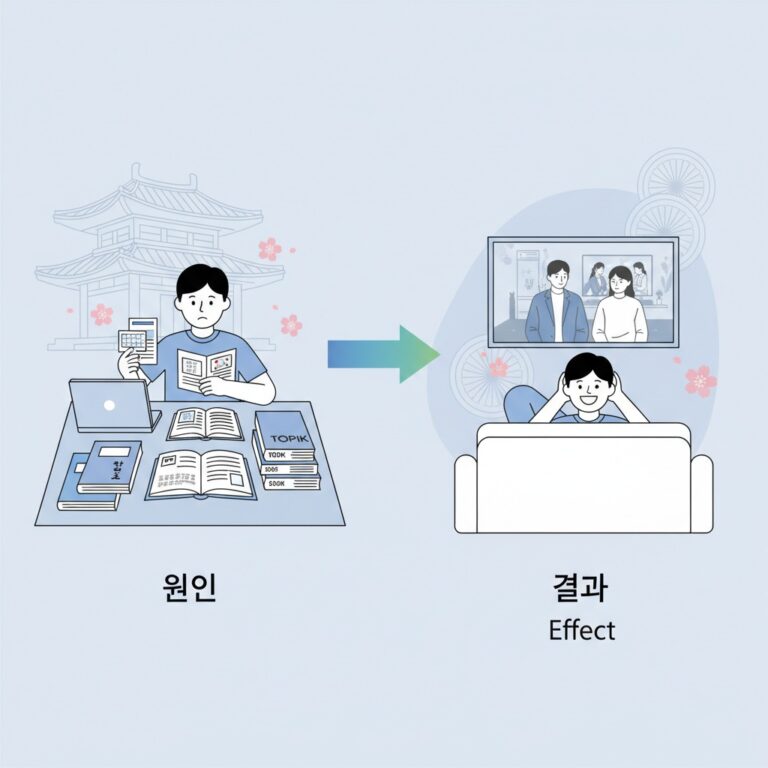
Ace Your Korean Test Like a K-Drama Star! Master Cause & Effect
Hello! Welcome to [Daily Hangul], here to upgrade your Korean skills!
Have you ever wanted to explain why you did something in Korean? Like why you were late, why you love K-pop, or why you studied so hard for a test? Today, we’re going to learn how to do just that by mastering the grammar of cause and effect.
Lately in Korea, dramas about ambitious students are super popular. You’ll constantly hear characters explaining the reason for their success or their struggles. After this lesson, you’ll understand them perfectly and be able to share your own stories, too! Let’s get started!
Core Expressions for Explaining “Why”
Here are three essential ways to connect a cause (the reason) with an effect (the result).
1. -(아/어)서 (so / because)
- Korean Expression: 열심히 공부해서 시험을 잘 봤어요.
- Pronunciation [Romanization]: Yeolshimhi gongbuhaeseo siheomeul jal bwasseoyo.
- English Meaning: I studied hard, so I did well on the test.
- Detailed Explanation: This is the most common and versatile way to state a cause and effect. It feels natural and is used in everyday conversation. It connects two related actions in a sequence. The first clause is the reason for the second clause.
- 💡 Pronunciation Tip:
The ‘서’ in ‘-해서’ often sounds more like [haeseo] than “hay-suh.” Remember that Korean vowels are pure and short. Also, in a word like ‘잘 봤어요’ (jal bwasseoyo), the final ‘ㄹ’ (l) of ‘잘’ and the ‘ㅂ’ (b) of ‘봤어요’ are pronounced clearly but smoothly connected. Try not to pause between them.
2. -기 때문에 (because / due to)
- Korean Expression: K-드라마를 좋아하기 때문에 한국어를 배우기 시작했어요.
- Pronunciation [Romanization]: K-deuramareul joahagi ttaemune hangugeoreul baeugi sijakaesseoyo.
- English Meaning: Because I like K-dramas, I started learning Korean.
- Detailed Explanation:
-기 때문에is a bit more formal and emphatic than-(아/어)서. It clearly points out the specific reason for something. You can use it to give a strong, logical reason for your actions. You can also end a sentence with~기 때문이에요(It’s because…). - 💡 Pronunciation Tip:
The word ‘때문에’ can be tricky. It’s pronounced [ttaemune]. Notice the first sound is ‘ㄸ’ (tt), a tense, strong sound with no puff of air, like the “t” in the English word “stop.” Don’t pronounce it like the soft ‘ㄷ’ (d).
3. -느라고 (because of doing… / while doing…)
- Korean Expression: 숙제하느라고 전화를 못 받았어요.
- Pronunciation [Romanization]: Sukjehaneurago jeonhwareul mot badasseoyo.
- English Meaning: I couldn’t answer the phone because I was doing homework.
- Detailed Explanation: This one is special! You use
-느라고when the action in the first clause (the cause) has a somewhat negative consequence, like not being able to do something else. It implies you were so busy or focused on the first action that the second action (usually something you missed) happened as a result. - 💡 Pronunciation Tip:
The word ‘못’ (mot) is followed by ‘받았어요’ (badasseoyo). The final ‘ㅅ’ (s) sound of ‘못’ changes to a ‘ㄷ’ (d) sound before a consonant, but here it links with the vowel ‘아’ (a) in ‘받았어요’. However, the rule for ‘못’ is that its ‘ㅅ’ becomes a ‘ㄷ’ sound before another consonant or a pause. Here, it links to the next syllable, but the underlying sound change rule makes it sound like [mot badasseoyo] with a clipped ‘t’ sound rather than a soft ‘s’ sound. So, it’s not “mos-badasseoyo” but closer to [mod-badasseoyo].
Example Dialogue
Let’s see these expressions in a real conversation about a popular new drama!
- A: 지수 씨, 한국어 시험 100점 맞았어요? 대박!
- Jisoo, you got a perfect score on the Korean test? Awesome!
- B: 네! 요즘 인기 있는 드라마 ‘서울대 챌린지’를 자막 없이 보고 싶어서 정말 열심히 공부했어요.
- Yes! I wanted to watch the popular drama ‘Seoul University Challenge’ without subtitles, so I studied really hard.
- A: 와, 정말요? 저는 아르바이트를 하느라고 공부할 시간이 별로 없었어요.
- Wow, really? I was busy working my part-time job, so I didn’t have much time to study.
- B: 괜찮아요. 제가 드라마를 좋아하기 때문에 공부하는 게 재미있었어요. 다음엔 같이 공부할까요?
- It’s okay. Because I love the drama, studying was fun for me. Should we study together next time?
Culture Tip & Trend Deep Dive
In Korea, education is incredibly competitive, a theme you often see in dramas like Sky Castle or the recent hit Hierarchy. The expression -느라고 perfectly captures the feeling of sacrifice that is often romanticized in these shows. A character might say, “어젯밤에 공부하느라고 한숨도 못 잤어” (I couldn’t sleep at all because I was busy studying last night). It shows their dedication and the reason for their exhaustion.
When you see your favorite K-pop idols on shows, listen for how they explain their success. They often use -기 때문에 to show gratitude to their fans. For example: “팬 여러분이 계시기 때문에 저희가 이 상을 받을 수 있었어요” (We were able to receive this award because you, our fans, are here for us). It’s a powerful way to give a heartfelt reason.
Using these expressions correctly will make you sound much more natural and help you understand the deeper emotions in Korean conversations and media!
Let’s Practice!
Ready to try it yourself? Review what you learned and test your skills!
- Fill in the blank: I was tired yesterday ________ I met my friend and we talked a lot.
- 어제 친구를 만나서 (eoje chingureul mannaseo)
- 어제 친구를 만나기 때문에 (eoje chingureul mannagi ttaemune)
- Make a sentence: Why are you studying Korean? Answer the question using the grammar point
-기 때문에. (Example: 저는 한국 여행을 좋아하기 때문에…)
Great job today! You’ve learned some incredibly useful ways to express yourself more clearly.
Now, it’s your turn! Try answering the practice questions in the comments below. I can’t wait to read your reasons!







