

Hello! It’s your favorite Korean language booster, [Everyday Hangul], here to upgrade your skills!
Have you ever been lost in a new city, trying to find your way? It can be tough! But don’t worry, because today we’re learning some super useful Korean phrases to talk about location. These words will help you find anything, from the bathroom to the right bus stop.
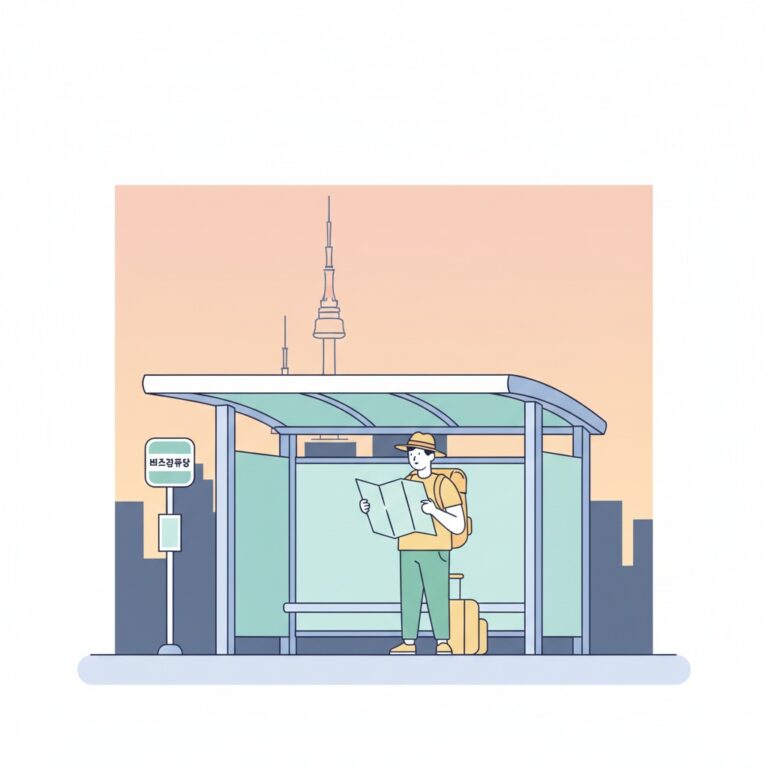
Speaking of which, have you noticed in recent K-dramas how characters always seem to have meaningful conversations while waiting for the bus? It’s a classic scene! Today, we’ll learn the exact phrases you need to navigate a Korean bus stop like a local (or even a K-drama star!). Let’s get started!
Core Expressions You Need to Know
Here are the essential words to describe where things are.
1. 어디에 있어요? (Where is it?)
- Pronunciation [Romanization]: Eodi-e isseo-yo?
- English Meaning: Where is it? / Where are you?
- Detailed Explanation: This is THE most important question for finding anything. 어디 (eodi) means ‘where’, and 있어요 (isseo-yo) means ‘to be’ or ‘to exist’. You can use it to ask for the location of a place (화장실은 어디에 있어요? – Hwajangsil-eun eodi-e isseo-yo? – Where is the bathroom?) or a person. It’s a polite and standard expression you can use with anyone.
- 💡 Pronunciation Tip: The double consonant ‘ㅆ’ in 있어요 (isseo-yo) is a ‘tense’ sound. It’s stronger and sharper than a single ‘ㅅ’ (s). Make the sound at the front of your mouth with no puff of air, like the “ss” in “hiss.” So it’s [isseo-yo], not [iseo-yo].
2. 앞에 (In front of)
- Pronunciation [Romanization]: Ap-e
- English Meaning: In front of
- Detailed Explanation: This word is used to say something is in front of a noun. You simply place the noun before it. For example, 학교 앞에 (hakgyo ap-e) means “in front of the school.” 앞 (ap) means “front,” and 에 (e) is a location particle, similar to “at” or “in” in English.
- 💡 Pronunciation Tip: The Korean letter ‘ㅍ’ (p) is an ‘aspirated’ sound. This means you should release a strong puff of air when you say it, like the ‘p’ in “park.” Hold your hand in front of your mouth when you say [ap] – you should feel the air!
3. 뒤에 (Behind)
- Pronunciation [Romanization]: Dwi-e
- English Meaning: Behind
- Detailed Explanation: This is the direct opposite of 앞에. 뒤 (dwi) means “back” or “behind.” So, 의자 뒤에 (uija dwi-e) means “behind the chair.” It follows the same grammar rule: [Noun] + 뒤에.
- 💡 Pronunciation Tip: The vowel combination ‘ㅜㅣ’ makes a ‘wi’ sound, similar to “we” in English. It’s one smooth syllable: [dwi]. Practice saying it quickly!
4. 옆에 (Next to / Beside)
- Pronunciation [Romanization]: Yeop-e
- English Meaning: Next to / Beside
- Detailed Explanation: Use this to say something is beside something else. For example, 은행 옆에 (eunhaeng yeop-e) means “next to the bank.” It’s incredibly common and useful.
- 💡 Pronunciation Tip: This is a fantastic example of a Korean pronunciation rule called liaison (연음 – yeon-eum)! The final consonant of a syllable, in this case ‘ㅍ’ (p) from ‘옆’, moves over to the next syllable if it starts with a vowel (like ‘에’). So, we don’t say ‘yeop’ and then ‘e’. Instead, the ‘p’ sound attaches to ‘e’, making it sound like [여페 / yeo-pe]. This makes your Korean sound much more natural and fluid!
Example Dialogue at the Bus Stop
Let’s see these phrases in action! Imagine a tourist (A) asking a local (B) for help.
A: 실례합니다. 143번 버스 정류장은 어디에 있어요?
Sillyehamnida. Baek-saship-sam-beon beoseu jeongnyujang-eun eodi-e isseo-yo?
Excuse me. Where is the bus stop for bus number 143?
B: 아, 저기 편의점 앞에 있어요.
A, jeogi pyeonuijeom ap-e isseo-yo.
Oh, it’s over there, in front of that convenience store.
A: 은행 옆에 있는 편의점이요?
Eunhaeng yeop-e inneun pyeonuijeom-iyo?
The convenience store next to the bank?
B: 네, 맞아요! 그리고 정류장은 큰 광고판 바로 뒤에 있어요.
Ne, majayo! Geurigo jeongnyujang-eun keun gwanggo-pan baro dwi-e isseo-yo.
Yes, that’s right! And the stop is right behind the big billboard.
A: 감사합니다!
Gamsahamnida!
Thank you!
Culture Tip & K-Drama Analysis
Why are bus stops such a popular setting in K-dramas like Twenty-Five Twenty-One or My Liberation Notes?
In Seoul, public transportation is a huge part of daily life for everyone, from students to office workers. The bus stop is a public, “in-between” space where people wait, reflect, and often have chance encounters. It’s a perfect place for drama!
Notice how directors use these location words visually. When a character stands 앞에 (ap-e), in front of another, they might be protecting them. If someone is secretly watching from 뒤에 (dwi-e), it creates suspense. Knowing these simple words adds a whole new layer to watching your favorite shows! So next time you see a bus stop scene, listen for these words!
Let’s Practice!
Ready to check your understanding?
- Fill in the blank: How would you say, “The café is next to the post office”?
카페는 우체국 _______ 있어요. (Kape-neun ucheguk _______ isseo-yo.)
- Make a sentence: Look around your room. Describe where something is using 앞에 or 뒤에. For example: “The chair is in front of the desk.”
You did an amazing job today! Now you’re ready to find your way around Korea with confidence.
Try to answer the practice questions in the comments below! We’d love to see your sentences
Frequently Asked Questions (FAQ)
Q: What does "어디" mean in Korean and how do you pronounce it?
A: In Korean, "어디" is pronounced [eodi] and means: means 'where', and
Q: What does "있어요" mean in Korean and how do you pronounce it?
A: In Korean, "있어요" is pronounced [isseo-yo] and means: means 'to be' or 'to exist'. You can use it to ask for the location of a place (화장실은 어디에 있어요? -
Q: What does "있어요" mean in Korean and how do you pronounce it?
A: In Korean, "있어요" is pronounced [isseo-yo] and means: is a 'tense' sound. It's stronger and sharper than a single 'ㅅ' (s). Make the sound at the front of your mouth with no puff of air, like the "ss" in "hiss." So it's
Q: What does "학교 앞에" mean in Korean and how do you pronounce it?
A: In Korean, "학교 앞에" is pronounced [hakgyo ap-e] and means: means "in front of the school."







