

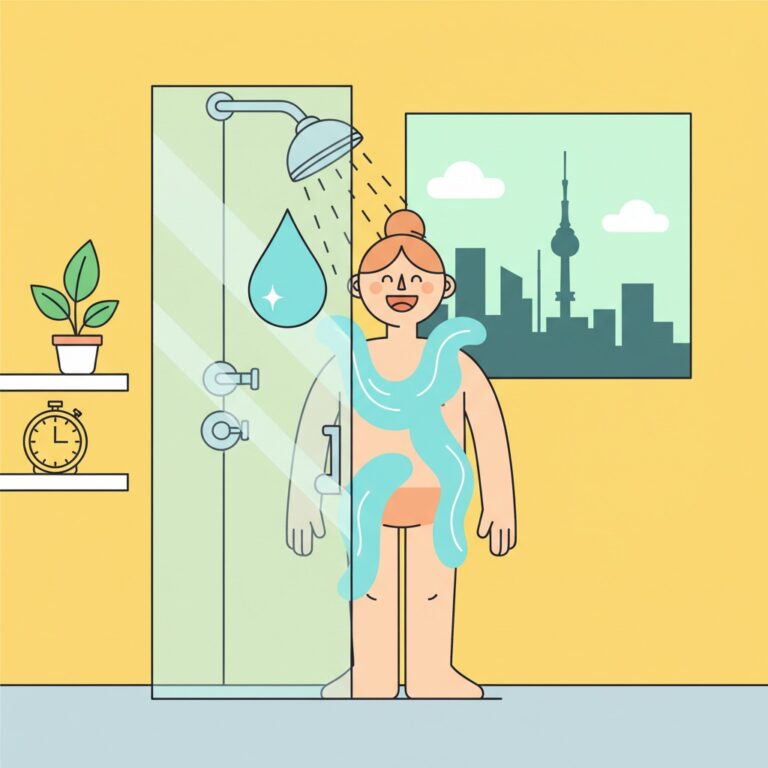
Save the Earth in 5 Mins! Korean for Eco-Showers
Hello! It’s your favorite Korean language booster, [Maeil Hangeul], here to upgrade your skills!
Have you ever thought about how you can practice Korean while also helping the planet? Well, today you’re in for a treat! We’re going to learn some simple but powerful Korean phrases related to taking shorter showers.
These days in Korea, being eco-friendly (친환경, chinhwangyeong) is a huge trend, especially among younger generations. From K-pop idols promoting reusable cups to popular TV shows featuring “zero-waste” lifestyles, everyone is talking about how to protect our environment. So, let’s dive in and learn how you can join the conversation and save some water, Korean style!
Core Expressions You Need to Know
Here are three essential phrases to talk about your new eco-friendly shower habit!
1. 물 아껴 써요 (Mul akkyeo sseoyo)
- Pronunciation [Romanization]: Mul a-kkyeo sseo-yo
- English Meaning: Let’s save water. / Please use water sparingly.
- Detailed Explanation: This is a fantastic phrase you’ll see and hear everywhere in Korea, from public bathrooms to environmental campaigns. It combines 물 (mul), meaning “water,” with the verb 아껴 쓰다 (akkyeo sseuda), which means “to use sparingly” or “to conserve.” The -아요/어요 (-ayo/eoyo) ending makes it a polite suggestion, perfect for saying to friends, family, or even as a personal reminder.
- 💡 Pronunciation Tip:
The double consonant ‘ㄲ’ (kk) and ‘ㅆ’ (ss) are “tense sounds.” To make this sound, tighten the back of your throat as if you’re holding your breath for a split second, then release the sound forcefully but without a puff of air. It’s the difference between g and the kk in “bookkeeping,” or s and the ss in “miss you.” So, it’s not a-kyeo sseo-yo, but [a-kkyeo-sseo-yo] with sharp, tense sounds.
2. 샤워 빨리 할게요 (Syawo ppalli halgeyo)
- Pronunciation [Romanization]: Sya-wo ppal-li hal-ge-yo
- English Meaning: I’ll take a quick shower.
- Detailed Explanation: This is your go-to phrase to promise you won’t be long!
- 샤워 (syawo) is the Konglish (Korean-style English) word for “shower.”
- 빨리 (ppalli) means “quickly” or “fast.”
- 할게요 (halgeyo) comes from the verb 하다 (hada, to do) and the grammar pattern -(으)ㄹ게요 (-(eu)lgeyo). This ending is used to express your intention or promise to the listener. You’re not just stating a fact; you’re assuring someone, “Don’t worry, I will be quick!”
- 💡 Pronunciation Tip:
The word 빨리 (ppalli) has another tense consonant: ‘ㅃ’ (pp). Just like with ‘ㄲ’, make the sound sharp and without aspiration. It sounds different from the regular ‘ㅂ’ (b/p). Practice saying “bali” (like the island) and then “ppalli,” making the “pp” sound more forceful and tight.
3. 시간 재고 있어요 (Sigan jaego isseoyo)
- Pronunciation [Romanization]: Si-gan jae-go i-sseo-yo
- English Meaning: I’m timing it.
- Detailed Explanation: This phrase shows you’re serious about your 5-minute shower challenge! 시간 (sigan) means “time,” and 재다 (jaeda) means “to measure” or “to time.” The grammar pattern -고 있어요 (-go isseoyo) is the present progressive tense, just like “-ing” in English. It means you are in the middle of doing something—in this case, you are timing yourself right now!
- 💡 Pronunciation Tip:
Listen for the “linking sound” (연음, yeoneum) in 있어요 (isseoyo). The final consonant ‘ㅆ’ (ss) from the first block (있) moves over to the empty vowel position in the next block (어). So, instead of pronouncing it as “it-eo-yo,” the sounds flow together smoothly to become [이써요, i-sseo-yo]. This rule makes Korean sound much more natural and fluid!
Example Dialogue
Let’s see how these phrases work in a real conversation between two roommates, Alex and Minjun.
Alex: 나 이제 샤워하러 가. (Na ije syawohareo ga.) – I’m going to take a shower now.
Minjun: 아, 알았어! 근데 요즘 한국에서는 물 절약하는 게 완전 대세인 거 알지? BTS 멤버 RM도 환경 보호에 엄청 관심 많대. (A, arasseo! Geunde yojeum hangugeseoneun mul jeoryakaneun ge wanjeon daesein geo alji? BTS membeo RMdo hwangyeong bohoe eomcheong gwansim mantae.) – Oh, okay! But you know, saving water is a huge trend in Korea these days. I heard that RM from BTS is also really interested in protecting the environment.
Alex: 진짜? 와, 알았어. 그럼 물 아껴 써요! 샤워 빨리 할게요. (Jinjja? Wa, arasseo. Geureom mul akkyeo sseoyo! Syawo ppalli halgeyo.) – Really? Wow, got it. Then, let’s save water! I’ll take a quick shower.
Minjun: 좋아! 5분 챌린지 어때? (Joa! Obun chaellinji eottae?) – Great! How about a 5-minute challenge?
Alex: 콜! 나 지금 시간 재고 있어요! (Kol! Na jigeum sigan jaego isseoyo!) – Deal! I’m timing it now!
Culture Tip & Trend Deep Dive
The phrases we learned today are more than just words; they’re a window into a major cultural shift in Korea. The “MZ Generation” (a term combining Millennials and Gen Z) is leading the charge on eco-consciousness.
You’ll often hear about the “제로 웨이스트” (jero weiseuteu – zero waste) movement. A fun part of this is the “용기내 챌린지” (Yonggi-nae Chaellinji). The word 용기 (yonggi) cleverly means both “container” and “courage.” So the challenge is to have the “courage” to take your own “container” to restaurants for takeout or to shops to buy groceries, reducing plastic waste.
When you use phrases like “물 아껴 써요,” you’re not just speaking Korean—you’re participating in a positive, modern cultural trend. Using these expressions shows you’re aware of what’s important to people in Korea right now. You’re not just a tourist; you’re culturally connected!
Let’s Wrap It Up & Practice!
Great job today! We learned three awesome phrases to help the environment:
* 물 아껴 써요 (Mul akkyeo sseoyo) – Let’s save water.
* 샤워 빨리 할게요 (Syawo ppalli halgeyo) – I’ll take a quick shower.
* 시간 재고 있어요 (Sigan jaego isseoyo) – I’m timing it.
Now, it’s your turn to practice!
1. Fill in the Blank:
You want to tell your friend you’re trying to save electricity (전기, jeongi). What would you say?
______ 아껴 써요.
2. Make a Sentence:
How would you promise your roommate that you’ll do the dishes (설거지, seolgeoji) quickly?
(Hint: Use the ‘-(으)ㄹ게요’ pattern with the verb ‘하다’.)
You’re doing an amazing job on your Korean journey. Keep up the great work!
Now, share your own eco-friendly promise in Korean in the comments below! We’d love to see you use today’s expressions.
Frequently Asked Questions (FAQ)
Q: What does ""제로 웨이스트"" mean in Korean and how do you pronounce it?
A: In Korean, ""제로 웨이스트"" is pronounced [jero weiseuteu - zero waste] and means: movement. A fun part of this is the
Q: What does ""용기내 챌린지"" mean in Korean and how do you pronounce it?
A: In Korean, ""용기내 챌린지"" is pronounced [Yonggi-nae Chaellinji] and means: . The word
Q: What does "용기" mean in Korean and how do you pronounce it?
A: In Korean, "용기" is pronounced [yonggi] and means: cleverly means both "container" and "courage." So the challenge is to have the "courage" to take your own "container" to restaurants for takeout or to shops to buy groceries, reducing plastic waste.
Q: What does "물 아껴 써요" mean in Korean and how do you pronounce it?
A: In Korean, "물 아껴 써요" is pronounced [Mul akkyeo sseoyo] and means: - Let's save water.







