

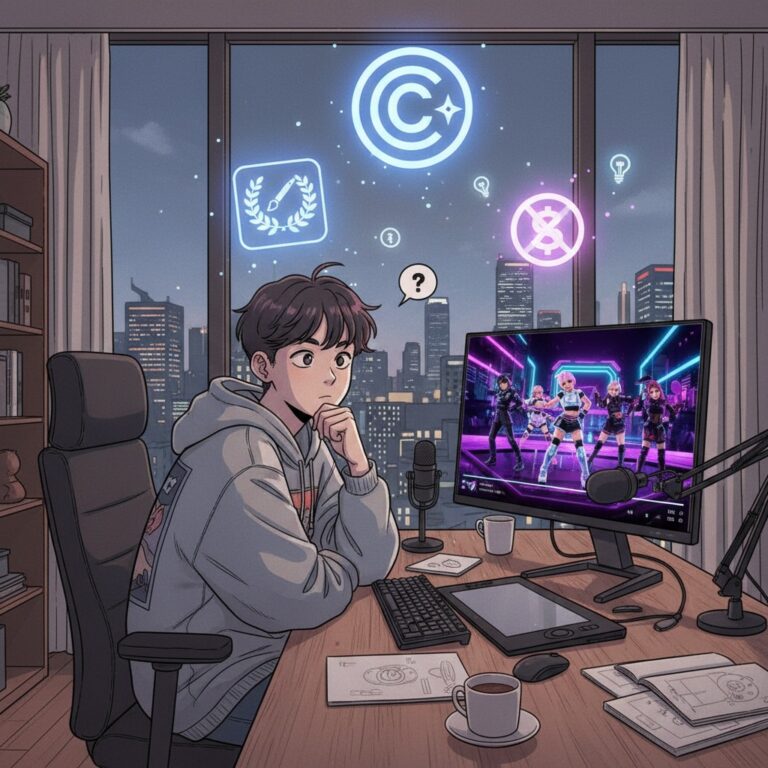
Unlock K-Content: A Creator’s Guide to CCL in Korean
Hello! This is Daily Hangeul, here to upgrade your Korean skills! 🧑🏫
Are you a content creator, a student working on a project, or simply someone who loves sharing things online? Then today’s topic is essential for you! We’re diving into the world of Creative Commons Licenses, or CCL, in Korean.
These days in Korea, from government websites to K-Pop agencies, more and more content is being shared under specific CCL conditions. Understanding these terms will not only help you use materials correctly but also allow you to share your own creations like a pro. Let’s learn how to navigate the world of digital sharing, the Korean way!
Core Expressions You Need to Know
Here are the key terms you’ll encounter when dealing with CCL in Korea.
1. 저작권 (jeojakgwon)
- Pronunciation [Romanization]: [jeo-jak-gwon]
- English Meaning: Copyright
- Detailed Explanation: This is the foundational word. 저작 (jeojak) means ‘creation’ or ‘work’, and 권 (gwon) means ‘right’ or ‘authority’. So, 저작권 literally means “the right to a creation.” It’s the legal right of the owner of intellectual property. Before you can understand sharing licenses, you must first know the word for the right you are licensing!
-
💡 Pronunciation Tip:
The final consonant in 작 (jak), which is ‘ㄱ’ (g/k), links to the next syllable when it’s followed by a vowel. However, here it’s followed by ‘권’ (gwon), a consonant, so the sounds remain separate and distinct. Just pronounce each syllable clearly: [jeo-jak-gwon].
2. 저작자 표시 (jeojakja pyosi)
- Pronunciation [Romanization]: [jeo-jak-jja pyo-si]
- English Meaning: Attribution (BY)
-
Detailed Explanation: This is the most basic requirement of all CCLs. 저작자 (jeojakja) means ‘creator’ or ‘author’, and 표시 (pyosi) means ‘indication’ or ‘mark’. Together, it means you must credit the original creator. This is the “BY” part of the license (e.g., CC BY).
-
💡 Pronunciation Tip:
Notice the sound of 자 (ja) becomes a tense [jja]. This is due to a phenomenon called ‘사이시옷’ (Sai-siot or ‘middle s’), where a ‘ㅅ’ is conceptually inserted between two nouns (저작 + 자) for smoother pronunciation, tensing the following consonant. You don’t write it, but you hear it!
3. 비영리 (biyeongni)
- Pronunciation [Romanization]: [bi-yeong-ni]
- English Meaning: NonCommercial (NC)
-
Detailed Explanation: If a work is licensed as 비영리, you cannot use it for commercial purposes. The prefix 비 (bi-) is a common way to make a word negative, similar to ‘non-‘ in English. 영리 (yeongni) means ‘profit’ or ‘commercial gain’. So, 비영리 means “non-profit” or “non-commercial.”
-
💡 Pronunciation Tip:
While it’s spelled 비영리 (bi-yeong-ri), the ‘ㄹ’ (r/l) sound in 리 (ri) changes to a ‘ㄴ’ (n) sound after a syllable ending in ‘ㅇ’ (ng). This is a standard Korean pronunciation rule called nasalization. So, instead of [bi-yeong-ri], the natural pronunciation is [bi-yeong-ni].
4. 변경 금지 (byeongyeong geumji)
- Pronunciation [Romanization]: [byeon-gyeong geum-ji]
- English Meaning: No Derivatives / No Modifications (ND)
-
Detailed Explanation: This condition means you can use the work, but you cannot change or alter it in any way. 변경 (byeongyeong) means ‘change’ or ‘modification’, and 금지 (geumji) means ‘prohibition’. This is a very strict condition often used for official documents or artistic works the creator wants to preserve in their original form.
-
💡 Pronunciation Tip:
The pronunciation is quite straightforward. However, pay attention to the nasal ‘ㅇ’ (ng) sound in 변경 (byeongyeong). It’s the same sound as the “-ing” in the English word “singing.” Make sure to pronounce both syllables clearly: [byeon-gyeong].
Example Dialogue
Let’s see how these terms are used in a real conversation. Imagine two friends, Minjun (A) and Sora (B), who are working on a presentation about modern Seoul.
A (민준): 이 서울시 공식 사진, 우리 발표에 써도 될까? 저작권 문제없을까?
A (Minjun): Can we use this official photo from the Seoul city government in our presentation? Will there be any copyright issues?
B (소라): 아, 괜찮아. 사이트에 ‘공공누리’ 표시가 있어. CC 라이선스 같은 거야. 조건만 확인하면 돼.
B (Sora): Oh, it’s fine. It has a ‘Gonggongnuri’ mark on the site. It’s like a CC license. We just need to check the conditions.
A (민준): 조건이 뭔데?
A (Minjun): What are the conditions?
B (소라): 저작자 표시는 필수고, 비영리 목적으로만 사용하래. 그리고 변경 금지야. 원본 그대로 써야 해.
B (Sora): Attribution is mandatory, and it says to use it for NonCommercial purposes only. Also, it’s No Derivatives. We have to use it as is.
A (민준): 알겠어! 그럼 출처만 정확히 밝히면 우리 학교 발표에는 문제없겠네. 고마워!
A (Minjun): Got it! So as long as we cite the source correctly, there’s no problem for our school presentation. Thanks!
Culture Tip & Trend Deep Dive ✨
In Korea, understanding these terms is becoming increasingly important, especially in the world of K-Pop and online content.
- The Rise of “2차 창작” (icha changjak – Secondary Creation): The K-Pop fandom is famous for its vibrant culture of secondary creation, such as fan art, reaction videos, and translated clips. While many agencies are lenient, some officially release materials (like behind-the-scenes photos) with clear CCL tags. Knowing if something is 비영리 (NonCommercial) or 변경 금지 (No Derivatives) can save a fan creator a lot of trouble!
- “공공누리” (Gonggongnuri – Korea Open Government License): The Korean government actively promotes the sharing of public data. The “공공누리” license is based on CCL and is used by museums, libraries, and government offices to release high-quality photos, documents, and data for public use. If you ever need resources for a project on Korea, looking for the “공공누리” mark is a fantastic tip! It shows a societal push towards open and shared information.
Let’s Review and Practice!
Great job today! We’ve learned some advanced but incredibly useful Korean terms for navigating the digital world. You now know how to talk about 저작권 (copyright) and understand key CCL conditions like 저작자 표시 (Attribution), 비영리 (NonCommercial), and 변경 금지 (No Derivatives).
Now, let’s test your knowledge!
- Fill in the blank: If you want to use a photo but must credit the photographer, you have to follow the __________ condition.
- O / X Quiz: You found a beautiful song licensed as 비영리. Can you use it as background music for a YouTube video where you earn ad revenue? (O / X)
Leave your answers in the comments below, and feel free to create your own sentence using one of today’s expressions! Keep up the fantastic work! 💪
Frequently Asked Questions (FAQ)
Q: What does "저작" mean in Korean and how do you pronounce it?
A: In Korean, "저작" is pronounced [jeojak] and means: means 'creation' or 'work', and
Q: What does "권" mean in Korean and how do you pronounce it?
A: In Korean, "권" is pronounced [gwon] and means: means 'right' or 'authority'. So,
Q: What does "작" mean in Korean and how do you pronounce it?
A: In Korean, "작" is pronounced [jak] and means: , which is 'ㄱ' (g/k), links to the next syllable when it's followed by a vowel. However, here it's followed by '권' (gwon), a consonant, so the sounds remain separate and distinct. Just pronounce each syllable clearly:
Q: What does "저작자" mean in Korean and how do you pronounce it?
A: In Korean, "저작자" is pronounced [jeojakja] and means: means 'creator' or 'author', and







