

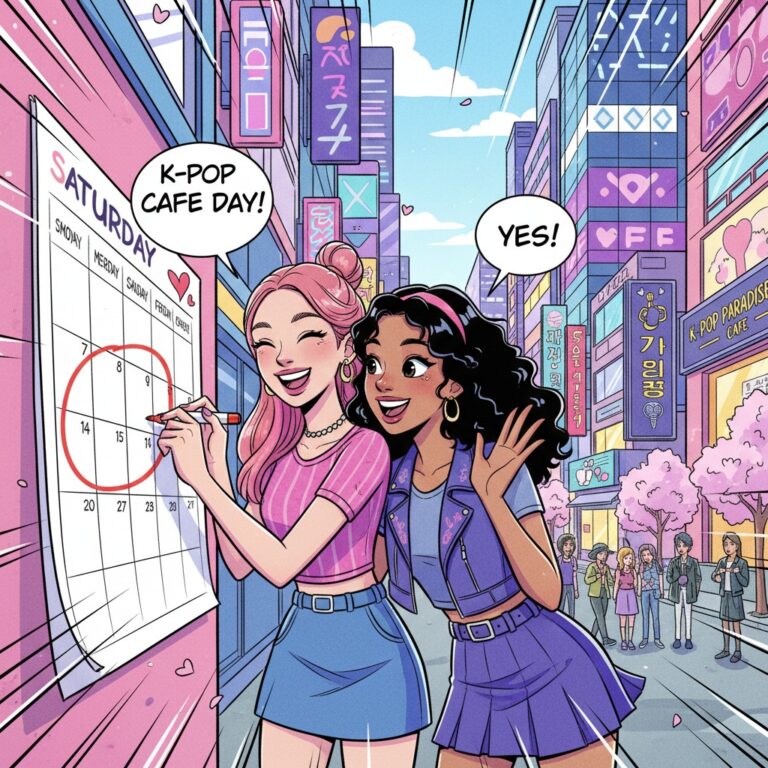
Plan Your K-Pop Weekend in Korean! Days of the Week 🗓️
Hello! It’s your favorite Korean guide, [Everyday Hangul], here to level up your skills! 😊
Have you ever wanted to ask a friend to go to a concert or a cafe in Seoul? To do that, you’ll need one of the most essential tools for making plans: the days of the week!
Lately in Korea, everyone is buzzing about the latest K-pop group pop-up stores and fan events that always happen on weekends. If you want to ask your new Korean friend, “Wanna go together on Saturday?”, you’ve come to the right place! Today, we’ll master the weekend vocabulary so you can start making fun plans right away.
Core Expressions You Need to Know
Here are the essential words and phrases for planning your perfect weekend.
1. 주말 (Jumal)
- Pronunciation [Jumal]: Joo-mal
- English Meaning: Weekend
- Detailed Explanation: This is your go-to word for “weekend.” It’s a combination of 주 (ju), meaning “week,” and 말 (mal), meaning “end.” Simple and logical, right? You can use it in many situations, like asking “What are you doing this weekend?” (이번 주말에 뭐 해요? – Ibeon jumare mwo haeyo?).
-
💡 Pronunciation Tip: The pronunciation is quite straightforward. Just remember that the ‘J’ sound in Korean (ㅈ) is a bit softer than the English ‘J’, somewhere between a ‘j’ and a ‘ch’ sound.
2. 토요일 (Toyoil)
- Pronunciation [Toyoil]: To-yo-il
- English Meaning: Saturday
-
Detailed Explanation: This is Saturday! The particle -에 (e) is often attached to days of the week to mean “on” that day. For example, “토요일에 만나요!” (Toyoire mannayo!) means “Let’s meet on Saturday!”
-
💡 Pronunciation Tip: This word is also pronounced as it’s written. Break it down: To-yo-il. Practice saying it slowly, then speed it up. You’ll sound like a natural in no time!
3. 일요일 (Iryoil)
- Pronunciation [Iryoil]: Ee-ryo-il
- English Meaning: Sunday
-
Detailed Explanation: And here’s Sunday! Just like with Saturday, you can add -에 (e) to say “on Sunday.” For example, “일요일에 뭐 해요?” (Iryoire mwo haeyo?) means “What are you doing on Sunday?”
-
💡 Pronunciation Tip: This one has a small trick! The last letter of the first block, ‘일’ (il), is ‘ㄹ(l)’. When it’s followed by a vowel in the next block (like ‘요’, yo), the ‘ㄹ(l)’ sound moves over to the next syllable. This is called linking sound (연음 – yeoneum).
- Instead of saying: il – yo – il
- You say it smoothly like: [i-ryo-il]
- This makes your Korean sound much more fluid and natural!
4. 뭐 해? (Mwo hae?)
- Pronunciation [Mwo hae]: Mwo-hae
- English Meaning: What are you doing?
- Detailed Explanation: This is a casual, friendly way to ask “What are you doing?”. It’s the perfect phrase to start a conversation about making plans with a friend. For a slightly more polite version, you can say 뭐 해요? (Mwo haeyo?).
-
💡 Pronunciation Tip: The pronunciation is easy, but the nuance is key! Use 뭐 해? (Mwo hae?) with close friends or people younger than you. Use 뭐 해요? (Mwo haeyo?) with people you’ve just met or who are older than you.
Example Dialogue: K-Pop Cafe Planning!
Let’s see how these expressions work in a real conversation. Imagine two friends, A and B, planning to visit a new cafe opened by their favorite idol.
A: 이번 주말에 뭐 해?
(Ibeon jumale mwo hae?)
What are you doing this weekend?
B: 아직 계획 없어. 왜?
(Ajik gyehoek eopseo. Wae?)
I don’t have plans yet. Why?
A: 새 K-pop 카페 가고 싶어. 토요일 어때?
(Sae K-pop kape gago sipeo. Toyoil eottae?)
I want to go to the new K-pop cafe. How about Saturday?
B: 좋아! 토요일에 만나자!
(Joa! Toyoile mannaja!)
Sounds good! Let’s meet on Saturday!
Culture Tip & Trend Deep Dive
In Korea, the weekend (주말) is precious! After a long week of hard work or studying, people love to make the most of their Saturdays and Sundays.
A very common phrase you’ll see on Korean social media after a fun weekend is “주말 순삭” (jumal sunsak).
* 주말 (jumal) means “weekend.”
* 순삭 (sunsak) is a slang term meaning “instantly deleted” or “gone in a flash.”
So, “주말 순삭” means “The weekend disappeared in a flash!” It’s a relatable way to say you had so much fun that the weekend felt too short. If you visit a pop-up store for your favorite K-pop group on Saturday, you might post a picture on Sunday with the caption: “너무 재미있었다! 주말 순삭 ㅠㅠ” (Neomu jaemiisseotda! Jumal sunsak ㅠㅠ) – “It was so fun! The weekend is already over ㅠㅠ”. Try using it to sound just like a local!
Let’s Wrap It Up & Practice!
Great job today! You’ve learned the essential words for the weekend (주말, 토요일, 일요일) and a key phrase for making plans (뭐 해?). Now you’re ready to plan your own adventures in Korean!
Practice Time!
- Fill in the blank: You want to tell your friend you are busy on Sunday.
- 저는 ______에 바빠요. (Jeoneun ______e bappayo.)
- Make a sentence: How would you ask a friend, “What are you doing on Saturday?” in casual Korean?
Leave your answers and your dream Korean weekend plan in the comments below using the phrases you learned today! We can’t wait to see them. Until next time! 👋
Frequently Asked Questions (FAQ)
Q: What does "주" mean in Korean and how do you pronounce it?
A: In Korean, "주" is pronounced [ju] and means: , meaning "week," and
Q: What does "말" mean in Korean and how do you pronounce it?
A: In Korean, "말" is pronounced [mal] and means: , meaning "end." Simple and logical, right? You can use it in many situations, like asking "What are you doing this weekend?" (이번
Q: What does "-에" mean in Korean and how do you pronounce it?
A: In Korean, "-에" is pronounced [e] and means: is often attached to days of the week to mean "on" that day. For example, "
Q: What does "-에" mean in Korean and how do you pronounce it?
A: In Korean, "-에" is pronounced [e] and means: to say "on Sunday." For example, "






