

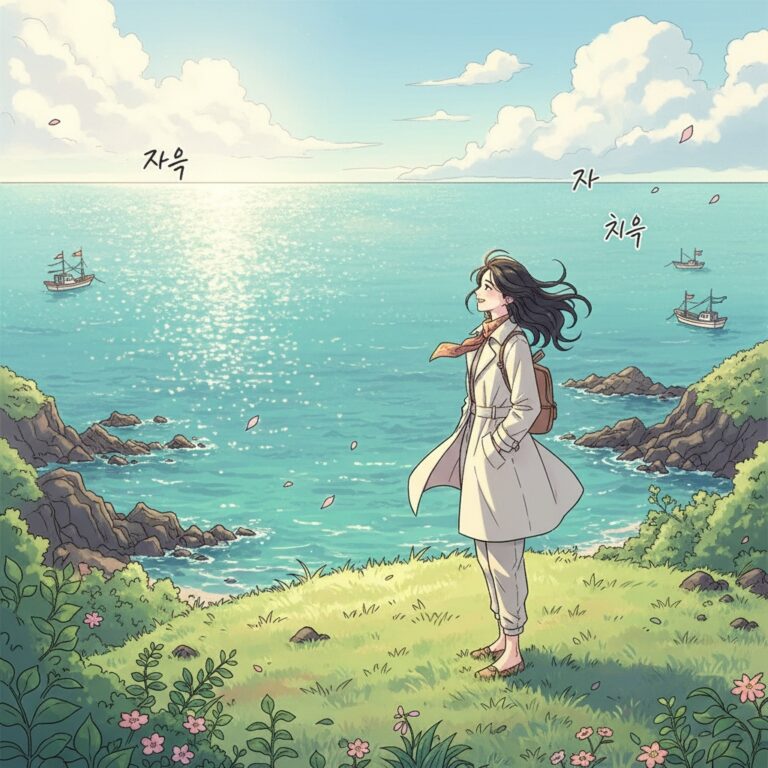
Capture Jeju’s Beauty in Korean: Postcard Phrases! 🏞️✍️
Hello! It’s your favorite Korean skill-booster, Maeil Hangeul, here to upgrade your language game!
Have you ever seen a landscape so beautiful you were at a loss for words? Today, we’re going to fix that! We’ll learn how to describe stunning scenery in Korean, just like you’re writing a postcard from a beautiful destination.
Lately in Korea, “healing travel” (힐링 여행) to places with beautiful nature is a huge trend. Many people escape the busy city to visit places like Jeju Island, which you’ve probably seen in popular K-dramas! With the phrases we learn today, you’ll be able to share that “healing” feeling with your friends in perfect Korean.
Let’s get started!
Core Expressions for Your Postcard
Here are three poetic and common phrases to describe beautiful scenery.
1. 그림 같다 (Geurim gatda)
- Pronunciation [Romanization]: Geurim gatda
- English Meaning: It’s like a picture. / It’s picture-perfect.
- Detailed Description: This is a wonderful compliment for any view. You use it when the scenery is so perfect and beautiful that it looks like a painting or a photograph. It’s a very common and natural-sounding expression that will impress your Korean friends. You can use it for mountains, the sea, a sunset—anything!
- 💡 Pronunciation Tip:
The final consonant ‘ㅌ’ (t) in ‘같다’ is a great example of a Korean sound rule called tensing (된소리되기). When ‘ㅌ’ (or other similar consonants like ㄱ, ㄷ, ㅂ) is followed by certain consonants like ‘ㄷ’ (d), the second consonant becomes a strong, tense sound. So, instead ofgat-da, you pronounce it as [gat-tta], with a short, sharp ‘tta’ sound, almost like a double ‘d’.
2. 가슴이 뻥 뚫리는 것 같다 (Gaseumi ppeong ttullineun geot gatda)
- Pronunciation [Romanization]: Gaseumi ppeong ttullineun geot gatda
- English Meaning: It feels like my heart/chest is opening up.
- Detailed Description: This is a very evocative phrase! “가슴” means chest/heart, and “뻥 뚫리다” is a sound-imitating phrase that means to be wide open or cleared. You use this expression when you see a wide, open view (like the ocean or a vast field) and you feel a sense of relief, freedom, and release from stress. It’s that refreshing “ahhh” feeling put into words.
- 💡 Pronunciation Tip:
The syllable ‘뚫’ [ttul] can be tricky. The ‘ㄸ’ is a tense ‘tt’ sound. The vowel ‘ㅜ’ is a simple ‘u’ (like in ‘blue’). The final consonant ‘ㄹ’ (l) is pronounced with your tongue tip touching the roof of your mouth, right behind your front teeth. Practice making a clear ‘l’ sound at the end of the syllable: [ttul].
3. 눈에 담다 (Nune damda)
- Pronunciation [Romanization]: Nune damda
- English Meaning: To capture in one’s eyes. / To store the view in one’s memory.
- Detailed Description: This is a beautiful, poetic phrase. “눈” means ‘eye’ and “담다” means ‘to put something into a container.’ So, you are literally “putting the view into your eyes” to remember it forever. You can use this when you want to express that you’re savoring a special moment and don’t want to forget the beautiful sight in front of you.
- 💡 Pronunciation Tip:
The pronunciation here is quite straightforward, which is great practice! Notice the final consonant ‘ㅁ’ (m) in ‘담다’ [damda]. Unlike some other final consonants, ‘ㅁ’ is always pronounced as a clear ‘m’ sound. Just close your lips completely to make the sound, like the ‘m’ in the English word “mom.”
Example Dialogue: A Postcard from Jeju
Let’s see how these phrases work in a real conversation between two friends, A and B, on Jeju Island.
A: 와, 저기 바다 좀 봐! 색깔이 정말 예쁘다.
(Wa, jeogi bada jom bwa! Saekkari jeongmal yeppeuda.)
Wow, look at the sea over there! The color is so beautiful.
B: 진짜 그림 같다. 필터가 필요 없겠어.
(Jinjja geurim gatda. Pilteoga piryo eopgesseo.)
It’s truly like a picture. We won’t need any filters.
A: 맞아. 이렇게 넓은 바다를 보니까 가슴이 뻥 뚫리는 것 같아.
(Maja. Ireoke neolbeun badareul bonikka gaseumi ppeong ttullineun geot gata.)
I know. Looking at this wide ocean, it feels so refreshing and freeing.
B: 나 이 풍경 잊어버리기 싫어. 내 눈에 담아 가야지. 가족들한테 보낼 엽서도 하나 사야겠다.
(Na i punggyeong ijeobeorigi sireo. Nae nune dama gayaji. Gajokdeulhante bonael yeopsodo hana sayagetda.)
I don’t want to forget this scenery. I have to capture it in my eyes. I should also buy a postcard to send to my family.
Culture Tip & Trend Deep Dive 🕵️♀️
In Korea, the concept of “healing” (힐링) is more than just a word; it’s a lifestyle trend. Many people feel tired from the fast-paced “ppalli-ppalli” (빨리빨리, hurry-hurry) culture. Going on a “healing trip” (힐링 여행) to a place with beautiful nature is a popular way to de-stress.
When Koreans post photos of these trips on Instagram, they don’t just write “Beautiful view.” They use expressive captions like the ones we learned today! You’ll often see photos of Jeju Island or the East Sea with captions like:
- “오랜만에 가슴이 뻥 뚫리는 기분! #힐링여행”
(It’s been a while since I’ve felt so refreshed! #healingtrip) - “모든 순간을 눈에 담아 가야지 ✨”
(I’m going to capture every moment in my eyes ✨)
Using these phrases will not only make your Korean sound more natural, but it will also show that you understand the modern Korean culture of seeking emotional and mental rest through nature.
Let’s Practice!
Time to review what you’ve learned.
- Fill in the Blank: You are standing on a mountain looking at a perfect sunset. It’s so beautiful it doesn’t look real. You say: “와, 정말 ______ 같아요.” (Hint: picture)
-
Make a Sentence: Imagine you are at your favorite park on a clear, sunny day. How do you feel? Try to make a sentence using 눈에 담다.
Great job today! You’re now ready to describe beautiful scenery like a native speaker.
Why not try it now? Leave a comment below describing a beautiful place you know using one of today’s expressions!







