

Hello! It’s Maeil Hangeul here, ready to upgrade your Korean skills to the next level!
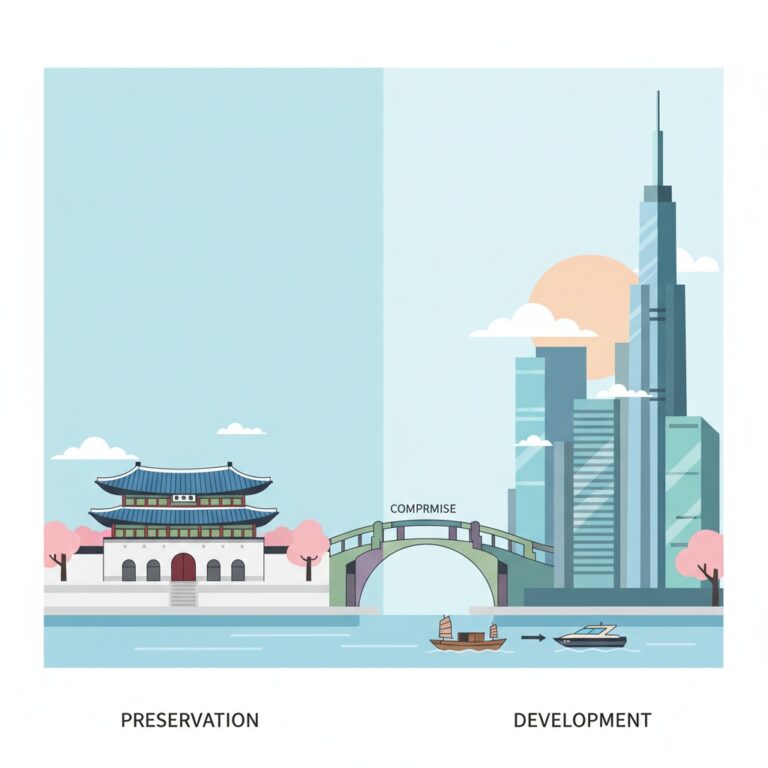
Today, we’re diving into a topic that requires sophisticated language and nuanced expression: mediating a conflict. Specifically, we’ll tackle the classic clash between development and preservation. Ever wondered how to articulate a balanced argument or propose a compromise in a high-stakes Korean discussion? This lesson is for you.
Recently in Korea, there’s a growing public discourse about how to handle development projects near significant cultural heritage sites. From ancient temples to historic city districts, the debate is heating up, making today’s vocabulary incredibly relevant and useful for understanding modern Korean society. Let’s get started!
Core Expressions for Negotiation
Here are some essential phrases you’ll need to navigate these complex conversations like a pro.
1. 상충되다 (sangchungdoeda)
- Romanization: [sang-chung-doe-da]
- English Meaning: to conflict with; to be at odds with; to clash
- Detailed Explanation: This is a formal, academic verb perfect for written reports or formal debates. It’s used when two ideas, interests, or values are in direct opposition. Using
상충되다instead of a simpler phrase like서로 다르다(to be different from each other) immediately elevates the formality and precision of your argument. - 💡 Pronunciation Tip: The key is the aspirated
ㅊ(ch) sound in충. It’s not a soft ‘ch’ like in “church,” but a stronger puff of air. Think of it as “t-h” sound. Also, the vowelㅚ(oe) in되is pronounced like “weh.” So, it sounds like [sang-chung-dwe-da].
2. -는 데에 있어서 (-neun de-e isseoseo)
- Romanization: [-neun de-e i-sseo-seo]
- English Meaning: when it comes to…; in terms of…; regarding the matter of…
- Detailed Explanation: This grammatical pattern is a fantastic way to frame a topic or specify the context of your statement. It isolates a particular aspect of the issue for discussion. It’s a sophisticated alternative to simpler prepositions and adds a layer of focus to your sentence. For example, “환경을 보호하는 데에 있어서…” means “When it comes to protecting the environment…”
- 💡 Pronunciation Tip: A natural liaison (연음) occurs here. The sound flows smoothly from
데[de] to에[e], sounding like [de-e]. For있어서, theㅆ(ss) is a tensed consonant, so you pronounce it strongly without aspiration, sounding like [i-sseo-seo].
3. 절충안을 모색하다 (jeolchungan-eul mosaekada)
- Romanization: [jeol-chung-a-neul mo-sae-ka-da]
- English Meaning: to seek a compromise; to explore a middle ground
- Detailed Explanation: This is a set phrase crucial for any negotiation or mediation.
절충안(jeolchungan) means “a compromise proposal” and모색하다(mosaekada) is a formal verb for “to seek” or “to grope for a solution.” Using this phrase shows you are focused on finding a constructive, mutually agreeable outcome. - 💡 Pronunciation Tip: Be careful with the final consonants and liaisons.
절충안을is pronounced [절충아늘 / jeolchung-aneul] because the ‘ㄴ’ 받침 (final consonant) moves to the next syllable. In모색하다, theㄱ(k) in색is an unaspirated, plain sound. It’s not a hard ‘k’ or a soft ‘g’, but somewhere in between.
Example Dialogue
Let’s see these expressions in action. Imagine a meeting between a developer (A), a preservationist (B), and a mediator (C) discussing a new hotel project near a historic fortress wall.
A (개발자): 저희는 지역 경제 활성화를 위해 이 프로젝트가 필수적이라고 봅니다.
(We believe this project is essential for revitalizing the local economy.)
B (환경보호론자): 경제 발전도 중요하지만, 역사적 유산의 보존 가치와 상충되는 개발은 재고해야 합니다.
(Economic development is important, but we must reconsider any development that conflicts with the preservation value of our historical heritage.)
C (중재자): 네, 양측의 입장이 이해됩니다. 그렇다면, 문화재를 보호하는 데에 있어서 구체적으로 어떤 점이 가장 우려되시나요?
(Yes, I understand both positions. In that case, when it comes to protecting the cultural asset, what is your most specific concern?)
B (환경보호론자): 호텔 건물이 성곽의 경관을 해치고, 공사 중 진동으로 인해 유적이 훼손될 수 있습니다.
(The hotel building will damage the fortress’s landscape, and vibrations during construction could harm the ruins.)
C (중재자): 알겠습니다. 그 점을 고려하여, 개발 계획을 일부 수정하고 경관을 해치지 않는 절충안을 모색하는 것은 어떻겠습니까?
(I see. Considering that point, how about we try to seek a compromise that modifies the development plan and doesn’t harm the landscape?)
Cultural Tip & Trend Deep Dive
In Korea, the tension between development and preservation is a very real and ongoing issue. The rapid economic growth of the 20th century, often called the “Miracle on the Han River,” was driven by a 빨리빨리 (ppalli-ppalli, “hurry, hurry”) culture. While this led to incredible progress, it sometimes came at the cost of historical preservation.
Today, however, there’s a huge shift. The younger generation (MZ 세대) and many civic groups are increasingly vocal about protecting cultural heritage. You’ll often see news reports or social media debates about redevelopment projects in old Seoul neighborhoods like Euljiro or Ikseon-dong. The conflict isn’t just about old buildings; it’s about preserving a tangible connection to the past and creating a sustainable future.
When you use phrases like 절충안을 모색하다 in a discussion, you show not only linguistic fluency but also a deep cultural understanding that recognizes the validity of both progress and history—a value that is becoming more and more central in modern Korea.
Let’s Practice!
Time to put your knowledge to the test.
- Fill in the blank:
지속 가능한 관광을 위해서는, 환경 보호와 관광객의 편의가 _______________ 않도록 균형을 잡는 것이 중요하다.
(For sustainable tourism, it’s important to strike a balance so that environmental protection and tourist convenience do not _______________.) -
Sentence Building:
Imagine you are a city planner. Using the phrase-는 데에 있어서, write one sentence explaining the most important factor in designing a new public park in a historic area.
Great job today! You’ve learned some incredibly powerful expressions for handling complex discussions.
Now, try using one of today’s phrases to leave a comment below about a development vs. preservation issue in your own country!






