

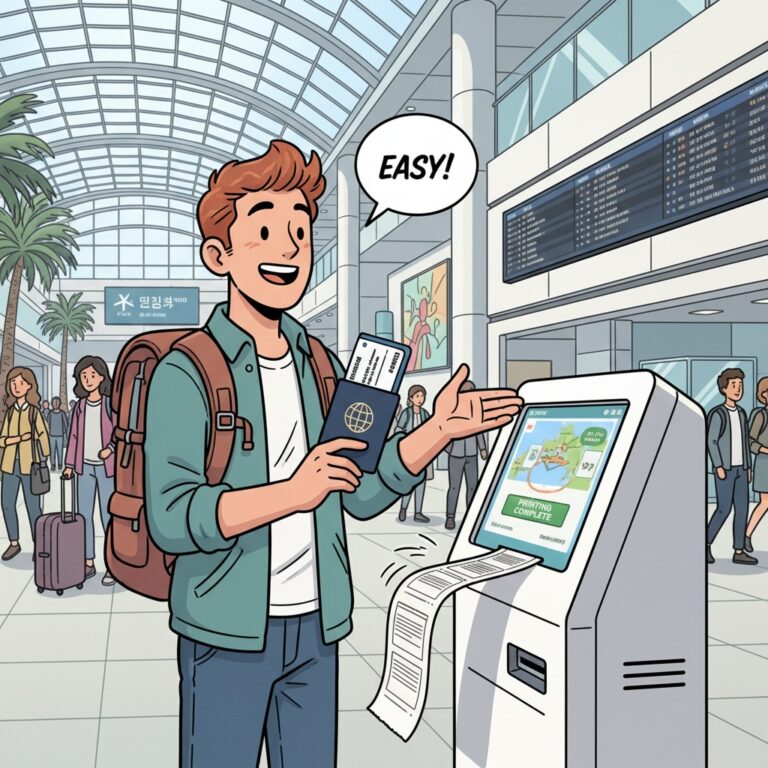
Korean Airport 101: Master the Self Check-in Kiosk!
Hello! This is [Maeil Hangul], here to upgrade your Korean skills!
Are you planning a trip to Korea? The first place you’ll use your Korean is at the airport! Long lines can be stressful, but what if you could skip them like a pro? Today, we’re going to learn the essential Korean words you need to use the self-check-in kiosk. Lately in Korea, with so many people visiting for K-pop concerts and food tours, the airports are busier than ever. Knowing how to use these machines will save you time and make you feel like a confident, savvy traveler from the moment you arrive!
Let’s get started!
Core Expressions for the Kiosk
Here are the key words you’ll see on the screen.
1. 여권 (Yeogwon)
- Pronunciation [Yeo-gwon]:
- English Meaning: Passport
- Detailed Explanation: This is the most important word! You will be asked to scan your
여권to start the check-in process. It’s a combination of여(yeo), meaning “travel,” and권(gwon), which can mean “document” or “book.” So, a “travel document”! - 💡 Pronunciation Tip: The first syllable
여(yeo) is pronounced like the “yo” in “yonder.” The second syllable권(gwon) sounds similar to the name “Gwen.” Try saying “Yo-Gwen” quickly: [Yeo-gwon]!
2. 항공권 예매 번호 (Hanggonggwon yemae beonho)
- Pronunciation [Han-gong-gwon ye-mae beon-ho]:
- English Meaning: Flight Booking Number (or Confirmation Number)
- Detailed Explanation: This is your magic number! If scanning your passport doesn’t work, you can type in this number. Let’s break it down:
항공권(hanggonggwon) = Airplane Ticket예매(yemae) = Booking / Reservation번호(beonho) = Number
You’ll find this on your flight confirmation email.
- 💡 Pronunciation Tip: In
항공권, the firstㅇ(in항) is a consonant and sounds like “ng” at the end of a syllable. However, the secondㅇ(in공) is also “ng”. But in예매, the firstㅇis just a placeholder and is silent! So you don’t say “eung-ye,” you just say [ye-mae].
3. 탑승권 (Tapseunggwon)
- Pronunciation [Tap-seung-gwon]:
- English Meaning: Boarding Pass
- Detailed Explanation: This is your goal! After you complete the check-in, the machine will print your
탑승권. This is your ticket to get on the plane. - 💡 Pronunciation Tip: The
ㅌ(t) sound in탑is an aspirated sound. It’s stronger than a regular ‘t’ and has a small puff of air, like the ‘t’ in “top.” Theㅆ(ss) in승is a tense sound, made with no puff of air. It sounds sharper than a regular ‘s’. Practice the difference: [Tap-seung-gwon].
4. 다음 (Daeum)
- Pronunciation [Da-eum]:
- English Meaning: Next
- Detailed Explanation: You will press this button on the screen to move to the next step. It’s a very common and useful word you’ll see everywhere in Korea, not just at the airport!
- 💡 Pronunciation Tip: The vowel
으(eu) is often tricky for English speakers. It doesn’t really exist in English! To make this sound, try smiling slightly and saying “oo” without rounding your lips. It’s like a flat “uh” sound from the back of your throat. [Da-eum].
Example Dialogue at the Airport
Here’s how you might use these words with a friend at Incheon Airport.
A: 와, 줄이 너무 길어요. (Wa, juri neomu gireoyo.) – Wow, the line is so long.
B: 괜찮아! 우리 셀프 체크인 하자. 여권 있어? (Gwaenchana! Uri selpeu chekeuin haja. Yeogwon isseo?) – It’s okay! Let’s do self-check-in. Do you have your passport?
A: 응, 여기. 이제 뭐 해야 돼? (Eung, yeogi. Ije mwo haeya dwae?) – Yep, here. What do I do now?
B: 먼저 여권을 스캔하고, 화면에서 항공권 예매 번호를 입력해. (Meonjeo yeogwon-eul seukaenhago, hwamyeon-eseo hanggonggwon yemae beonho-reul imnyeokae.) – First, scan your passport and enter the flight booking number on the screen.
A: 됐다! 와, 탑승권이 나온다! (Dwaetda! Wa, tapseunggwon-i naonda!) – It worked! Wow, the boarding pass is coming out!
B: 좋아! 이제 다음 버튼을 눌러서 마치면 돼. (Joa! Ije daeum beoteun-eul nulleoseo machimyeon dwae.) – Great! Now just press the next button to finish.
Culture Tip: The “Ppalli-Ppalli” (빨리빨리) Airport Experience
You’ve probably heard of Korea’s “빨리빨리” (ppalli-ppalli), or “hurry, hurry,” culture. Koreans value speed and efficiency, and that’s why you’ll find self-service kiosks everywhere—from movie theaters to restaurants and, of course, airports!
Using the self-check-in kiosk isn’t just about convenience; it’s about embracing the modern, fast-paced Korean lifestyle. When you confidently use the kiosk, you’re not just a tourist; you’re navigating Korea like a local. In fact, Incheon International Airport is famous for its technology and efficiency. Mastering the kiosk is your first step to enjoying a smooth and stress-free journey, the Korean way!
Let’s Review and Practice!
Great job today! You’ve learned four essential words to conquer the airport self-check-in kiosk: 여권 (passport), 항공권 예매 번호 (booking number), 탑승권 (boarding pass), and 다음 (next).
Now, let’s test your knowledge!
Practice Question:
- Fill in the blank.
You scan your _________ to get your _________.
(Hint: 여권, 탑승권) -
You’ve finished one step on the screen. Which button do you press to continue?
Leave your answers in the comments below! We’d also love to hear about your travel plans to Korea. Where do you want to go?
Happy learning
Frequently Asked Questions (FAQ)
Q: What does "탑승권" mean in Korean and how do you pronounce it?
A: In Korean, "탑승권" is pronounced [boarding pass] and means: , and







