

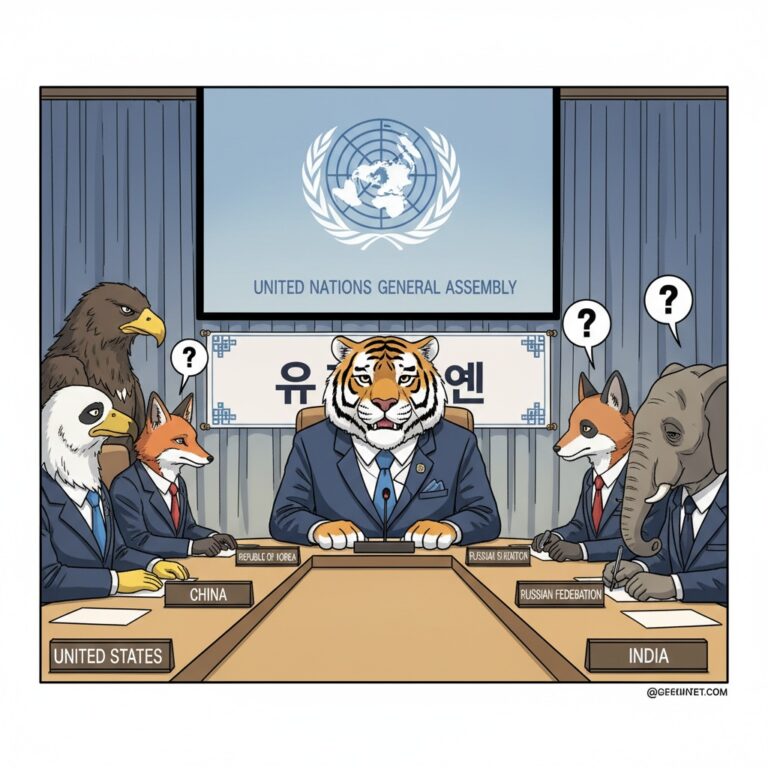
학습 블로그 내용
“Is the UN Paralyzed? Debating Global Security in Korean”
Introduction
Hello! It’s [Daily Hangeul], here to upgrade your Korean skills to a professional level!
While talking about travel and food is fun, true mastery comes when you can discuss complex global issues. Today, we are diving into a high-level topic: Geopolitics and International Security. Specifically, we will learn how to critique the “Role and Limitations of the UN Security Council.”
Why this topic now?
Lately, news outlets in Korea and around the world are filled with debates about the United Nations. With ongoing conflicts in Eastern Europe and the Middle East, there is a growing sentiment that the UN Security Council is failing to function properly due to the veto power of permanent members. In Korea, the term “UN Skepticism” (유엔 무용론) is trending in editorials.
If you want to read Korean newspapers or discuss international politics with Korean colleagues, this lesson is essential for you!
Key Expressions (C2 Advanced Level)
Here are 3 high-level expressions to help you sound like a geopolitical expert.
1. 거부권을 행사하다
- Pronunciation: [Geobu-kkwon-eul haengsa-hada]
- English Meaning: To exercise veto power
- Detailed Explanation:
This is a formal phrase used in political and legal contexts. ‘거부권’ means ‘veto power’ (literally: right to refuse), and ‘행사하다’ means ‘to exercise’ or ‘to use’ (a right or power). You wouldn’t use this when refusing a dinner invitation; it is strictly for official powers. - 💡 Pronunciation Tip:
- Tensification (경음화): In ‘거부권’, the ‘권(gwon)’ is pronounced as [꿘(kkwon)]. This is because in compound words, the second element often becomes tensed to mark the boundary or emphasis. So, say it strongly: [Geobu-kkwon].
2. 유명무실하다
- Pronunciation: [Yumyeong-musil-hada]
- English Meaning: To be nominal; to exist in name only (literally: having a name but no substance)
- Detailed Explanation:
This is a Saja-seong-eo (four-character idiom). It is used to criticize an organization or law that exists officially but has no real power or effect. It is the perfect word to describe a paralyzed international body. - 💡 Pronunciation Tip:
- Linking (연음): This word is relatively straightforward, but make sure to flow the sounds smoothly. The ‘ㅇ(ng)’ in ‘명’ and ‘ㅁ(m)’ in ‘무’ should be distinct. It sounds exactly as it is written, but keep the rhythm steady: [Yu-myeong-mu-sil].
3. 이해관계가 얽히다
- Pronunciation: [Ihae-gwangye-ga eolkida]
- English Meaning: Interests are intertwined/entangled
- Detailed Explanation:
‘이해관계’ means ‘interests’ (specifically regarding gain and loss), and ‘얽히다’ means ‘to be tangled’ or ‘intertwined.’ This phrase is used to explain why a solution is difficult to reach—because too many nations have conflicting interests involved. - 💡 Pronunciation Tip:
- Aspiration (격음화): Look at ‘얽히다’. The batchim ‘ㄺ’ combined with the following ‘ㅎ’ creates a strong aspirate sound. The ‘ㄱ(k)’ sound merges with ‘ㅎ(h)’ to become ‘ㅋ(k)’.
- Therefore, it is pronounced [얼키다 (eol-ki-da)]. Don’t try to pronounce the ‘ㅎ’ separately!
Example Dialogue
Let’s see how these expressions are used in a serious conversation about current events.
Min-ji: 이번 사태를 보면 유엔 안전보장이사회가 정말 유명무실하다는 생각이 들어.
(Looking at this situation, I really think the UN Security Council exists in name only.)
Chris: 맞아. 상임이사국들이 자국의 이익을 위해 거부권을 행사하니까 어떤 결의안도 통과되지 못하잖아.
(You’re right. Because permanent members exercise their veto power for their own national interests, no resolution can be passed.)
Min-ji: 국가 간의 복잡한 이해관계가 얽혀 있어서 개혁도 쉽지 않을 것 같아 걱정이야.
(I’m worried that reform won’t be easy because complex interests between nations are intertwined.)
Culture Tip & Trend Analysis: “UN Skepticism” (유엔 무용론)
In the dialogue, we touched upon the frustration with the UN. To sound like a true Korean intellectual, you should know the term “유엔 무용론” (UN Uselessness Theory).
- The Trend: Recently, as the UN fails to stop major wars due to the veto power of the P5 (Permanent 5 members), Korean news editorials frequently use the headline: “식물 유엔” (Vegetative UN) or “이빨 빠진 호랑이” (Toothless Tiger).
- Context: South Korea is currently serving as a non-permanent member (비상임이사국) of the UNSC for the 2024-2025 term. Because of this, Korean media is paying extra attention to how the council functions (or fails to function).
- Pro Tip: If you want to impress a Korean friend discussing politics, you can say: “요즘은 ‘식물 유엔’이라는 비판을 피하기 어려운 것 같아요.” (It seems difficult to avoid the criticism of being a ‘vegetative UN’ these days.)
Wrap-up & Practice
Today, we stepped away from casual conversation and learned how to critique international security organizations using C2-level vocabulary.
Let’s review:
1. 거부권을 행사하다 (To exercise veto power)
2. 유명무실하다 (To be nominal/powerless)
3. 이해관계가 얽히다 (Interests are intertwined)
📝 Mini Quiz:
Fill in the blank with the correct expression from today’s lesson!
“The organization has lost its authority and is now __________.”
“그 기구는 권위를 잃고 이제 __________.”
(Hint: It starts with ‘유’ and ends with ‘하다’.)
Please leave your answer in the comments! If you have any opinions on the UN’s role, try writing a sentence in Korean using today’s expressions. See you in the next lesson!







