

학습 블로그 내용
Pitching for Good: Social Biz 101
Introduction
Hello! It’s [Daily Hangeul], here to upgrade your Korean skills!
Today, we are diving into a slightly more advanced and professional topic: Presenting ideas for a Social Enterprise.
As you reach the C1 level, you should be able to discuss not just daily life, but also social issues and professional opinions. Recently in Korea, “ESG Management” (Environmental, Social, and Governance) and “Value Consumption” (가치 소비) have become massive trends. The MZ generation doesn’t just buy products; they buy the values behind the brand.
Whether you are a student preparing for a debate or a professional pitching a business idea, these expressions will help you sound intelligent, persuasive, and socially conscious. Let’s learn how to propose a business that changes the world!
Key Expressions
Here are 3 essential expressions for discussing social justice and business models.
1. 양극화 해소 (Yanggeukhwa haeso)
- English Meaning: Resolving polarization (inequality)
- Detail: This is a high-level C1 vocabulary phrase. ‘양극화’ (Polarization) refers to the widening gap between the rich and the poor, or different social groups. ‘해소’ (Resolution/Relief) is used when solving abstract problems or stress. You use this when stating the mission of your social enterprise.
- 💡 Pronunciation Tip:
- [양그콰 해소] (Yang-geu-kwa hae-so)
- Notice the ‘화’ becomes [콰 (kwa)]. This is due to Aspiration (격음화). When the final consonant ‘ㄱ’ (k) in ‘극’ meets the ‘ㅎ’ (h) in ‘화’, they combine to form the strong aspirated sound ‘ㅋ’ (kh). So, say it strongly: Yang-geu-KWA!
2. 취약 계층 (Chwiyak gyecheung)
- English Meaning: Vulnerable social groups / The underprivileged
- Detail: Instead of simply saying “poor people” (which can sound blunt), use this professional term. It refers to the elderly, people with disabilities, or low-income families who need social support. It shows you understand social welfare terminology.
- 💡 Pronunciation Tip:
- [취약 께층] (Chwi-yak kke-cheung)
- Why does ‘계’ sound like ‘께’ (kke)? This is Tensification (경음화). The stop sound ‘ㄱ’ (k) at the bottom of ‘약’ creates tension, causing the following ‘ㄱ’ in ‘계’ to stiffen into a double consonant sound ‘ㄲ’.
3. 선순환 구조 (Seonsunhwan gujo)
- English Meaning: Virtuous cycle structure
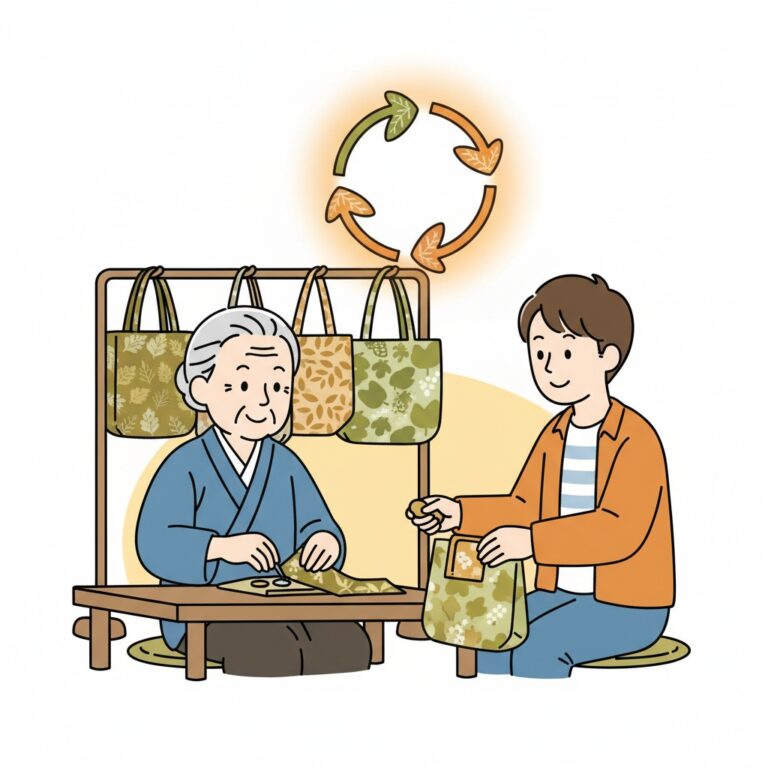
- Detail: This is the “magic word” in business presentations. It means your business isn’t just a one-time charity, but a system where profit leads to more social good, which leads to more profit. It’s the opposite of a “vicious cycle” (악순환).
- 💡 Pronunciation Tip:
- [선순환 구조] (Seon-sun-hwan gu-jo)
- Pronounce the ‘ㄴ’ (n) clearly. Also, be careful with ‘의’ (possessive particle) if you say “Structure of virtuous cycle” (선순환의 구조). In spoken Korean, the particle ‘의’ is often pronounced as [에 (e)]. So, “Seonsunhwan-e gujo” is perfectly natural!
Example Dialogue
Let’s look at how these words are used in a pitch meeting.
(Context: Min-su is presenting his start-up idea to an investor.)
Min-su: 저희 회사의 목표는 노인 빈곤 문제를 해결하여 양극화 해소에 기여하는 것입니다.
(My company’s goal is to contribute to resolving polarization by solving the issue of elderly poverty.)
Investor: 좋은 취지네요. 구체적인 비즈니스 모델이 있나요?
(That’s a good purpose. Do you have a specific business model?)
Min-su: 네, 폐지를 줍는 어르신들을 고용해 친환경 가방을 제작합니다. 이를 통해 취약 계층에게 일자리를 제공하고, 수익금은 다시 교육에 투자하는 선순환 구조를 만들겠습니다.
(Yes, we hire elderly people who collect scrap paper to make eco-friendly bags. Through this, we provide jobs to vulnerable groups, and we will create a virtuous cycle structure where profits are reinvested into education.)
Investor: 요즘 트렌드인 ‘가치 소비’와 딱 맞는 아이템이군요. 기대됩니다.
(That item fits perfectly with the recent ‘Value Consumption’ trend. I look forward to it.)
Culture Tip & Trend Deep Dive
“Don-jjul” (돈쭐) and the Rise of Social Enterprises
Have you heard the slang “돈쭐 내다” (Don-jjul naeda)?
It is a combination of Money (돈) + Scolding (혼쭐). Originally, “scolding” implies punishment, but here, it means “punishing a shop owner by buying all their products because they are so kind!”
Korean consumers, especially the younger generation, actively look for businesses that support social justice. If a restaurant gives free food to hungry children, people will flock there to “Don-jjul” them (buy everything to make them rich).
When you present a social enterprise idea in Korean, mentioning that your brand targets the “MZ generation’s Value Consumption” (MZ세대의 가치 소비) will make your pitch much more convincing. It shows you understand the current Korean market psychology!
Conclusion & Practice
Today, we learned high-level vocabulary to discuss social justice and business. These words will help you sound like a professional who cares about society.
📝 Mini Quiz:
Fill in the blank with the correct expression we learned today.
“Our project aims to create a _______________ where helping the environment also creates profit.”
(우리 프로젝트는 환경을 돕는 것이 수익 창출로 이어지는 [ ? ? ? ]를 만드는 것을 목표로 합니다.)
Answer: (Drag to see) -> [ 선순환 구조 ]
Don’t be afraid to use these advanced words! Leave a comment below using one of today’s expressions to describe a social problem you want to solve.
See you next time with more useful Korean!
Frequently Asked Questions (FAQ)
Q: What does "'양극화'" mean in Korean and how do you pronounce it?
A: In Korean, "'양극화'" is pronounced [Polarization] and means: refers to the widening gap between the rich and the poor, or different social groups.
Q: What does "'해소'" mean in Korean and how do you pronounce it?
A: In Korean, "'해소'" is pronounced [Resolution/Relief] and means: is used when solving abstract problems or stress. You use this when stating the
Q: What does "'께'" mean in Korean and how do you pronounce it?
A: In Korean, "'께'" is pronounced [kke] and means: ? This is







