

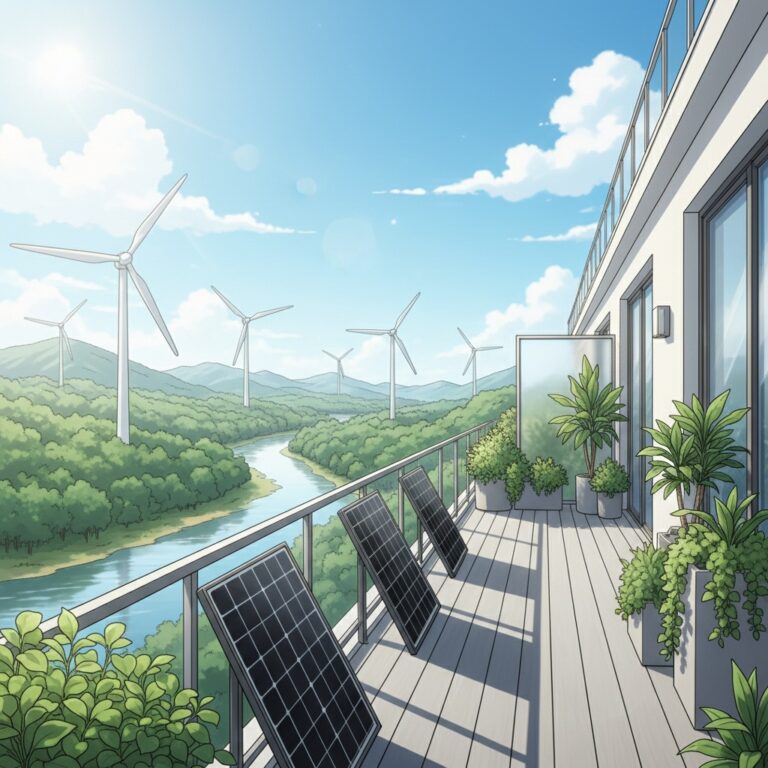
Let’s Discuss Renewable Energy in Korean!
Introduction
Hello! This is [Daily Korean], here to upgrade your Korean skills to the next level!
Today, we are going to dive into a topic that is essential for any Global Citizen: Renewable Energy. Have you noticed how much the world is talking about climate change lately? In Korea, “Carbon Neutrality” (탄소 중립) and “ESG Management” are huge trends right now. Whether you are reading the news or discussing social issues with your Korean colleagues, knowing how to explain the types, pros, and cons of energy sources will make you sound very intellectual and fluent.
Let’s learn how to express your thoughts on this important global issue in natural Korean!
Key Expressions
Here are 4 key expressions to help you discuss renewable energy like a pro.
1. 재생 가능 에너지 (Renewable energy)
- Pronunciation: [Jaesaeng ganeung eneoji]
- English Meaning: Renewable energy
- Detail: This is the direct translation. ‘재생’ means regeneration, ‘가능’ means possible. You can use this term when introducing the topic. Common types include ‘태양광’ (Solar) and ‘풍력’ (Wind).
- 💡 Pronunciation Tip:
- In Korean, when two words are combined, we often pause slightly, but try to flow smoothly.
- ‘능 (neung)’ + ‘에 (e)’: When you say this quickly, the ‘ㅇ(ng)’ sound carries over to the next vowel. So it sounds a bit like [Jaesaeng ganeung-ngeneoji]. This linking makes your speech sound much more natural!
2. 장단점이 뚜렷하다 (The pros and cons are clear)
- Pronunciation: [Jangdanjeomi tturyeothaeyo]
- English Meaning: The pros and cons are clear/distinct.
- Detail: ‘장점’ (Pros) + ‘단점’ (Cons) = ‘장단점’. This is a B2 level phrase used to analyze a situation objectively. It shows you aren’t just agreeing, but thinking critically.
- 💡 Pronunciation Tip:
- ‘장단점’ is pronounced [Jang-ttan-jeom]. Why does ‘ㄷ(d)’ become ‘ㄸ(tt)’? This is called Tensification (Doensori). Because of the ending sound of the previous syllable, the following consonant hardens.
- ‘뚜렷하다’: The ‘ㅎ(h)’ is weak. Often, it blends with the final consonant or disappears in fast speech, sounding like [tturyeotaeyo].
3. ~는 반면에 (On the other hand / While…)
- Pronunciation: [~neun banmyeone]
- English Meaning: On the other hand; While…
- Detail: This is a crucial grammar point for intermediate learners. Use this to contrast two ideas in one sentence. It’s perfect for comparing the benefits and drawbacks of energy sources.
- Example: Solar power is clean, while it is expensive to install.
- 💡 Pronunciation Tip:
- Pay attention to ‘반면 (Banmyeon)’. The ‘ㄴ(n)’ and ‘ㅁ(m)’ are nasal sounds. Make sure to articulate them clearly so it doesn’t sound like “Bam-myeon”.
4. 친환경적이다 (To be eco-friendly)
- Pronunciation: [Chin-hwangyeong-jeogida]
- English Meaning: To be eco-friendly
- Detail: ‘친(Chin)’ means pro/friendly, and ‘환경(Hwangyeong)’ means environment. You will hear this word everywhere in Korea these days, from coffee shops (paper straws) to car commercials (EVs).
- 💡 Pronunciation Tip:
- ‘환경 (Hwangyeong)’: The ‘ㅘ (wa)’ sound combined with the ‘yeo’ sound can be tricky. Practice rounding your lips for ‘Hwa’ and opening them for ‘gyeong’.
Example Dialogue
Let’s see how these expressions work in a conversation about the latest trends.
Situation: Minji and Tom are talking about the solar panels installed on a new apartment building.
Tom: 민지 씨, 저 아파트 베란다에 있는 거 태양광 패널이죠? 요즘 한국에 저런 게 많네요.
(Minji, is that a solar panel on that apartment veranda? There are so many of those in Korea these days.)Minji: 네, 맞아요. 요즘은 재생 가능 에너지에 대한 관심이 정말 높거든요.
(Yes, that’s right. Interest in renewable energy is really high these days.)Tom: 태양광 에너지는 정말 좋은 것 같아요. 공해도 없고요.
(Solar energy seems really good. There is no pollution either.)Minji: 맞아요. 친환경적인 건 큰 장점이죠. 하지만 날씨의 영향을 많이 받는다는 단점도 있어요.
(That’s true. Being eco-friendly is a big advantage. However, there is also the disadvantage that it is heavily influenced by the weather.)Tom: 아, 그렇군요. 모든 에너지에는 장단점이 뚜렷하네요.
(Ah, I see. Every energy source has clear pros and cons.)Minji: 네. 유지 비용은 저렴한 반면에, 초기 설치 비용은 좀 비쌀 수 있어요.
(Yes. While maintenance costs are low, the initial installation cost can be a bit expensive.)
Culture Tip & Trend Analysis
🌏 The “RE100” Movement and Korean Companies
Did you know that many major Korean companies (like Samsung and SK) are joining the RE100 campaign? This stands for “Renewable Energy 100%,” meaning they aim to use only renewable energy for their operations.
Because of this trend, the ability to discuss energy isn’t just for scientists anymore—it’s a common topic in business meetings and news reports.
Also, among the younger generation (MZ Generation), being an “Eco-Warrior” is trendy! They use the word ‘가치 소비 (Value Consumption)’, which means spending money on products that align with their values, such as eco-friendly or renewable energy-supporting brands. Using the expressions you learned today will definitely help you connect with these socially conscious friends!
Conclusion & Practice
Today, we explored how to discuss Renewable Energy in Korean. We learned words like Jaesaeng ganeung eneoji and grammar structures like ~neun banmyeone to compare pros and cons. These expressions are key to showing your B2 (Intermediate) proficiency!
📝 Practice Quiz
Try to complete the sentence below using today’s expressions:
“Wind power is eco-friendly, [ ? ] it makes a lot of noise.”
(풍력 발전은 친환경적이다 / 소음이 심하다)Hint: Use ‘~는 반면에’ to connect the two ideas!
Answer: 풍력 발전은 친환경적인 반면에, 소음이 심해요.
Did you get it right? Leave your own sentence using “장단점” or “반면에” in the comments below! I’d love to see your Korean skills in action.
See you in the next lesson!







