

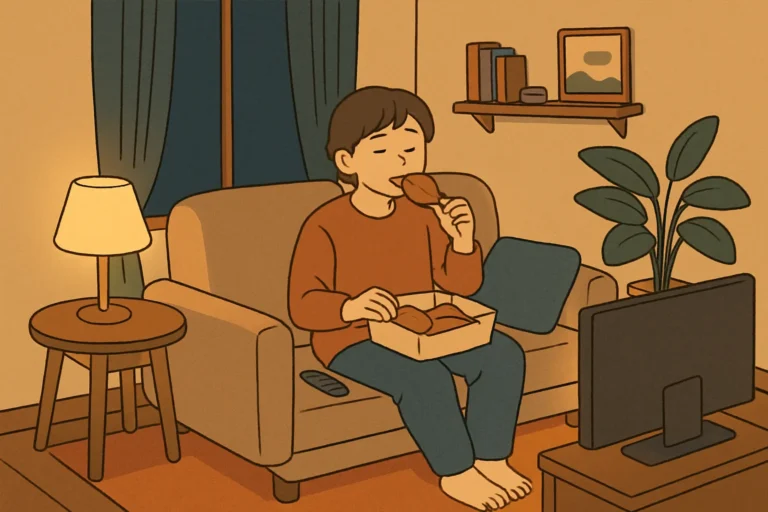
Korean Diary: My Healing Evening Routine 🌙
Introduction
Hello! It’s [Daily Hangeul], here to upgrade your Korean skills! 👋
Today, we are going to learn how to write a simple diary entry about your evening after work. Being able to describe your day is a crucial skill for A2 level learners!
In Korea these days, sharing one’s daily life via “Vlog” or “Instagram Stories” is a huge trend. People love to show their #OOTD (Outfit of the Day) or their cozy evening routine, often calling it “Healing” (힐링) time. Do you want to write a Korean diary that sounds natural and trendy like a local? Let’s dive in!
Key Expressions (3~5)
Here are the essential expressions you need to describe a relaxing evening.
1. 퇴근하다 (To get off work)
- Pronunciation: [Toe-geu-na-da]
- English Meaning: To finish work / To get off work
- Detail: This is the happiest word for office workers! It combines ‘퇴 (retreat)’ and ‘근 (work)’. You can say “저 퇴근해요” (I’m getting off work now).
- 💡 Pronunciation Tip:
- Even though it is written as ‘toe-geun-ha-da’, it is often pronounced as [toe-geu-na-da].
- The ‘ㅎ(h)’ sound is weak. When it meets the ‘ㄴ(n)’ patchim (final consonant) from the previous block, the ‘ㅎ’ often disappears, and the ‘ㄴ’ slides over. This makes your speech sound much smoother!
2. 끝나다 (To finish / To end)
- Pronunciation: [Kkeun-na-da]
- English Meaning: To be finished / To end
- Detail: You use this when an event or a specific task is over. For example, “일이 끝났어요” (Work is finished).
- 💡 Pronunciation Tip:
- Written as ‘kkeut-na-da’, but pronounced [kkeun-na-da].
- Why? The bottom letter ‘ㅌ’ (t sound) meets the ‘ㄴ’ (n sound) next to it. The ‘t’ changes into an ‘n’ sound to make it easier to say. This phenomenon is called ‘Nasalization’. Don’t say “Kkeut-na-da” stiffly; say “Kkeun-na-da” softly!
3. 시키다 (To order [food])
- Pronunciation: [Si-ki-da]
- English Meaning: To order (delivery food)
- Detail: While ‘주문하다’ is the formal word for order, in casual conversation and diaries, Koreans often say “치킨 시켜 먹자” (Let’s order and eat chicken). It implies ordering delivery, which is huge in Korea.
- 💡 Pronunciation Tip:
- Pronounce ‘Si’ clearly like the ‘se’ in “See”. The ‘ki’ is an aspirated sound, so let a little burst of air out when you say it!
4. 꿀잠 (Sweet sleep / Sound sleep)
- Pronunciation: [Kkul-jam]
- English Meaning: A very good, deep sleep
- Detail: This is a very common slang/compound word used in diaries and texts. ‘꿀’ means honey 🍯 and ‘잠’ means sleep 💤. So, it literally means “Honey Sleep.”
- 💡 Pronunciation Tip:
- The ‘ㄲ’ in ‘꿀’ is a tense sound (Double Consonant). Tense your throat slightly to make a sharp, strong ‘K’ sound, different from a soft ‘g’ or airy ‘k’.
Example Dialogue
Let’s see how these expressions are used in a real conversation.
(Minji and Jason are texting after work)
Minji: 제이슨, 일 끝났어요? (Jason, is work finished?)
Jason: 네! 방금 퇴근했어요. 너무 피곤해요. (Yes! I just got off work. I’m so tired.)
Minji: 오늘 저녁은 뭐 먹을 거예요? (What are you going to eat for dinner?)
Jason: 집에서 치킨 시켜 먹고 넷플릭스 볼 거예요. (I’m going to order chicken at home and watch Netflix.)
Minji: 오, 완벽한 저녁이네요! 오늘 밤 꿀잠 주무세요! (Oh, that’s a perfect evening! Have a sweet sleep tonight!)
Culture Tip & Trend Analysis 🇰🇷
Did you know about “Bul-geum” and “Baedal”?
- Bul-geum (불금): In the dialogue, Jason is relaxing, but if it were Friday, he might say “It’s Bul-geum!” This stands for “Burning Friday” (Fire Friday), similar to TGIF.
- Delivery Culture: In Korea, ordering food (배달) is not just about eating; it’s a culture. You can order almost anything (coffee, ice cream, sashimi) to anywhere (even a park bench!) using apps like Baemin or Coupang Eats.
- Writing Tip: When Korean Z-gens write diaries on blogs or Instagram, they often post a picture of their delivery food and write “오늘의 소확행” (Today’s small but certain happiness). Try using this phrase in your diary!
Conclusion & Practice
Today, we learned how to describe a cozy evening routine for your diary. You learned how to say you finished work (퇴근하다), ordered food (시키다), and plan to sleep well (꿀잠).
📝 Mini Quiz!
Fill in the blanks to complete your diary entry:
“오늘 6시에 __________ (got off work). 집에 와서 피자를 __________ (ordered). 정말 행복했다!”
Answer: 퇴근했다 / 시켰다 (Past tense forms!)
How was your evening today? Try writing one sentence in the comments using today’s expressions! I’ll be waiting! 👋
See you next time on Daily Hangeul!







