

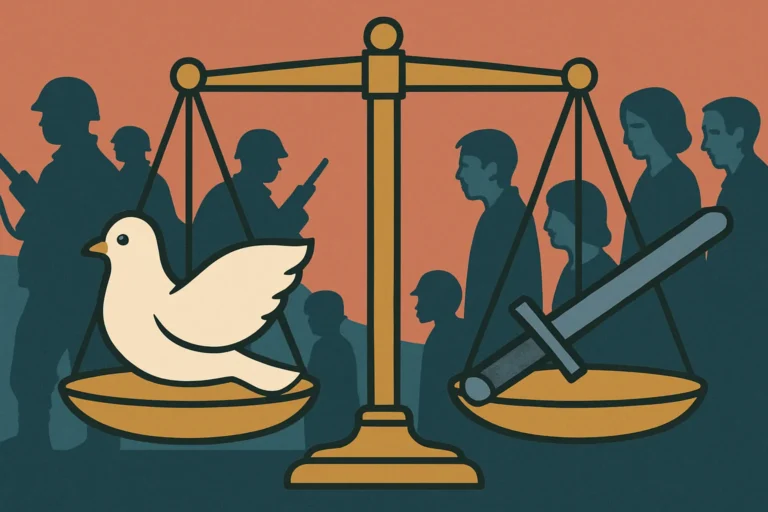
Is War Ever Justified? Advanced Korean Ethics
Hello! This is [Daily Hangeul], here to upgrade your Korean skills to the next level!
Welcome back, advanced learners! Today, we are diving into a rather serious but intellectually stimulating topic: Ethics and War. As C1 level learners, your goal is to be able to discuss social issues, read news editorials, and express opinions on complex matters.
Trend Alert: Recently, with various global conflicts dominating the headlines, Korean news outlets and academic forums are buzzing with debates about “Peace through Strength” versus “Peace through Dialogue.” You might also see these themes in popular Korean movies like 12.12: The Day (서울의 봄) or political dramas, where characters constantly argue about the justification of their actions.
Today, we will learn how to discuss Just War Theory (Jus ad Bellum & Jus in Bello) in Korean. This will help you sound professional and articulate when discussing current events!
Core Expressions (Key Vocabulary)
Here are 4 high-level expressions to help you debate the ethics of war.
1. 정당성 (Jeongdangseong)
- Pronunciation: [Jeong-dang-sseong]
- English Meaning: Justification / Legitimacy
- Detail: This is the most crucial word for “Jus ad Bellum” (the right to go to war). It refers to having a valid, moral, or legal reason for an action. You will often hear politicians or news anchors ask, “Does this war have justification?” (이 전쟁은 정당성이 있는가?).
- 💡 Pronunciation Tip:
- Notice the last syllable changes from ‘성(seong)’ to [썽(sseong)].
- This is a rule called Tensification (Doen-sori). Because the preceding batchim ‘ㅇ(ng)’ creates a pause, the ‘ㅅ(s)’ sound naturally hardens into a tense ‘ㅆ(ss)’ sound for emphasis. So, say it with energy: Jeong-dang-SSEONG!
2. 최후의 수단 (Choihu-ui sudan)
- Pronunciation: [Choihu-e sudan] or [Choihu-ye sudan]
- English Meaning: Last resort
- Detail: In Just War Theory, war must only be waged as a “last resort” after all diplomatic efforts have failed. This is a very common phrase in formal writing and debates.
- 💡 Pronunciation Tip:
- The possessive particle ‘의 (ui)’ is officially pronounced as ‘ui’, but in spoken Korean, it is very often pronounced as [에 (e)].
- So, it sounds much more natural to say [Choihu-e sudan] rather than twisting your tongue to say [Choihu-ui].
3. 교전 수칙 (Gyojeon suchik)
- Pronunciation: [Gyo-jeon su-chik]
- English Meaning: Rules of Engagement (ROE)
- Detail: This relates to “Jus in Bello” (justice in war). It refers to the rules soldiers must follow during combat to minimize unnecessary harm. If a character in a drama asks, “Did you follow the rules?” in a military context, they are talking about this.
- 💡 Pronunciation Tip:
- This word is relatively straightforward! Just remember to keep the ‘jeon’ clear. It is not ‘jun’. Open your mouth slightly wider for the ‘eo’ sound.
4. 민간인 피해 (Minganin pihae)
- Pronunciation: [Min-ga-nin pi-hae]
- English Meaning: Civilian casualties / Civilian damage
- Detail: The core ethical dilemma in modern warfare. Discussing how to minimize minganin pihae is essential when talking about the ethics of war conduct.
- 💡 Pronunciation Tip:
- Linking (Yeoneum): When ‘민간인’ is spoken fast, the final ‘ㄴ’ of ‘간’ moves over to ‘인’.
- So instead of Min-gan-in, it flows like [Min-ga-nin]. This makes your Korean sound much smoother and native-like!
Real-Life Dialogue Example
Let’s see how two colleagues, Min-jun and Sarah, discuss a recent international news report.
Min-jun: 이번 전쟁에 대한 뉴스를 봤어요? 상황이 점점 심각해지네요.
(Did you see the news about the war this time? The situation is getting serious.)
Sarah: 네, 봤어요. 하지만 저는 그 전쟁 개시에 정당성이 있는지 의문이에요.
(Yes, I saw it. But I question whether there is justification for starting that war.)
Min-jun: 맞아요. 전쟁은 외교적 노력이 실패했을 때 최후의 수단이어야 하니까요.
(That’s right. Because war should be the last resort when diplomatic efforts fail.)
Sarah: 게다가 민간인 피해가 계속 늘어나고 있어서 너무 안타까워요.
(Furthermore, it’s so tragic that civilian casualties keep increasing.)
Culture Tip & Trend Deep Dive
🇰🇷 The Concept of “Myeongbun” (명분)
When discussing ethics in Korea, you cannot ignore the concept of ‘Myeongbun’ (명분). It translates roughly to “moral justification” or “pretext.”
In Korean history and modern politics, having a proper Myeongbun is vital. Even if a war or an action is strategically necessary, if it lacks Myeongbun, the public will heavily criticize it.
Trend Analysis:
Recently, in Korean online communities and news comments regarding global conflicts, you will see netizens debating:
“Is this a war for peace (Defense), or a war for profit (Invasion)?”
To sound like a true intellectual (C1 level), try connecting today’s word ‘정당성’ (Justification) with ‘명분’.
* Example: “그 공격은 명분이 없어서 정당성을 인정받기 힘들어요.” (That attack lacks a moral cause, so it’s hard to recognize its justification.)
Wrap-up & Practice
Today we tackled a heavy but necessary topic for advanced communication: The Ethics of War. You learned how to discuss justification, last resorts, and civilian protection. These words will appear frequently in news editorials (사설) and academic texts.
📝 Mini Quiz:
Fill in the blanks using the words we learned today!
- War should only be considered as a ( _________ ) when diplomacy fails.
(전쟁은 외교가 실패했을 때 [최후의 수단]으로 고려되어야 합니다.) -
Soldiers must strictly follow the ( _________ ) to prevent war crimes.
(군인들은 전쟁 범죄를 막기 위해 [교전 수칙]을 엄격히 따라야 합니다.)
Answer Key: 1. 최후의 수단, 2. 교전 수칙
Have you ever debated a social issue in Korean? Leave a comment below using one of today’s expressions!
See you in the next post, where we will make you sound even more like a native speaker! 👋
Frequently Asked Questions (FAQ)
Q: What does "'정당성'" mean in Korean and how do you pronounce it?
A: In Korean, "'정당성'" is pronounced [Justification] and means: with







