

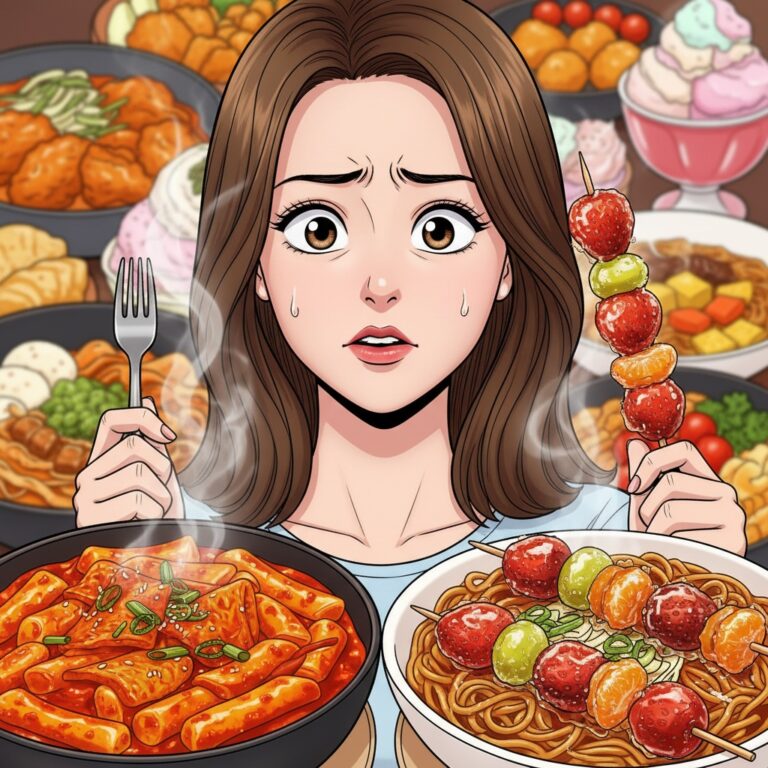
학습 블로그 내용
“Guilty Pleasure Foods: Delicious or Dangerous?”
Hello! This is [Daily Hangeul], here to upgrade your Korean skills!
Welcome back, everyone! Today, we are diving into a delicious yet controversial topic in our Food and Nutrition module: “Guilty Pleasure” foods.
We all have that one food we know isn’t great for our health but is just too delicious to resist, right? Nowadays in Korea, there is a huge craze for “Sweet and Salty” (단짠단짠) combinations, like eating spicy Mala Tang followed by sweet Tanghulu (candied fruit). At the same time, the “Zero Sugar” trend is booming because people want to manage their health.
Today, let’s learn how to express your thoughts on these high-calorie temptations and discuss nutrition like a local!
Key Expressions
Here are 4 essential expressions to discuss food, calories, and your feelings about them.
1. 참을 수 없다 (Can’t resist / Can’t stand)
- Pronunciation: [Chameul su eop-tta]
- Meaning: I can’t resist / I can’t stand it.
- Detail: This is a B2-level expression used when your desire for something is overwhelming. You can use it when you see delicious food and want to say, “I can’t hold back anymore!”
- 💡 Pronunciation Tip:
- ‘없다’ is pronounced [eop-tta].
- First, the double final consonant ‘ㅂㅅ’ simplifies to ‘ㅂ’ (p).
- Second, the following ‘다’ (da) hardens to ‘따’ (tta) because of the ‘ㅂ’ sound. This is called Tensification. So, it’s not ‘eop-da’, but strong [eop-tta].
2. 칼로리 폭탄 (Calorie bomb)
- Pronunciation: [Kallori pok-tan]
- Meaning: Calorie bomb (very high-calorie food).
- Detail: This is a very common idiomatic expression. It refers to food that is extremely high in calories, like a burger with extra cheese or deep-fried chicken.
- 💡 Pronunciation Tip:
- ‘폭탄’ is pronounced [pok-tan].
- Make sure to pronounce the ‘k’ in ‘pok’ clearly but stop the air flow (unreleased stop), then say ‘tan’. It sounds impactful, just like a bomb!
3. 죄책감이 들다 (To feel guilty)
- Pronunciation: [Joe-chaek-kka-mi deul-da]
- Meaning: To feel a sense of guilt.
- Detail: This is useful for expressing abstract feelings. You use this when you eat a late-night snack and regret it slightly because of your diet or health.
- 💡 Pronunciation Tip:
- ‘감’ (gam) followed by ‘이’ (i) connects smoothly.
- However, notice the [kka] sound in the middle? The ‘ㄱ’ in ‘책’ (chaek) makes the ‘ㄱ’ in ‘감’ (gam) sound harder, like ‘kk’. This is another example of Tensification.
- So, it flows like: Joe-chaek-ka-mi.
4. 맛있으면 0칼로리 (If it tastes good, it’s 0 calories)
- Pronunciation: [Ma-si-sseu-myeon yeong-kallori]
- Meaning: If it’s delicious, it’s zero calories.
- Detail: This is a famous Korean quote! It’s a humorous way to justify eating high-calorie food. It means “Let’s enjoy this food happily without stressing about weight.”
- 💡 Pronunciation Tip:
- ‘맛있으면’ involves Liaison (Linking).
- The final consonant ‘ㅅ’ (from 맛) moves to the empty ‘ㅇ’ spot in ‘있’. Then the ‘ㅆ’ (from 있) moves to ‘으’.
- It sounds like [ma-si-sseu-myeon]. It flows like water!
Real-Life Dialogue
Let’s see how A and B decide on their dinner menu using these expressions.
A: 오늘 스트레스 받는데, 저녁으로 엽기 떡볶이 어때?
(I’m so stressed today. How about Yeopgi Tteokbokki for dinner?)B: 떡볶이? 그거 완전 칼로리 폭탄이잖아. 나 다이어트 중인데…
(Tteokbokki? That’s a total calorie bomb. I’m on a diet…)A: 에이, 매운 떡볶이 냄새는 참을 수 없지! 딱 오늘만 먹자.
(Hey, you can’t resist the smell of spicy Tteokbokki! Let’s eat it just for today.)B: 하… 먹고 나면 죄책감이 들 것 같은데.
(Sigh… I think I’m going to feel guilty after eating it.)A: 걱정 마! 한국에는 이런 말이 있어. “맛있으면 0칼로리!”
(Don’t worry! There is a saying in Korea. “If it tastes good, it’s 0 calories!”)
Culture Tip & Trend Analysis
Did you know? The “Healthy Pleasure” Trend
While expressions like “맛있으면 0칼로리” (coined by actress Choi Hwa-jung) remain legendary, the current trend among Korean Gen Z is “Healthy Pleasure” (헬시 플레저).
Instead of starving or feeling guilty (죄책감), young Koreans are looking for sustainable ways to enjoy food. This is why:
1. Zero Sugar drinks and snacks are everywhere in convenience stores (even Zero Sugar Soju!).
2. Protein-fortified snacks are replacing traditional junk food.
So, you can say: “I ate a calorie bomb, but I drank Zero Coke, so it’s okay!” This is a very “Korean” way to joke about your diet!
Wrap-up & Practice
Today, we learned how to talk about temptations and nutrition using expressions like “Calorie bomb” and “If it tastes good, it’s 0 calories.” Remember, enjoying food happily is also good for your mental health!
📝 Mini Quiz:
Fill in the blanks with the correct expression from today’s lesson.
- This cake is delicious, but it looks like a __________ (칼로리 폭탄).
- I shouldn’t eat this late at night, but I __________ (참을 수 없어).
Leave a comment below!
What is your “Guilty Pleasure” food? Try writing a sentence using “참을 수 없어요”!
See you in the next post! 👋
Frequently Asked Questions (FAQ)
Q: What does "'감'" mean in Korean and how do you pronounce it?
A: In Korean, "'감'" is pronounced [gam] and means: followed by
Q: What does "'이'" mean in Korean and how do you pronounce it?
A: In Korean, "'이'" is pronounced [i] and means: connects smoothly.







