

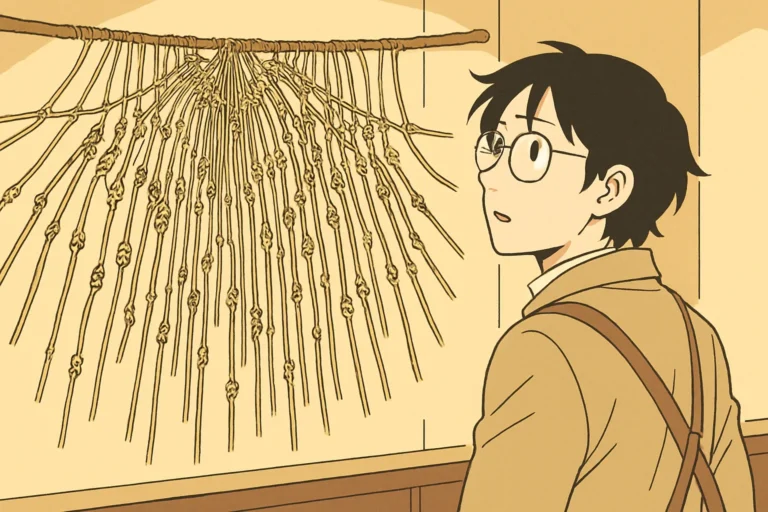
Unraveling the Inca’s Knotted Secret: Let’s Decode the Quipu!
Hello! This is Maeil Hangeul, here to upgrade your Korean skills to a whole new level!
Today, we’re stepping away from daily conversations and diving deep into the world of history and archaeology. We’ll be discussing the fascinating Inca Empire and their unique information system, the Quipu. Why this topic? Recently in Korea, there’s been a surge of interest in historical documentaries that explore the mysteries of ancient civilizations. Learning the vocabulary to discuss these complex subjects will not only impress your Korean friends but also allow you to engage with sophisticated content like academic articles, museum exhibits, and intellectual TV shows.
Let’s get ready to discuss the rise and fall of empires like a true expert!
Core Expressions for the Aspiring Historian
Here are some key expressions you’ll need to discuss the enigma of the Inca’s knotted strings.
1. 결승문자 (Gyeolseungmunja)
- English Meaning: Knotted-string writing (a system of writing using knots in strings)
- Detailed Explanation: This is a highly specific, academic term perfect for a C2 learner. It’s a compound noun derived from Hanja: 결 (結) meaning ‘to tie’ or ‘knot’, 승 (繩) meaning ‘rope’ or ‘string’, and 문자 (文字) meaning ‘writing’ or ‘characters’. While ‘키푸’ (Kipu) is the proper noun for the Inca system, 결승문자 is the general term for this type of writing technology. Using it shows a deep and precise understanding of the topic.
- 💡 Pronunciation Tip: The ‘ㅆ’ (ss) in ‘승’ is a tense consonant. It’s pronounced with more force in your throat and no puff of air, making it sharper and tighter than a regular ‘ㅅ’ (s). Imagine a slight “hissing” sound. It’s not seung, but sseung. This tension is crucial for sounding like a native speaker.
2. 해독하다 (Haedokada)
- English Meaning: To decipher; to decode
- Detailed Explanation: This verb is essential when talking about ancient scripts, codes, or any complex information that isn’t immediately understandable. It implies a process of scholarly investigation and breaking a code. You can use it for Egyptian hieroglyphs, Mayan glyphs, and of course, the quipu.
- 💡 Pronunciation Tip: In Korean, when a syllable ending in ‘ㅎ’ (h) is followed by a syllable starting with ‘ㄷ’ (d), they often merge to create an aspirated ‘ㅌ’ (t) sound. So, ‘해독’ is not pronounced hae-dok but rather [해독/haedok], with a slight aspiration on the ‘ㄷ’. However, the more important rule here is the aspiration of ‘ㅋ’ (k). Unlike the English ‘k’, the Korean ‘ㅋ’ requires a strong puff of air. Hold your hand in front of your mouth when you say [haedokada] – you should feel the air!
3. ~에 대한 가설을 세우다 (e daehan gaseoreul seuda)
- English Meaning: To establish/formulate a hypothesis about ~
- Detailed Explanation: This is a key phrase for any academic or scientific discussion. It’s a grammatical pattern composed of: ~에 대한 (a modifier meaning ‘about’ or ‘regarding’), 가설 (hypothesis), and 세우다 (literally ‘to set up’ or ‘to build’, but in this context, ‘to establish’). It’s the standard way to say you’re creating a scholarly theory about something.
- 💡 Pronunciation Tip: Notice the liaison (or linking sound) in ‘가설을’ [gaseoreul]. The final consonant ‘ㄹ’ (l) of ‘가설’ moves over to the empty initial spot of the following syllable ‘을’, making the pronunciation smooth and connected: [ga-seo-reul], not ga-seol eul. This is a fundamental rule in Korean pronunciation.
4. 실마리를 제공하다 (Silmarireul jegonghada)
- English Meaning: To provide a clue; to offer a lead
- Detailed Explanation: ‘실마리’ is a beautiful native Korean word that literally means the ‘end of a thread’. Metaphorically, it means a clue or a starting point for solving a mystery or problem. 제공하다 means ‘to provide’ or ‘to offer’. This phrase is perfect for describing how a new archaeological find might help researchers understand the past.
- 💡 Pronunciation Tip: Just like our previous example, liaison is key here. ‘실마리를’ is pronounced [silmarireul]. The ‘ㄹ’ (l) from ‘리’ links smoothly to the ‘를’, creating a fluid, rolling sound. Practice saying it quickly: sil-ma-ri-reul.
Example Dialogue: At the National Museum
Two friends, Minjun and Sofia, are discussing a special exhibit on ancient civilizations.
A (Sofia): 와, 이 키푸 좀 봐. 정말 복잡하게 생겼다. 이게 잉카 제국의 결승문자였다니, 믿기지가 않아.
Wa, i kipu jom bwa. Jeongmal bokjaphage saenggyeotda. Ige ingka jegugui gyeolseungmunjayeotdani, mitgijiga ana.
(Wow, look at this quipu. It looks so complex. I can’t believe this was the Inca Empire’s knotted-string writing.)
B (Minjun): 맞아. 수십 년 동안 학자들이 이걸 완벽하게 해독하려고 노력했지만 아직도 미스터리로 남아있대.
Maja. Susim nyeon dongan hakjadeuri igeol wanbyeokage haedokaryeogo noryeokaetjiman ajikdo miseuteriro namaitdae.
(Right. They say scholars have been trying to fully decipher it for decades, but it still remains a mystery.)
A (Sofia): 전시 설명에 따르면, 이게 단순한 회계 장부라는 가설을 세운 학자도 있고, 신화나 역사를 기록한 문자 체계라고 주장하는 학자도 있대.
Jeonsi seolmyeonge ttareumyeon, ige dansunhan hoegye jangburaneun gaseoreul seun hakjado itgo, sinhwana yeoksareul girokan munja chegyerago jujanghaneun hakjado itdae.
(According to the exhibit’s description, some scholars have formulated the hypothesis that it’s a simple accounting ledger, while others claim it’s a writing system that recorded myths and history.)
B (Minjun): 맞아. 그래서 새로운 키푸가 발견될 때마다 그게 결정적인 실마리를 제공해 주길 모두가 기대하는 거지.
Maja. Geuraeseo saeroun kipuga balgyeondoel ttaemada geuge gyeoljeongjeogin silmarireul jegonghae jugil moduga gidaehaneun geoji.
(Exactly. That’s why every time a new quipu is discovered, everyone hopes it will provide a crucial clue.)
Culture Tip & Deeper Dive
Why does a topic like this resonate in Korea? Korea has one of the most meticulously documented histories in the world. The 조선왕조실록 (Joseon Wangjo Sillok – The Annals of the Joseon Dynasty) is a UNESCO Memory of the World, recording 472 years of the dynasty’s history in painstaking detail.
This deep-rooted appreciation for record-keeping and historical truth means that Koreans are often fascinated by how other cultures preserved their past. The mystery of the quipu, a potential lost library of an entire empire, is a captivating subject. When you discuss this topic, you can draw a parallel to Korea’s own rich tradition of historiography. Mentioning something like, “The quipu is as mysterious as the parts of our own ancient history that were lost,” shows a profound level of cultural and historical awareness. You’ll sound less like a student and more like a well-read intellectual!
Let’s Wrap Up & Practice!
Today, we learned four sophisticated Korean expressions to discuss the historical mystery of the Inca quipu. We explored 결승문자 (knotted-string writing), 해독하다 (to decipher), ~에 대한 가설을 세우다 (to formulate a hypothesis about), and 실마리를 제공하다 (to provide a clue).
Now it’s your turn to be the historian!
Practice Question:
Imagine a new quipu has just been discovered in the Andes. Using at least two of the expressions we learned today, write one or two sentences in Korean describing its significance.
Share your sentences in the comments below! We can’t wait to see the brilliant hypotheses you come up with. Happy learning
Frequently Asked Questions (FAQ)
Q: What does "결" mean in Korean and how do you pronounce it?
A: In Korean, "결" is pronounced [結] and means: meaning 'to tie' or 'knot',
Q: What does "승" mean in Korean and how do you pronounce it?
A: In Korean, "승" is pronounced [繩] and means: meaning 'rope' or 'string', and
Q: What does "문자" mean in Korean and how do you pronounce it?
A: In Korean, "문자" is pronounced [文字] and means: meaning 'writing' or 'characters'. While
Q: What does "'키푸'" mean in Korean and how do you pronounce it?
A: In Korean, "'키푸'" is pronounced [Kipu] and means: is the proper noun for the Inca system,







