

Hello! This is Maeil Hangul (매일한글), here to upgrade your Korean skills!
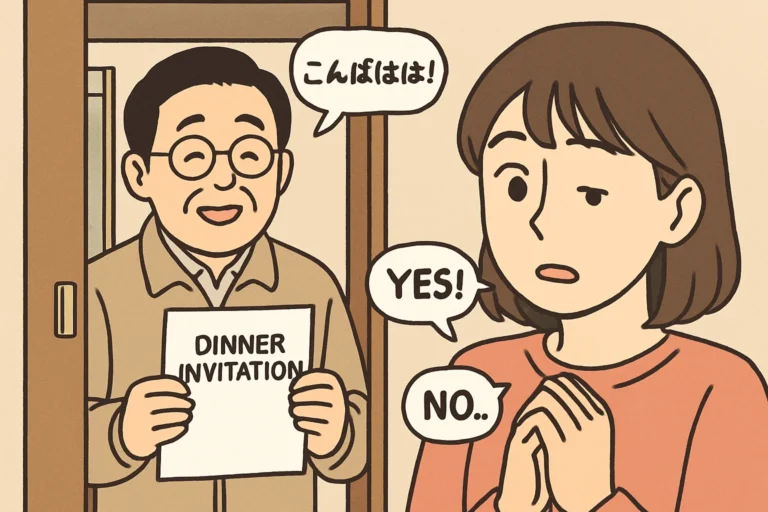
Have you ever bumped into your friendly Korean neighbor who then asks, “Would you like to come over for dinner sometime?” It’s a wonderful gesture, but it can also be a little nerve-wracking if you don’t know how to respond!
These days in Korea, with the popularity of home-cafes (홈카페) and cozy gatherings, inviting neighbors over is becoming more common. So, how do you accept graciously or decline politely without causing any awkwardness? Don’t worry, we’ve got you covered! Today, let’s learn the essential phrases to handle any invitation like a pro.
Key Expressions for Invitations
Here are the must-know phrases for responding to your neighbor.
1. Happily Accepting: 네, 좋아요! 꼭 갈게요.
- Pronunciation: [Ne, joayo! Kkok galgeyo.]
- English Meaning: Yes, sounds great! I’ll definitely be there.
- Detailed Explanation: This is a perfect and enthusiastic way to accept an invitation.
네, 좋아요!(Ne, joayo!) means “Yes, it’s good!” or “Yes, sounds great!” It shows your positive feeling.꼭 갈게요(Kkok galgeyo) is the key part.꼭(kkok) means “definitely” or “surely,” and the grammar-(으)ㄹ게요shows your strong intention or promise to do something. It sounds very sincere and friendly.
- 💡 Pronunciation Tip:
The double consonantㄲin꼭(kkok) has a tensed sound. It’s stronger and sharper than a regularㄱ(g/k). Make the sound at the back of your throat without a puff of air. For갈게요[galgeyo], the pronunciation is smooth. Notice theㄱsounds more like a soft ‘g’ here, not a hard ‘k’.
2. Showing Gratitude: 초대해 주셔서 감사해요.
- Pronunciation: [Chodaehae jusyeoseo gamsahaeyo.]
- English Meaning: Thank you for inviting me.
-
Detailed Explanation: This is a golden phrase! You can use it whether you’re accepting or declining. It’s incredibly polite and shows you appreciate the thought.
초대하다(chodaehada) is the verb “to invite.”-아/어 주셔서 감사해요is a polite grammar pattern that means “Thank you for doing (the verb) for me.”
You can say this right before you say “Yes, I’ll go!” to sound extra polite.
- 💡 Pronunciation Tip:
Listen carefully to주셔서[jusyeoseo]. Theㅅ(s) sound in셔is softer than an English ‘sh’, almost like a mix between ‘s’ and ‘sh’.
3. Politely Declining: 아쉽지만, 그날은 선약이 있어요.
- Pronunciation: [Aswipjiman, geunareun seonyagi isseoyo.]
- English Meaning: That’s a shame, but I have a prior engagement on that day.
-
Detailed Explanation: This is the most common and polite way to say no in Korean. Instead of a direct “No, I can’t,” you soften it.
아쉽지만(Aswipjiman) means “It’s a pity, but…” or “Unfortunately…”. Starting with this phrase shows you regret that you can’t make it.선약이 있어요(Seonyagi isseoyo) means “I have a prior plan/engagement.” It’s a perfect, polite excuse that doesn’t require you to give too many details.
- 💡 Pronunciation Tip:
Let’s look at선약이[seonyagi]. The final consonantㄱ(k) from약(yak) links to the vowel이(i) that follows it. So, instead of a choppyseon-yak / i, it flows smoothly into [seo-nya-gi]. This sound-linking rule is called liaison (연음) and is super important for sounding natural!
4. Keeping the Door Open: 다음에 꼭 같이 식사해요.
- Pronunciation: [Daeume kkok gachi siksahaeyo.]
- English Meaning: Let’s definitely have a meal together next time.
-
Detailed Explanation: If you decline an invitation but still want to be friends with your neighbor, this is the perfect follow-up! It shows your genuine interest in getting to know them.
다음에(Daeume) means “next time.”같이(gachi) means “together.”식사해요(siksahaeyo) means “let’s have a meal.”
- 💡 Pronunciation Tip:
The word같이is pronounced [gachi], not [gat-i]. Why? When the final consonantㅌ(t) is followed by the vowelㅣ(i), it changes into aㅊ(ch) sound. This rule is called palatalization (구개음화). It makes the pronunciation softer and easier. Another example is굳이(gudi), which is pronounced [구지, guji].
Example Dialogue
Let’s see these phrases in action! Minjun and his new neighbor, Sarah, meet in their apartment hallway.
(Scenario 1: Accepting)
A (민준): 사라 씨, 안녕하세요! 이번 주 토요일에 저희 집에서 간단하게 집들이를 하는데, 시간 괜찮으세요?
(Sarah, hello! I’m having a small housewarming party at my place this Saturday. Are you free?)B (사라): 와, 정말요? 초대해 주셔서 감사해요. 네, 좋아요! 꼭 갈게요!
(Wow, really? Thank you for inviting me. Yes, sounds great! I’ll definitely be there!)
(Scenario 2: Declining)
A (민준): 사라 씨, 안녕하세요! 이번 주 토요일에 저희 집에서 간단하게 집들이를 하는데, 시간 괜찮으세요?
(Sarah, hello! I’m having a small housewarming party at my place this Saturday. Are you free?)B (사라): 아, 집들이 하시는군요! 정말 가고 싶은데, 아쉽지만, 그날은 선약이 있어요.
(Oh, you’re having a housewarming party! I’d love to go, but that’s a shame, I have a prior engagement that day.)A (민준): 괜찮아요! 다음에 기회가 있겠죠.
(That’s okay! Maybe next time.)B (사라): 네! 다음에 꼭 같이 식사해요!
(Yes! Let’s definitely have a meal together next time!)
Culture Tip: The Art of Saying ‘No’ & Housewarming Gifts
In Korea, maintaining a good relationship (관계, gwangye) is very important. Directly saying “no” can sometimes feel too harsh. That’s why using softeners like 아쉽지만 (It’s a shame, but…) is key to being a polite and friendly neighbor.
And if you accept an invitation to a housewarming party (집들이, jipdeuri), it’s customary to bring a small gift! The most classic gifts are toilet paper (휴지) or laundry detergent (세제). It might sound strange, but they carry a symbolic meaning: the toilet paper roll unwinding symbolizes things going smoothly, and the bubbles from the detergent symbolize growing prosperity and fortune!
Let’s Practice!
Time to check your understanding.
- Fill in the blank: You want to politely decline your neighbor’s invitation because you’re busy.
“정말 가고 싶지만, 아쉽게도 그날은 ___________이 있어요.”
- Your turn! Your Korean friend invites you for coffee. How would you accept enthusiastically using the phrases we learned today?
You’re all set! Now you can confidently respond to any invitation that comes your way.
Leave a comment below using one of today’s expressions! We’d love to see you practice. 다음에 또 만나요! (See you next time!)







