

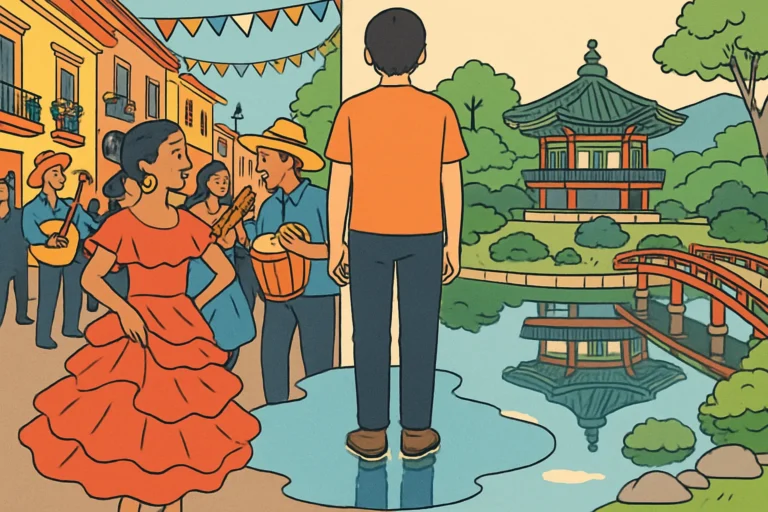
Beyond Borders: The Latin Diaspora’s Identity in Korea
Hello! Welcome to [Maeil Hangeul], your go-to place for upgrading your Korean skills!
Today, we’re diving into a profound and fascinating topic: the diaspora and identity of Latin Americans in Korea. This might sound academic, but it’s incredibly relevant for understanding modern Korean society. You’ll learn how to discuss complex ideas about culture, belonging, and identity—perfect for deep conversations or understanding sociological content.
Lately in Korea, there’s been a growing wave of documentaries and YouTube content that beautifully captures the lives of diverse communities. Instead of monolithic portrayals, we’re seeing personal stories, including those from the burgeoning Latin American community. Let’s learn the vocabulary to engage with these important conversations!
Core Expressions You Need to Know
Here are five key expressions to help you navigate this topic like a pro.
1. 디아스포라 (Diaspora)
- Pronunciation [Romaja]: Diaseupora
- English Meaning: Diaspora
- Detailed Explanation: This is a loanword from English, but it’s used frequently in academic and intellectual circles in Korea to refer to any group of people who live outside their ancestral homeland. When discussing immigration, history, or global culture, using
디아스포라shows a high level of understanding. It encompasses the collective experience of displacement, nostalgia, and the creation of a new community abroad. - 💡 Pronunciation Tip:
- As a loanword, the pronunciation is quite straightforward and follows the English sound as closely as Korean phonetics allow. The key is to pronounce each syllable clearly: 디-아-스-포-라 (Di-a-seu-po-ra). Avoid slurring them together.
2. 정체성 (Jeongcheseong)
- Pronunciation [Romaja]: Jeongcheseong
- English Meaning: Identity
- Detailed Explanation: This is the most common word for “identity.” It’s a Sino-Korean word (Hanja: 正體性).
정체(正體)means “true form” or “essence,” and성(性)means “nature” or “quality.” So, it literally means “the nature of one’s true form.” It can be used for personal identity (개인의 정체성), cultural identity (문화적 정체성), or national identity (국가 정체성). - 💡 Pronunciation Tip:
- The
ㅈ(j) in정is an unaspirated sound, somewhere between an English ‘j’ and ‘ch’. Theㅊ(ch) in체is heavily aspirated, like the ‘ch’ in “cheese,” so you should feel a strong puff of air. Many learners mix these up, but distinguishing them is key to sounding natural.
- The
3. 이중 문화 (Ijung munhwa)
- Pronunciation [Romaja]: Ijung munhwa
- English Meaning: Biculturalism; dual culture
- Detailed Explanation: This term refers to the experience of belonging to and navigating two different cultures.
이중(二重)means “double” or “dual,” and문화(文化)means “culture.” It’s often used to describe the lives of second-generation immigrants (이민 2세) who grow up balancing their parents’ culture with the culture of the country they live in. It captures the challenges and unique strengths of this experience. - 💡 Pronunciation Tip:
- This is a great example of linking sound (연음 법칙). The final consonant of the first syllable
중(ng) links to the next syllable문, but sinceㅇ(ng) is a nasal sound, it doesn’t dramatically change the following sound. The most important thing is the smooth transition: [이중문화 (ijungmunhwa)], not “ijung-munhwa.”
- This is a great example of linking sound (연음 법칙). The final consonant of the first syllable
4. 귀속감 (Gwisokgam)
- Pronunciation [Romaja]: Gwisokgam
- English Meaning: A sense of belonging
- Detailed Explanation: This is a sophisticated, C2-level word.
귀속(歸屬)means “belonging to” or “being affiliated with,” and감(感)means “feeling” or “sense.” Together,귀속감describes that deep, emotional feeling of being part of a group or community where you feel accepted and at home. It’s a much more precise and powerful term than simply saying소속되는 느낌(the feeling of being included). - 💡 Pronunciation Tip:
- Here we see tensification (경음화). The final
ㄱ(k)sound in속causes the initialㄱ(g)in the next syllable감to become a tense, unaspiratedㄲ(kk)sound. So, you don’t pronounce it as “gwisok-gam,” but rather as [귀속깜 (gwisokkkam)]. This small change makes a huge difference in fluency.
- Here we see tensification (경음화). The final
5. 편견을 깨다 (Pyeongyeoneul kkaeda)
- Pronunciation [Romaja]: Pyeongyeoneul kkaeda
- English Meaning: To break prejudice/stereotypes
- Detailed Explanation: This is a powerful and common idiomatic phrase.
편견(偏見)means “prejudice” or “bias,” and깨다means “to break” or “to shatter.” You use this phrase to talk about actively challenging and dismantling stereotypes about a certain group of people. It’s an active, positive expression often used in social commentary. - 💡 Pronunciation Tip:
- Similar to
귀속감, theㄲin깨다is a tense sound. It should be sharp and short, with no puff of air, like the ‘k’ in the English word “sky.” Contrast this with the aspiratedㅍ(p) in편, which requires a strong puff of air, like the ‘p’ in “park.”
- Similar to
Sample Dialogue
Here’s how these expressions might appear in a real conversation between two university students.
A: 소민아, 어제 새로 나온 다큐멘터리 봤어? 한국에서 활동하는 멕시코계 예술가에 대한 거.
A (Somin-ah, eoje saero naon dakyumenteori bwasseo? Hangugeseo hwaldonghaneun meksikogye yesulga-e daehan geo.)
(Somin, did you see the new documentary that came out yesterday? The one about the Mexican artist working in Korea.)
B: 아, 봤어! 라틴 아메리카 디아스포라로서 겪는 경험을 예술로 승화시키는 게 정말 인상 깊더라.
B (A, bwasseo! Ratin amerika diaseuporaseo gyeokkneun gyeongheomeul yesullo seunghwasikineun ge jeongmal insang gipdeora.)
(Ah, I saw it! It was so impressive how she sublimated her experiences as part of the Latin American diaspora into art.)
A: 맞아. 특히 그녀가 한국과 멕시코의 이중 문화 속에서 자신의 정체성을 찾아가는 과정이 감동적이었어.
A (Maja. Teuki geunyeoga hangukgwa meksikoui ijung munhwa sogeseo jasinui jeongcheseongeul chajaganeun gwajeongi gamdongjeogieosseo.)
(Exactly. I was especially moved by the process of her finding her own identity within the biculturalism of Korea and Mexico.)
B: 응. 어릴 때 어디에도 완전한 귀속감을 느끼지 못했다고 말할 때 나도 모르게 눈물이 났어. 그녀의 작품이 그런 편견을 깨는 데 큰 역할을 하는 것 같아.
B (Eung. Eoril ttae eodiedo wanjeonhan gwisokgameul neukkiji motaetdago malhal ttae nado moreuge nunmuri nasseo. Geunyeoui jakpumi geureon pyeongyeoneul kkaeneun de keun yeokareul haneun geot gata.)
(Yeah. I teared up without realizing it when she said she couldn’t feel a complete sense of belonging anywhere as a child. I think her work plays a huge role in breaking those kinds of stereotypes.)
Culture Tip & Trend Analysis
The recent focus on diaspora stories in Korean media reflects a significant societal shift. For a long time, the narrative of “foreigner in Korea” was often simplified. However, as Korea becomes more diverse, there’s a growing appetite for more nuanced stories.
Korean Z-ennials (a combination of Millennials and Gen Z) are particularly driving this trend. They consume global content on platforms like YouTube and Netflix and are more likely to challenge traditional, homogenous ideas of what it means to be “Korean.” When you use a term like 귀속감 in a conversation about an immigrant’s experience, or discuss how someone’s art 편견을 깨다, you’re not just showing off your vocabulary; you’re participating in a very current and important conversation happening in Korea today. You are showing that you understand the complex, evolving fabric of modern Korean society.
Let’s Practice!
Time to put your knowledge to the test.
- Fill in the blank:
많은 이민 2세들은 두 문화 사이에서 자신의 ________을/를 찾기 위해 노력한다.
(Many second-generation immigrants strive to find their own ________ between two cultures.) -
Short Answer:
Think about a diaspora community you are familiar with (perhaps from your own country). How do they maintain their identity while living abroad? Try to write one or two sentences using the expressions you learned today.
Great job today! Tackling these advanced topics is a huge step in your Korean journey.
Leave a comment below with your answers to the practice questions! I’d love to see you use these new expressions. 화이팅
Frequently Asked Questions (FAQ)
Q: What does "디-아-스-포-라" mean in Korean and how do you pronounce it?
A: In Korean, "디-아-스-포-라" is pronounced [Di-a-seu-po-ra] and means: . Avoid slurring them together.







