

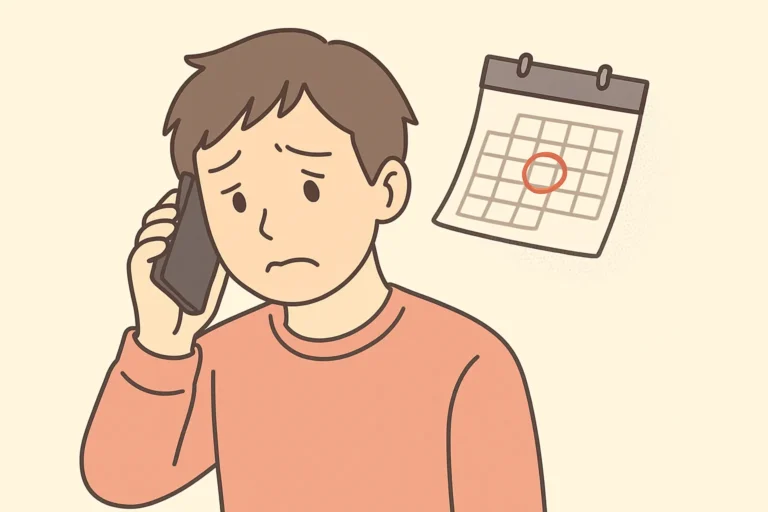
Korean Voice Message SOS: Changing Plans Like a Pro!
Hello! This is [Daily Hangul], here to upgrade your Korean skills!
Have you ever had to cancel plans at the last minute? It can be awkward in any language, but especially in Korean where politeness is key. Today, we’re going to learn how to change an appointment by leaving a clear and polite voice message.
Lately in Korea, with everyone’s busy schedules, leaving a quick voice message to reschedule is super common. It feels more personal and sincere than just a text. Let’s learn how to do it without the stress!
Key Expressions You Need to Know
Here are three essential phrases that will make you sound like a natural when changing plans.
1. 죄송하지만 (Joesonghajiman)
- English Meaning: I’m sorry, but… / Excuse me, but…
- Detailed Explanation: This is your magic phrase for politely introducing bad news or a difficult request. It’s a combination of
죄송하다(to be sorry) and~지만(but). Using this at the beginning of your sentence immediately shows respect and consideration for the other person’s time. It’s more formal and polite than미안하지만 (mianhajiman), which you would use with close friends. - 💡 Pronunciation Tip: The vowel
ㅚ(oe) in죄 (joe)can be tricky! While it’s written as ‘oe’, it’s often pronounced like ‘we’ in English. So, instead of ‘jo-e-song’, try saying [jwe-song-ha-ji-man]. It will make your pronunciation sound much smoother!
2. ~게 됐어요 (~ge dwaesseoyo)
- English Meaning: It turned out that… / I ended up…
- Detailed Explanation: This grammar pattern is perfect for explaining a situation that was out of your control. You attach it to a verb stem. For example,
생기다(to arise/happen) becomes생기게 됐어요(it happened / something came up). It softens the reason for your cancellation, implying it wasn’t your intention. It sounds much better than saying “I have a new plan.” - 💡 Pronunciation Tip:
됐어요 (dwaesseoyo)is a contraction of되었어요 (doe-eosseoyo). In conversation, Koreans almost always use the shortened form. Theㅆ(ss) is a tensed sound. Make sure to pronounce it with a strong, sharp ‘s’ sound, like the ‘s’ in “snake,” but with more force: [dwess-eo-yo].
3. 혹시 (Hoksi)
- English Meaning: By any chance / Perhaps
- Detailed Explanation:
혹시is a wonderful little word that makes your questions and suggestions sound much less demanding. When you ask, “혹시 다음 주에 시간 괜찮으세요?” (By any chance, are you free next week?), it adds a layer of politeness, showing that you’re not assuming the other person is available. - 💡 Pronunciation Tip: The final consonant
ㄱ(k) in혹 (hok)is an unaspirated sound. This means you should say it without a puff of air, stopping the sound at the back of your throat. It’s not “hock” with a strong ‘k’ sound, but a softer [hok-shi].
Example Voicemail Script
Let’s see how these expressions work together in a real voice message. Imagine you have to cancel dinner plans with your friend, 수빈 (Subin).
(Beep!)
A:
여보세요, 수빈아? 나야, 민준이.
(Yeoboseyo, Subin-a? Naya, Minjun-i.)
Hello, Subin? It’s me, Minjun.
A:
오늘 저녁 약속 때문에 전화했는데… 죄송하지만, 제가 회사에 갑자기 일이 생기게 됐어요.
(Oneul jeonyeok yaksok ttaemune jeonhwahaenneunde… Joesonghajiman, jega hoesa-e gapjagi iri saenggigye dwaesseoyo.)
I’m calling about our dinner plans tonight… I’m so sorry, but something suddenly came up at work.
A:
그래서 오늘 저녁은 좀 힘들 것 같아요. 혹시 우리 약속 다음 주로 바꿀 수 있을까?
(Geuraeseo oneul jeonyeogeun jom himdeul geot gatayo. Hoksi uri yaksok daeum juro bakkul su isseulkka?)
So I don’t think I can make it tonight. By any chance, could we change our appointment to next week?
A:
이 메시지 들으면 연락 줘!
(I mesiji deureumyeon yeollak jwo!)
Call me when you get this message!
Culture Tip & Trend Deep Dive
In Korea, your relationships (인간관계) are incredibly important. Cancelling plans, especially last-minute, can be a sensitive issue.
- Sincerity is Key: That’s why using phrases like
죄송하지만and~게 됐어요is so crucial. It shows that you are genuinely sorry and that the change was unavoidable. This sincerity helps maintain a good relationship. - The Follow-Up: After leaving a voice message, it’s common practice to also send a text message. You could write something simple like, “수빈아, 방금 음성 메시지 남겼어. 확인하고 연락 줘!” (Subin, I just left you a voice message. Check it and get back to me!).
- The “Sorry Gift” Trend: A popular trend among young Koreans is to send a mobile gift coupon (기프티콘) for a coffee or a small dessert when they have to cancel. If you cancel on a friend, sending a Starbucks coupon with a message like “오늘 정말 미안해! 이걸로 커피 마셔 ㅠㅠ” (I’m so sorry about today! Have a coffee on me ㅠㅠ) is a sweet gesture that shows you care.
Let’s Practice!
Time to check your understanding. You can do it!
1. Fill in the blank: You have to change plans because you have to go to the hospital. How would you start the sentence politely?
________________, 병원에 가야 하게 됐어요.(Hint: “I’m sorry, but…”)
2. Make a sentence: Using 혹시, ask your friend if they are free this weekend.
Ready for the answers? 1. 죄송하지만 2. 혹시 이번 주말에 시간 괜찮아?
Great job today! You’re now ready to handle changing plans in Korean with confidence and politeness.
Why not try using one of today’s expressions in the comments below? Tell us about a time you had to change your plans!







