

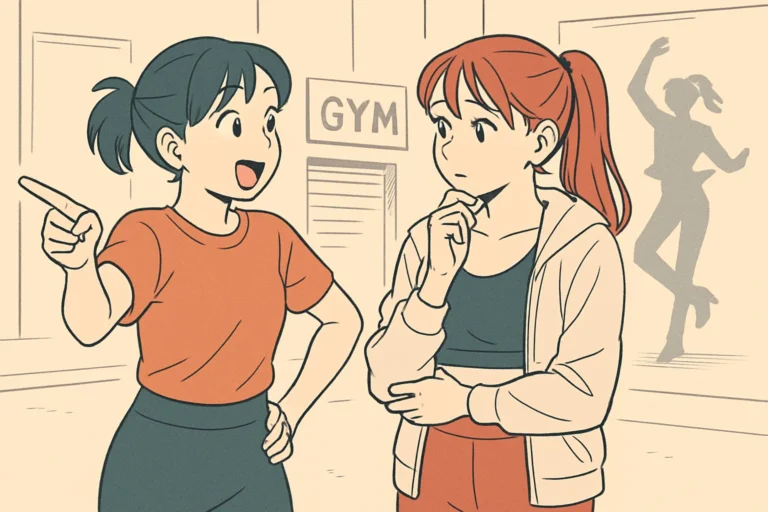
K-Pop Abs? Let’s Exercise Together in Korean!
Hello! Welcome to Maeil Hangeul, where we upgrade your Korean skills!
Have you ever seen your favorite K-pop idols’ workout routines and thought, “Wow, I want to try that”? In Korea, staying active is a huge trend, and exercising with friends is a popular way to stay motivated.
Today, we’re going to learn how to suggest working out together in Korean. These phrases are super useful for making friends and joining in on the fun. Let’s get started!
Core Expressions You Need to Know
Here are three essential phrases to invite a friend to exercise and plan it out.
1. 같이 운동할래? (Gachi undonghallae?)
- Romanization: Gachi undonghallae?
- English: Wanna work out together?
- Detailed Explanation: This is the perfect casual phrase to use with friends.
같이 (gachi)means “together,” and운동할래? (undonghallae?)is a friendly way of asking “do you want to work out?” The-(으)ㄹ래? (-eullae?)ending is informal and shows you’re close to the person you’re asking. Only use it with friends or people of the same age or younger! -
💡 Pronunciation Tip:
Listen closely to같이. It’s not pronounced ‘gat-i’ but [gachi]. Why? In Korean, when the final consonantㅌ (t)is followed by the vowelㅣ (i), it transforms into aㅊ (ch)sound. This rule is called palatalization, and it makes the pronunciation smoother. Another example is굳이 (gudi), which is pronounced as [구지 guji].
2. 좋아! (Joa!)
- Romanization: Joa!
- English: Sounds good! / Okay!
-
Detailed Explanation: This is the most common and enthusiastic way to say “yes!” to a suggestion. It’s simple, positive, and shows you’re excited about the idea. You can use it in almost any situation when you agree with a friend’s plan.
-
💡 Pronunciation Tip:
The final consonantㅎ (h)in좋아is very soft and almost silent. Instead of a strong “jo-ha,” it sounds more like a gentle [jo-a]. Think of thehas a little puff of air that connects the two vowels.
3. 언제 만날까? (Eonje mannalkka?)
- Romanization: Eonje mannalkka?
- English: When should we meet?
-
Detailed Explanation: Once you’ve agreed, this is the natural next question.
언제 (eonje)means “when,” and만날까? (mannalkka?)means “shall we meet?”. The-(으)ㄹ까? (-eulkka?)ending is used to make a suggestion or ask for the other person’s opinion, making the conversation collaborative. -
💡 Pronunciation Tip:
Theㄲ (kk)in만날까?is a tensed consonant. It’s stronger thanㄱ (g/k)but has no puff of air likeㅋ (k). To make the sound, tighten the back of your throat as you say it. It’s the sound you hear in words like “sky” or “call”.
Example Conversation
Let’s see how these phrases work in a real conversation! Imagine two friends, A and B, talking about the latest fitness trend.
A: 요즘 아이돌처럼 필라테스 하는 게 유행이래. 우리도 같이 운동할래?
(A: Hey, I heard doing Pilates like K-pop idols is trendy now. Wanna work out together?)
B: 좋아! 완전 좋은 생각이야. 언제 만날까?
(B: Sounds good! That’s a great idea. When should we meet?)
A: 이번 주 금요일 저녁 어때?
(A: How about this Friday evening?)
B: 금요일은 딱 좋아! 그때 보자!
(B: Friday is perfect! See you then!)
Cultural Tip & Trend Deep Dive
In Korea, the concept of “오운완 (O-un-wan)” is huge on social media, especially among the younger generation. It’s an abbreviation of “오늘 운동 완료 (Oneul Undong Wallyo),” which means “Today’s workout, complete!” People post a mirror selfie at the gym (or “헬스장 hel-seu-jang”) with the hashtag #오운완 to show they’ve finished their exercise for the day.
When you use phrases like 같이 운동할래?, you’re not just asking to exercise; you’re inviting someone to be part of this fun, modern health culture. If your friend agrees, you can even suggest taking an “오운완” picture together after your workout. It’s a great way to make memories and feel like a true local!
Let’s Review & Practice!
Great job today! You learned how to invite a friend to exercise, agree to a plan, and schedule a time.
Quick Quiz:
Your Korean friend sends you a message: “우리 같이 한강에서 자전거 탈래? (Wanna ride bikes together at the Han River?)”.
How would you respond in Korean to say: “Sounds good! When should we meet?”
(Scroll down for the answer!)
.
.
.
.
.
Answer: 좋아! 언제 만날까? (Joa! Eonje mannalkka?)
Now it’s your turn! Try making a sentence using one of the expressions you learned today in the comments below. Let’s get healthy together







