

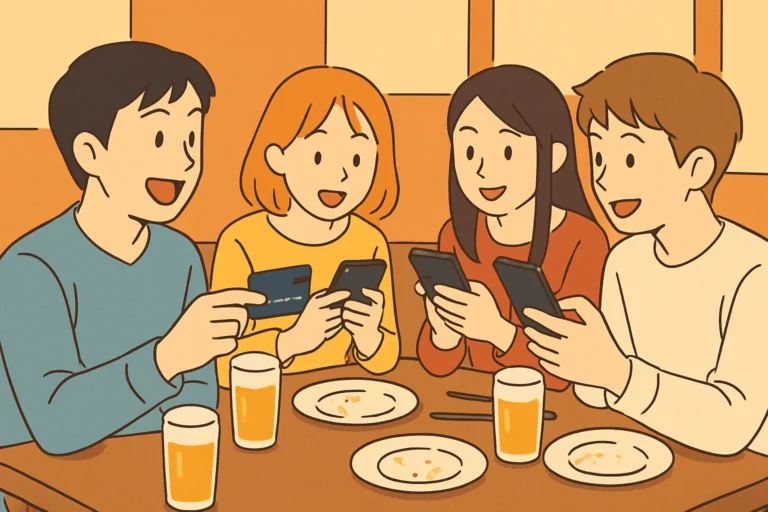
Let’s Split the Bill! Mastering “N-bbang” Culture
Hello! This is [Daily Hangeul], here to upgrade your Korean skills!
Have you ever enjoyed a delicious meal with Korean friends and then felt awkward when the bill arrived? In the past, it was part of Korean “Jeong” (affection) culture for the oldest person or the inviter to pay for everything. However, nowadays in Korea, especially among the younger generation (Gen Z and Millennials), splitting the bill has become the new normal!
Today, we will learn how to suggest splitting the bill politely and naturally. This is a crucial skill for social life and building relationships in modern Korea. Let’s dive into the world of “Dutch Pay” and “N-bbang”!
Key Expressions (3~5)
Here are three essential expressions you can use when paying for a meal.
1. 따로 계산해 주세요.
- Pronunciation: [Ttaro gyesanhae juseyo]
- English Meaning: Please calculate/charge us separately.
- Details: This is a polite and formal phrase used directly to the cashier. You use this when you want to pay with separate cards at the counter.
- 💡 Pronunciation Tip:
- Pay close attention to ‘따로 (ttaro)’. The ‘ㄸ (tt)’ is a tensed consonant. You need to build up air pressure behind your tongue and release it sharply without letting air burst out (unlike the English ‘t’).
- Also, in ‘계산해 (gyesan-hae)’, the ‘ㅎ(h)’ sound often becomes weak or silent in fast speech, making it sound like [gyesanae]. This makes your speech flow much smoother!
2. 우리 N빵 할까?
- Pronunciation: [Uri En-ppang halkka?]
- English Meaning: Shall we split the bill N ways?
- Details: This is a very common slang term. ‘N’ stands for the variable number of people, and ‘빵 (ppang)’ comes from splitting or distributing. It effectively means “dividing the total amount by N people.” Note that this is casual, so use it with friends or close colleagues!
- 💡 Pronunciation Tip:
- Even though it is written as ‘방 (bang)’ in some origins, it is always pronounced and written as ‘빵 (ppang)’ with a tensed sound.
- ‘할까 (halkka)’: The ‘ㄹ(l)’ in the batchim (final consonant) causes the following ‘ㄱ(g)’ to sound like a tensed ‘ㄲ(kk)’. So, it is pronounced [halkka], not [hal-ga]. This rule is called Tensification.
3. 제가 먼저 긁을게요.
- Pronunciation: [Jega meonjeo geulgeul-kkeyo]
- English Meaning: I will swipe (my card) first.
- Details: In busy Korean restaurants, it takes too long for everyone to pay separately. Usually, one person pays the full amount first, and others send money later. ‘긁다 (geukda)’ literally means “to scratch/swipe,” referring to swiping a credit card.
- 💡 Pronunciation Tip:
- ‘긁을게요 (geulgeul-kkeyo)’: This looks difficult! When a syllable ends with a double consonant like ‘ㄺ’ and is followed by a vowel (을), the second consonant moves to the next syllable.
- So, ‘긁’ becomes ‘글 (geul)’ and the ‘ㄱ’ moves over to make ‘글 (geul)’.
- Result: [geul-geul-kkeyo]. Practice linking the sounds smoothly!
Real-life Conversation
Let’s see how these expressions are used in real life. Minji and Alex just finished eating Malatang, which is hugely popular in Korea right now.
Minji: 와, 마라탕 진짜 맛있었다! 국물이 끝내주네.
(Wow, the Malatang was really delicious! The broth is amazing.)
Alex: 응, 정말 잘 먹었어. 이제 나갈까? 따로 계산해 달라고 할까?
(Yeah, I ate really well. Shall we go? Should we ask to pay separately?)
Minji: 음, 지금 점심시간이라 사람이 너무 많아. 그냥 내가 먼저 긁을게. 나중에 보내줘.
(Hmm, it’s lunch time so there are too many people. I’ll just swipe [pay] first. Send it to me later.)
Alex: 오케이! 그럼 N빵 해서 카톡으로 알려줘. 바로 보낼게!
(Okay! Then split it N ways and let me know on KakaoTalk. I’ll send it right away!)
Culture Tip & Trend Deep Dive
📱 Why “N-bbang” is easier than ever in Korea
In the dialogue, Minji paid first. This is very common in Korea because paying separately at the register (Split Pay) is considered inefficient during busy hours.
Instead, the “Trend” is using mobile finance apps like KakaoPay or Toss.
1. One person (often called the “Chongdae” – the gun carrier/leader) pays the full bill.
2. They use the “Dutch Pay” feature in the app to request money from the group chat.
3. Friends can send their share with just one touch, often without needing to type in a bank account number!
So, if you want to look like a local, don’t insist on standing at the register with three different credit cards. Say “제가 먼저 낼게요 (I’ll pay first)” and ask for a transfer later!
Wrap-up & Practice
Today we learned how to handle the bill in Korea like a pro! Remember, while “treating” others is still a nice gesture, “N-bbang” (splitting) is perfectly acceptable and efficient, especially among the younger generation.
📝 Mini Quiz
- Fill in the blank:
You want to suggest splitting the bill evenly with your close friend.
“우리 _____ 하자!” (Let’s do N-bbang!) -
Pronunciation Check:
How do you pronounce ‘할까’ (Shall we do)?
A. [hal-ga]
B. [hal-kka]
Answer Key:
1. N빵 (En-ppang)
2. B (Due to the tensification rule!)
Did you enjoy today’s lesson? Try using “N-bbang” with your Korean friends next time you eat out! Leave a comment below if you have any questions. See you next time!







