

Introduction
Hello! This is [Daily Hangeul], here to upgrade your Korean skills to a professional level! 🌟
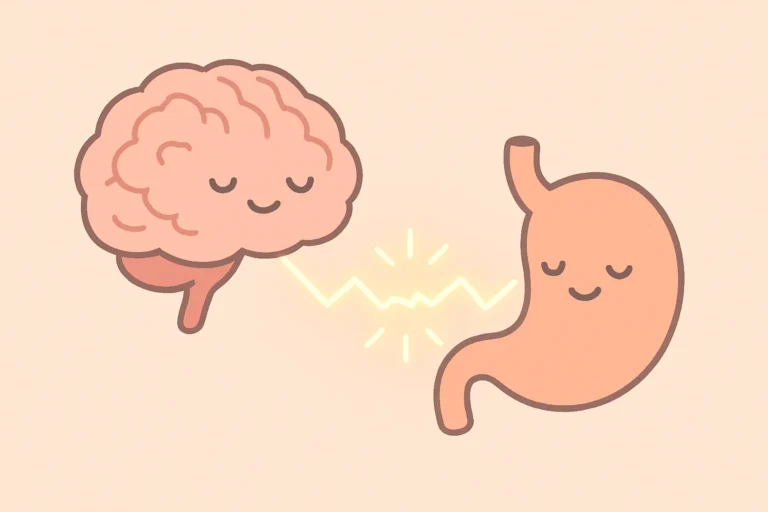
Today, we are diving into a slightly more advanced and fascinating topic: Neuroscience and Cognition. Specifically, we will talk about the “Gut-Brain Axis” (장-뇌 축).
You might be wondering, “Why are we talking about science?” Well, in Korea recently, the trend of “Healthy Pleasure” (헬시 플레저) is huge! People are realizing that physical health is directly connected to mental happiness. Have you noticed how many Koreans take probiotics (Lactobacillus) daily? It’s not just for digestion; it’s widely understood now that a healthy gut leads to a healthy mind.
If you want to discuss health, stress management, or medical trends in Korean at a high level (C1), this lesson is for you!
Key Expressions (Core Vocabulary)
Here are 4 advanced expressions to help you discuss the connection between the body and the brain.
1. 장-뇌 축
* Pronunciation: [Jang-noe chuk]
* English Meaning: Gut-Brain Axis
* Detail: This is the medical term referring to the signaling network between the gastrointestinal tract and the central nervous system. In Korean media, you will often hear this when doctors explain why stress causes stomach aches.
* Usage: “장-뇌 축 이론에 따르면…” (According to the Gut-Brain Axis theory…)
2. 신경 전달 물질
* Pronunciation: [Sin-gyeong jeon-dal mul-jil]
* English Meaning: Neurotransmitter
* Detail: A chemical substance released at the end of a nerve fiber. A famous example is ‘Serotonin’ (세로토닌). Since 95% of serotonin is produced in the gut, this word is essential when linking digestion to mood.
3. 상호작용하다
* Pronunciation: [Sang-ho-ja-gyong-ha-da]
* English Meaning: To interact / To have a reciprocal effect
* Detail: This is a high-level verb used in academic or formal settings to describe two things affecting each other. It’s much more sophisticated than just saying “영향을 주다” (to give influence).
4. 밀접한 관련이 있다
* Pronunciation: [Mil-jeo-pan gwal-lyeo-ni it-da]
* English Meaning: To be closely related / To have a strong correlation
* Detail: You will use this phrase constantly in reports, presentations, or debates. It emphasizes that the connection between two subjects is very strong.
💡 Pronunciation Tip
Let’s look at the word 관련 (Relation/Connection) in the phrase “밀접한 관련이 있다”.
- Written: 관련 (Gwan-ryeon)
- Pronunciation: [Gwal-lyeon] (괄련)
Why?
This is due to a rule called Liquidization (유음화).
When the consonant ‘ㄴ'(n) meets ‘ㄹ'(l) (either before or after), the ‘ㄴ’ sound changes into a ‘ㄹ'(l) sound to make the flow smoother.
* Instead of awkwardly saying “Gwan-ryeon,” Koreans say “Gwal-lyeon.”
* Another example: 관리 (Management) is pronounced [Gwal-li].
Try saying it softly: “장과 뇌는 밀접한 [괄련]이 있어요.” (The gut and brain are closely related.)
Example Conversation
Here is how you might use these expressions in a conversation about health trends.
Min-ji: 요즘 업무 스트레스 때문인지 소화가 너무 안 돼. 계속 속이 더부룩하네.
(I can’t digest food well lately, probably due to work stress. I feel constantly bloated.)
Ji-hoon: 그게 다 장-뇌 축 때문이야. 뇌가 스트레스를 받으면 장도 바로 반응하거든.
(That’s all because of the Gut-Brain Axis. When the brain gets stressed, the gut reacts immediately.)
Min-ji: 정말? 그냥 기분 탓인 줄 알았는데 과학적인 근거가 있구나.
(Really? I thought it was just a mood thing, but there is a scientific basis.)
Ji-hoon: 응, 장내 미생물이 뇌의 신경 전달 물질 생성과 상호작용하거든. 유산균 좀 챙겨 먹어!
(Yes, gut microbes interact with the production of neurotransmitters in the brain. You should take some probiotics!)
Culture Tip & Trend Analysis
🧠 Why is Korea obsessed with “Yusangyun” (Probiotics)?
In Korea, you will see advertisements for Yusangyun (Lactobacillus/Probiotics) everywhere, from TV commercials to Instagram feeds.
This is part of the “Healthy Pleasure” trend, where the MZ generation (Millennials + Gen Z) seeks health management that is also enjoyable and convenient.
* The Science: It is widely known in Korea that “The gut is the second brain.” Many office workers believe that taking care of their gut health is essential for maintaining their mental focus and managing depression or anxiety.
* The Product: There are even premium yogurt drinks labeled specifically for “Stress Care” (e.g., ‘Stress Care 1’ etc.) found in convenience stores.
If you tell a Korean friend, “My stomach hurts because I’m nervous,” they will likely suggest a probiotic drink immediately. Knowing the term “장-뇌 축” (Gut-Brain Axis) will make you sound like a true expert in these conversations!
Wrap-up & Practice
Today we explored the fascinating connection between our body and mind through the lens of neuroscience!
Summary:
1. 장-뇌 축 (Gut-Brain Axis) connects your stomach and brain.
2. Gut health and mental health 상호작용하다 (interact).
3. They have a 밀접한 관련 (close relation).
📝 Mini Quiz:
Fill in the blank to complete the sentence!
“최근 연구에 따르면, 장 건강은 우리의 감정과 ______ 관련이 있습니다.”
(According to recent studies, gut health is closely related to our emotions.)
A) 밀접한 (Mil-jeo-pan)
B) 희미한 (Hui-mi-han)
Leave your answer in the comments below! If you have ever felt “butterflies in your stomach” when nervous, tell us about it in Korean!
See you in the next lesson! 👋
Frequently Asked Questions (FAQ)
Q: What does "관련" mean in Korean and how do you pronounce it?
A: In Korean, "관련" is pronounced [Relation/Connection] and means: in the phrase "밀접한
Q: What does "관리" mean in Korean and how do you pronounce it?
A: In Korean, "관리" is pronounced [Management] and means: is pronounced
Q: What does ""장-뇌 축"" mean in Korean and how do you pronounce it?
A: In Korean, ""장-뇌 축"" is pronounced [Gut-Brain Axis] and means: will make you sound like a true expert in these conversations!
Q: What does "B) 희미한" mean in Korean and how do you pronounce it?
A: In Korean, "B) 희미한" is pronounced [Hui-mi-han] and means: Leave your answer in the comments below! If you have ever felt "butterflies in your stomach" when nervous, tell us about it in Korean!







